NYS Fair’s exhibits, cultural hubs teach SU students central NY’s legacy

Get the latest Syracuse news delivered right to your inbox.
Subscribe to our newsletter here.
Carnival rides flashing, people snacking on elephant ears and funnel cakes, a giant butter sculpture and drinking 25-cent cups of milk are all staples of the Great New York State Fair. Syracuse University students, Syracuse residents and out-of-towners alike gather with their family and friends for a sugar- and adrenaline-filled good time. But there’s more to the Fair than amusement rides and sweets.
Today, over a century’s worth of history and education lies on 581 State Fair Boulevard.
“At this point in our world, we have become very disconnected from the place things are grown to what we actually see,” Harold Nugent said. “The hope is to have people, when they’re coming out to the state fair, come into the garden and see the plant that the fruit is grown on.”
Nugent, a natural resources educator with Cornell Cooperative Extension of Onondaga County, is one of many people at the state Fair responsible for educating fairgoers about New York state.
The 375-acre Fair features dozens of hands-on displays, agricultural centers, educational hubs and historical buildings scattered throughout its grounds. From discovering the secrets of New York state agriculture to witnessing authentic performances at the Fair’s four cultural villages, SU students can learn more about their central New York home with a quick visit to the Fair.
What many fairgoers don’t know is that it’s rooted in agriculture. The butter sculpture’s attraction is all about the large dairy farming industry, gardens show off the crops of the region and barns full of livestock draw farmers from across the state and country. There was even a period of time — from 1938 to 1962 — where the Fair was named the New York State Agricultural and Industrial Exposition.
Decades later, Helena Chernosky, a junior at SU, grew up visiting the state Fair. When Chernosky was younger, she didn’t understand why people cared about exhibits like the Jared van Wagenen Carriage Museum or horse jockeying, but now she sees how much they can teach people about central New York’s history.
“When I was like five or six I was like ‘Why is this here? I didn’t care about the history,” Chernosky said. “Now, I get it.”
Near the Expo Center is the Voice of the Farmer Garden, a plot of vegetables, herbs, fruits and flowers meant to close the gap between what people eat and where their produce came from. The garden, which first opened at the Fair in 2023, is part of the Farm Journal Foundation’s national Voice of the Farmer Garden program. The garden is planted and maintained through a partnership between Cornell Cooperative Extension of Onondaga County and the New York State Department of Agriculture and Markets.
Nugent, who runs the garden alongside Kathleen Burns Copeletti, master gardener volunteer coordinator for the CCE, said the space is designed to represent and educate visitors on both New York state’s major crops and its cultural diversity.
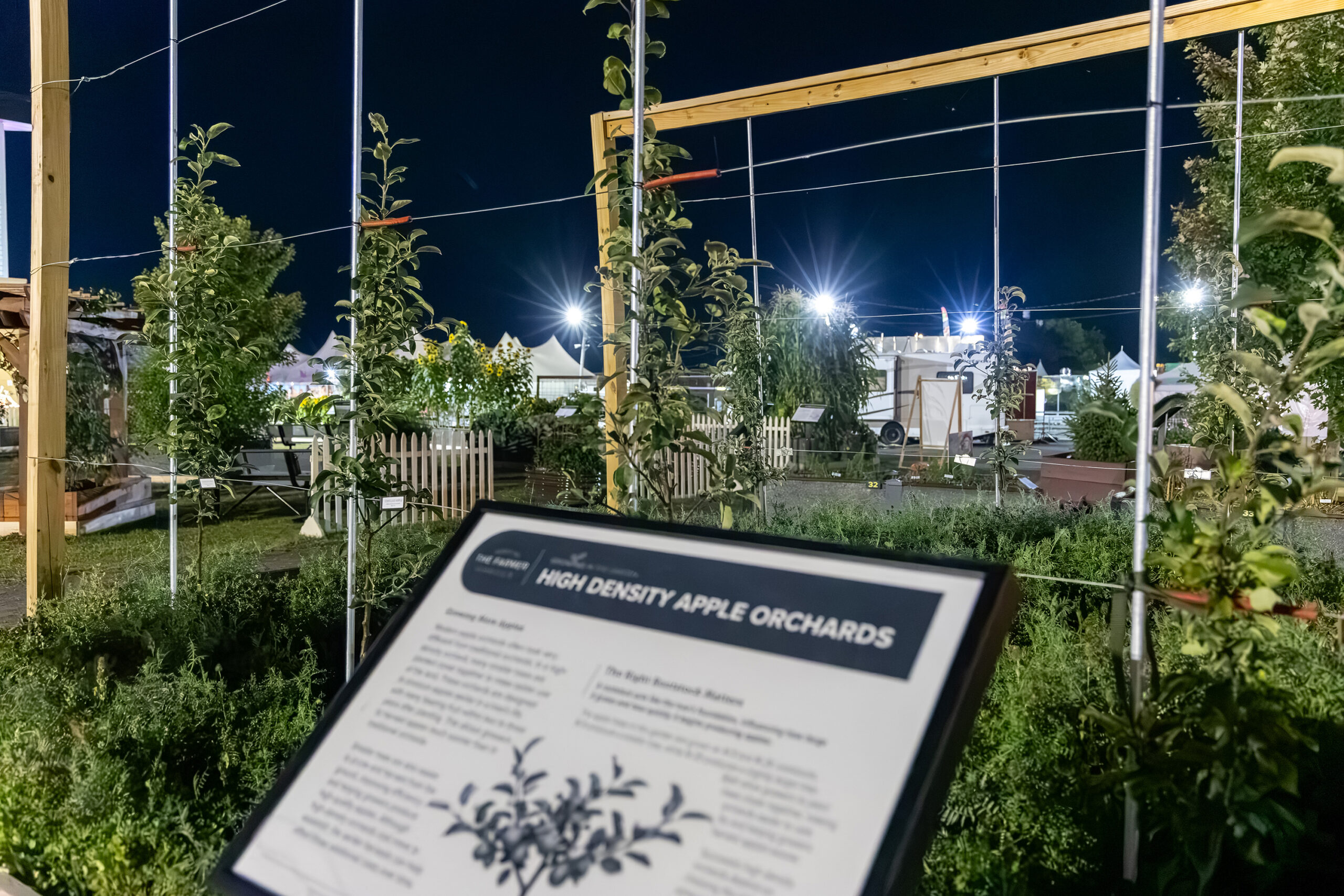
In the Voice of the Farmer Garden lies plots of vegetables, herbs, fruits and flowers. The garden was first opened in 2023 and is used to close the knowledge gap between what people eat and where their food comes from. Paul Hakimian | Contributing Photographer
“We are trying to showcase a lot of the agriculture that the farmers do grow here in New York state,” Nugent said, “But we also have some things that we grow that represent the diversity of New York state, different food or different plants and crops that the ethnic diversity of New York state would grow at home if they couldn’t find it.”
That diversity includes a bed of bok choy and kohlrabi, rows of grapes and conifer trees representing the state’s Christmas tree industry, an apple display modeled after high-density production orchards and, new this year, a bed of cut flowers — a growing industry in upstate New York.
One bed is planted with corn, beans and squash, arranged to reflect the Three Sisters, an agricultural practice developed by the Haudenosaunee, a confederacy of six Native American nations that originated in upstate and central New York.
“Coming into this space, you can get an idea of what the agriculture of New York state is,” Nugent said. “And I think a little bit better understanding of the people of New York by that agriculture.”
Visitors get an even deeper historical understanding of the Fair’s agricultural roots at the Daniel Parrish Witter Agricultural Museum, which opened in 1928. At least 1,000 people pass through the museum every hour, said Barbara Raymond-LaPrease, a member of the Friends of the Witter Agricultural Museum, the volunteer group that helps run the building.
Originally located in Schoharie County, the museum landed on the fairgrounds in 1928. It’s filled with recreations of 19th-century agricultural life: a general store, a maple sugaring display, a dairy collection, a hops exhibit and a log cabin built in the early 1800s.
Volunteers in period costumes weave textiles, work treadle lathes older than the museum itself and demonstrate woodworking entirely by hand — no power tools allowed.
“It’s so important for (the younger generation) to understand how things used to be done so that they know where their heritage is,” Raymond-LaPrease said. “That’s the key.”
Just next door is the Jared van Wagenen Carriage Museum. George Hand, a member of the board of directors, has spent recent years restoring and adding to the museum’s carriage displays, including a rare Victoria carriage from the 1980s with a restored leather top and fenders from funds raised by the friends’ group.
The room is full of Syracuse- and central New York-focused history. Three other carriages in the collection were built in Syracuse by a company called Moyer Carriage Lofts, which has now been turned into apartment buildings.
Hand said he volunteers and tries to educate visitors because he doesn’t want to lose its history, and warns that it repeats itself given time.
WHAT YOU SHOULD READ NEXT
Once rooted in farming, NYS Fair is a hub of innovation today
The Fair officially started on Sept. 29 and 30, 1841, attracting between 10,000 to 15,000 eager people who arrived in Syracuse for the nation’s first state fair.
Kay Smith, a fifth-year architecture student at SU, said she’s visited the carriage museum before and comes back mostly because she thinks carriages are “cool,” not necessarily because she set out to learn about New York state.
She pointed to a few carriages that had stuck with her from past visits — one she thought resembled the sleigh from “The Polar Express,” a funeral carriage and another she remembered as particularly ornate, though she couldn’t recall who it had belonged to.
Smith also connected the collection to research she’s done for her major, which she found often characterizes Syracuse and the surrounding region as part of the Rust Belt.
“They always mention that it’s a huge migration spot for the Black community and other minorities,” Smith said. “But again, there’s not really enough information on that aspect.”
A short walk from the museum buildings lies the Haudenosaunee Village, the oldest of the Fair’s four cultural villages. Each village — Haudenosaunee, Pan-African, Latino and Asian — is run by a superintendent from that community, who has autonomy over the vendors, art and performances on display.
“We have Native American populations, and that is represented by the Haudenosaunee here at the Fair,” Katie Rey, associate director of public information for the Fair, said. “We work closely with each of our villages to represent their cultures in the best way possible.”
The Van Robinson Pan-African Village is one of the larger cultural villages at the Fair, but it wasn’t always that way. The village opened in 1993 as a single tent, started by the Syracuse chapter of the NAACP in response to a lack of Black vendors and performers at the Fair. It was renamed in 2017 for its founder, longtime Syracuse Common Council President Van Robinson, who ran the village alongside his wife until his death in May 2025.
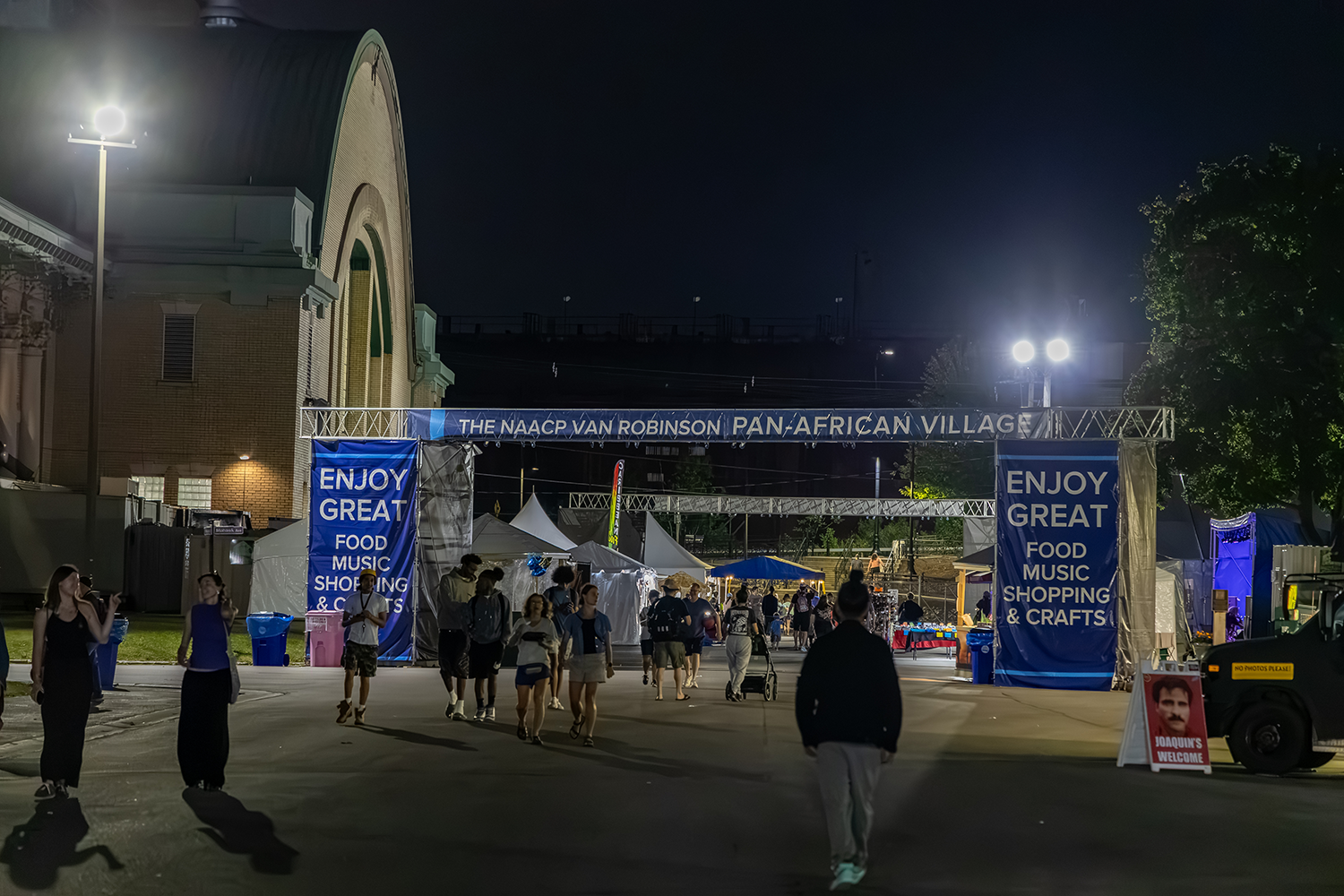
The Van Robinson Pan-African Village features vendors, crafts and music. The village is named after longtime Syracuse Common Council President Van Robinson, who ran it with his wife until 2025. Paul Hakimian | Contributing Photographer
Alongside musicians, performers and other vendors at the village, vendor Tabitha Munoko sells crafts sourced from Africa — olive wood and mahogany spoons, soapstone carvings and clothing. Munoko said she sources her products directly from Africa rather than making them herself, something she said matters to customers who want more than what they could order online.
“This is very important so that the young people around can learn something about their ancestry — you know, from where they came from originally, their parents, their grandparents,” Munoko said. “A lot of people come here, and they like to see all this culture, and they enjoy it.”
Next door, Joshua Williams has run a free African drumming tent at the Fair for more than 30 years. Williams, who grew up on Syracuse’s Southside, started learning African drumming and dance at 7-years-old, and later studied under teachers from Ghana, Senegal and the Ivory Coast, learning multiple drumming styles.
“When I found out what African drumming was about and the stories behind it, it was like, ‘I want everybody else to know what I know,’” Williams said. “It’s a positive message.”
Williams said the majority of the roughly 20 people who stop by his tent every 15 minutes have never experienced African drumming before — a fact that doesn’t discourage him. Life is about exposing people to unfamiliar cultures and educating them, Williams said.
A few roads away from the Pan-African Village is the New York State Grange booth. The Grange, a fraternal organization founded in 1867 for farmers recovering from the Civil War, now counts for around 3,000 members statewide, including roughly 300 across three active chapters in Onondaga County.
The Grange has taught people to grow their own food in recent years, Tom Lawton, the Grange’s leadership membership director, said. For the organization’s members, that can look like anything from a backyard plot to a box in a community garden the local chapter provides for free to residents without yard space.
“That has been one of the educational aspects we’ve been doing, to teach them and help them explore where their own food comes from,” Lawton said.
Tucked inside the Grange’s building is also a museum dedicated to the history of the Fair itself. The Fair started in 1841 in Syracuse — making it older than SU — and is the oldest state fair in the country. It moved throughout 11 cities before permanently settling on its current fairground site in the 1890s.
For a hands-on closure to a fairgrounds walk steeped in history, the timber framing demonstration outside the Agricultural Museum offers a look at 1850s-era construction — done entirely without power tools.
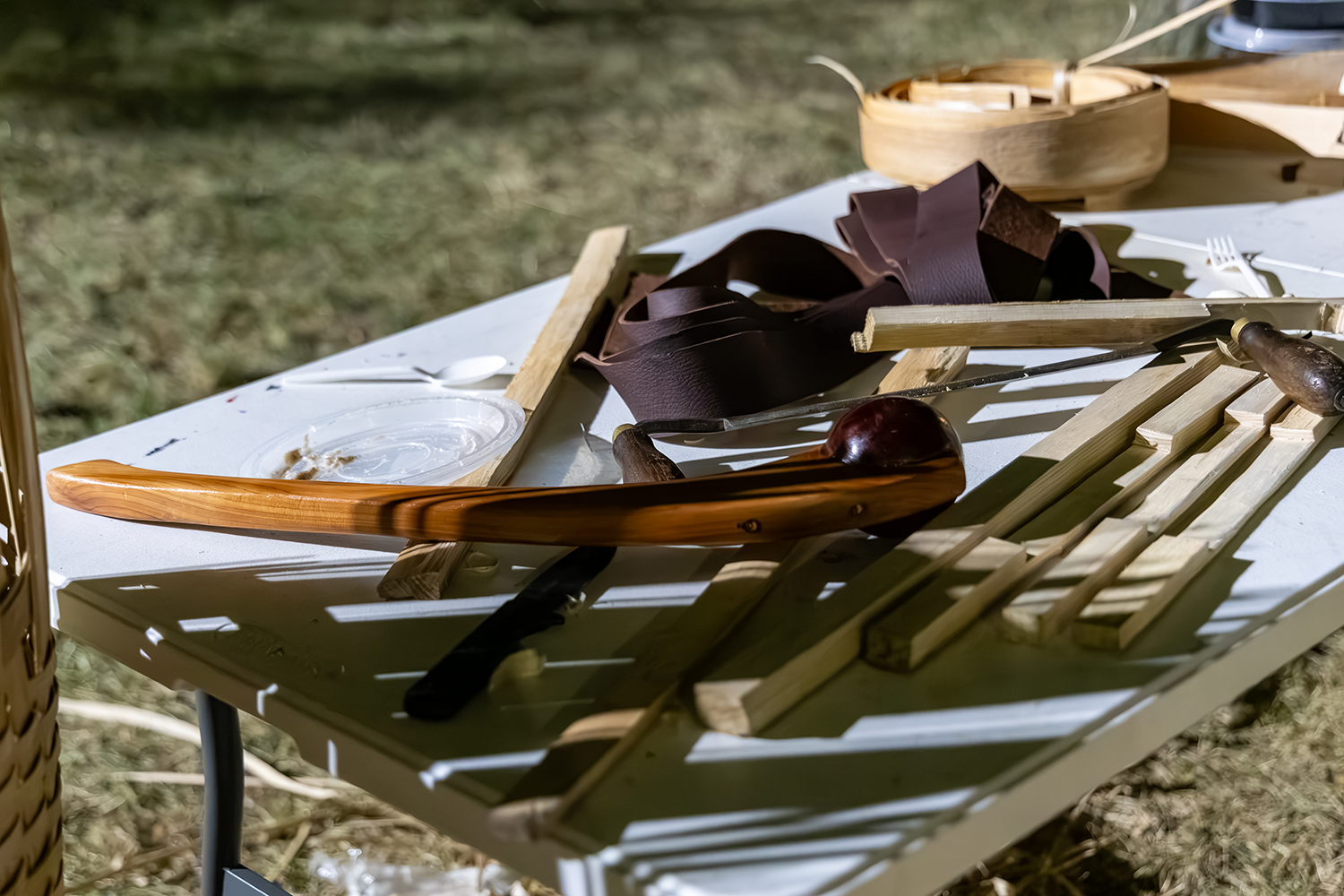
Woodworking is a common sight at the Great New York State Fair. The Woodwrights Guild hand-carved a 40-by-36-foot barn frame from pre-squared hemlock beams outside the Agricultural Museum. Paul Hakimian | Contributing Photographer
A group of timber framers with The Woodwrights Guild has spent the past three years coming together to work on hand-carving a 40-by-36-foot barn frame from pre-squared beams of hemlock, cutting scarf joints and tenons with chisels, axes and handmade wooden keys instead of nails.
Earl Burning, one of the group’s members, said the crew sharpens its own chisels by hand — some doing it 20 times, others 50, depending on how sharp they like the edge — and refurbishes old tools with new handles rather than buying new ones.
“We don’t want to lose our history,” Burning said of the demonstration’s purpose. “It’s just neat stuff.”
For SU students navigating a new home — whether they’ve traveled a state or an ocean to get here — the fairgrounds are a crash course in central New York: what grows here, who’s settled here and what they’ve built, taught and passed down along the way. The Fair encapsulates Chernosky’s New York state roots.
“Up here, it’s all about nature. It’s all about peace. All about being one with the land,” Chernosky said. “It’s a very different vibe from a lot of places and it’s important for people to learn more about upstate New York.”
DISCLAIMER: Helena Chernosky is a contributing writer for The Daily Orange. Chernosky did not influence the editorial content of this article.