‘Patterns of Migration’ illuminates immigrants’ perseverance in adversity

Get the latest Syracuse news delivered right to your inbox.
Subscribe to our newsletter here.
Against a striking red wall, Syracuse University alum Helen Zughaib’s paintings tell stories of migration shaped by ongoing conflict and the COVID-19 pandemic. Bold colors and abstract shapes shine a light on the perseverance of Syrian refugees who were uprooted from their homes.
“I felt a responsibility,” 58-year-old Zughaib said. “I felt I needed to do this so we would have a record of it.”
Opened Aug. 25, Zughaib’s latest exhibit, “Helen Zughaib: Patterns of Migration,” at the Syracuse University Art Museum aims to share the immigrant experience through art. Open through May 8, the exhibit is the sixth iteration of The Art Wall Project, which aims to inspire introspective dialogue through contemporary artists’ work.
Zughaib was born in Beirut, Lebanon, where she and her family lived before evacuating to Europe to escape the Lebanese Civil War in 1975. After finishing high school in Paris, Zughaib and her family immigrated to the United States. And in 1981, Zughaib graduated from SU with a Bachelor of Fine Arts.
The 12 pieces in the exhibition consumed Zughaib for nine years, with the final piece completed earlier this year. Noting similarities between Zughaib’s immigrant experience and that of South American immigrants, her motivations behind each piece worked closely with the ever-changing political climate.
Melissa Yuen, the museum’s curator, collaborated with Zughaib on the exhibit for almost two years. Yuen also works as the force behind The Art Wall Project, which chooses themes like “Patterns of Migration” to “help us engage our campus and our area,” Yuen said.
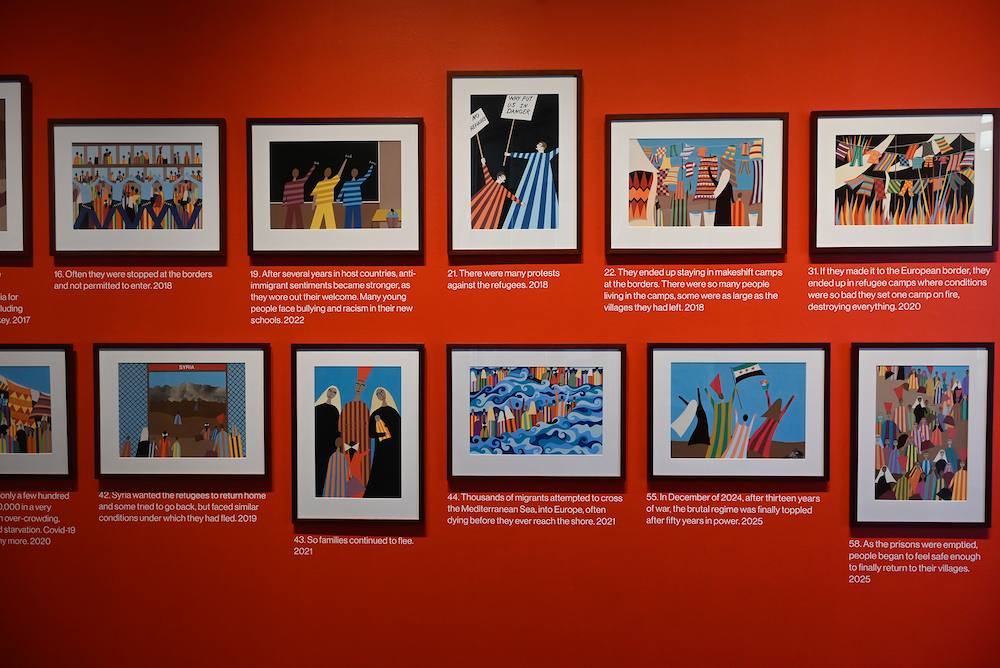
Helen Zughaib’s paintings focus on Syrian refugees who were displaced from their homes. Zughaib hopes her exhibit can highlight what viewers have in common, regardless of where they’re from. Christian Calabrese | Asst. Photo Editor
The final piece, “Wall of Resilience/American Mosaic,” was completed at her studio in Washington, D.C. Zughaib said she was especially motivated by the deaths of Renee Nicole Good and Alex Pretti, who were fatally shot in January by U.S. Immigration and Customs Enforcement officers in Minneapolis.
“I started thinking about the flag and I started thinking, of course, about immigration,” Zughaib said. “It was always top of my mind, given my background.”
The piece itself is an abstract take on the U.S. flag. A mosaic composed of panels represents the U.S.’ diversity — including cultures from South America, the Middle East, Africa and the Caribbean — which Zughaib believes strengthens this country. Zughaib said the tiles were purposefully placed “shoulder to shoulder” to illustrate that “we are not separated.”
Those curated decisions inspired Yuen to showcase Zughaib’s pieces at the SU Art Museum.
“What drew me to Helen’s work is the amount of detail that she includes in her paintings and how she is very incisive in her commentary on how people have moved around the world,” Yuen said.
Approximately one million Syrians were displaced because of the Lebanese Civil War, a fact Zughaib believes isn’t mentioned enough in Western culture.
Zughaib also noticed a general lack of Middle Eastern representation in Western culture, noting that she only learned of Middle Eastern artists — such as the Iraqi “fathers of impressionism” — through her parents’ art collection, rather than in the art history books she studied.
WHAT YOU SHOULD READ NEXT
Artists jointly examine chance, experimentation in ‘Strike It Lucky’ exhibit
The “Strike It Lucky” art exhibition features work by College of Visual and Performing Arts students, faculty and alumni.
Zughaib’s art aims to expose the disastrous events that forcibly displaced her people from their homes, and she purposefully used bright colors and abstract patterns to keep viewers’ attention. Through the show, Zughaib hopes to shed light on American immigrants who were forced to abandon their lives to look for a better future, she said.
“If they see it and it inspires them to take the initiative to try and leave somewhere to a better place, or a more safe place, I think that’s really great,” SU freshman Ellie Gordon said.
Gordon, who attended Zughaib’s exhibit Saturday, said she was moved by the work’s themes due to their alignment with her pro-immigration values.
Zughaib said she was heavily inspired by the life of her father, who first came to the U.S. to study political science at SU’s Maxwell School of Citizenship and Public Affairs. For over a decade, the father-daughter pair worked closely together on a previous exhibition titled “Stories My Father Told Me.” Zughaib continues to intertwine her father’s legacy and his personal anecdotes in her pieces.
At 16, Zughaib was forced to evacuate her home in Lebanon. When Zughaib asked her father when she and her family would return, he said it would be a week. It took Zughaib 35 years.
Through her exhibit, Zughaib primarily wanted to educate people on what isn’t equally represented in Western culture and remind viewers of their similarities — regardless of where they’re from.
“They have kids that they care about and they love,” Zughaib said. “So what’s the difference from any one of us? It’s the same.”