Quills N Baskets weaves Haudenosaunee basketry with advocacy at NYS Fair
Get the latest Syracuse news delivered right to your inbox.
Subscribe to our newsletter here.
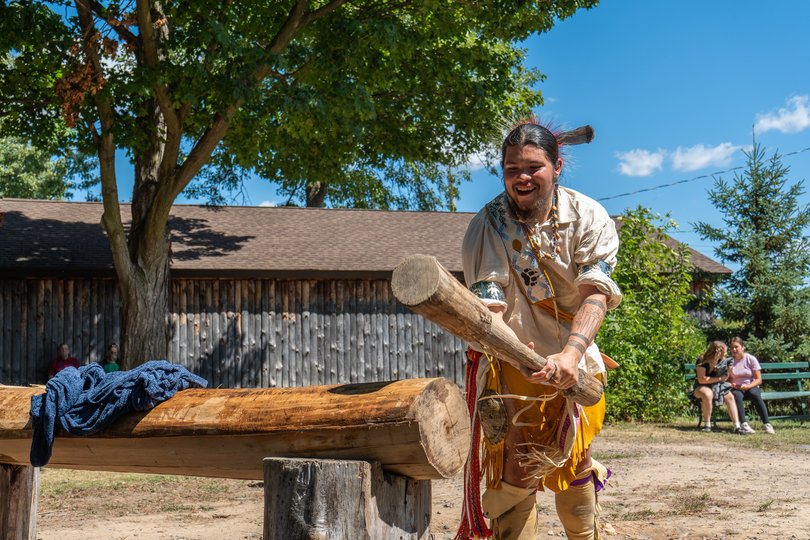
Tucked under the cover of trees in the Haudenosaunee Village at the Great New York State Fair, just past Gate 4, the repetitive ping of splint pounders hitting wood fills the air.
Travis Goff and Rahhesere Caldwell stand on opposing sides of the black ash log. Each holds a splint pounder made of hickory. When one raises their tool, the other strikes down on the log, creating a rhythm.
They’re basketmakers.
“It grounds me,” Caldwell said. “Whenever you’re pounding this, you can’t put anything negative in there, because you’re making it for someone or something. It’s mainly not for you.”
Goff, Caldwell and Jared Jock are part of Quills N Baskets, a craft studio based in Akwesasne, a sovereign territory of the Mohawk Nation that straddles the United States-Canada border. The studio specializes in basketry, quillwork and Haudenosaunee regalia, and they’re selling baskets in the Haudenosaunee Village for the entire state Fair, which runs until Monday.
But Jock doesn’t fully consider Quills N Baskets a business at the moment. Instead, he says its focus is helping the community in Akwesasne through basketry classes.
“We’re just trying to make baskets and spread the knowledge,” Jock said. “And also, spread the information of the beetle. It’s decimating the trees.”
The emerald ash borer, an invasive beetle species, was first discovered in Akwesasne around 2017. It lays eggs beneath the bark of ash trees, and its larvae bore into the tree’s flesh. The bugs prevent the plant from transporting nutrients and water to its branches, eventually suffocating the tree.
Black ash trees, due to their greater flexibility, are essential for traditional Haudenosaunee basketry. But that quality also makes them sensitive to invasive species, like the emerald ash borer.
“In Akwesasne, we’re seeing more dead standing trees than live trees,” Caldwell said. “This is going to be a dying art. My grandkids are probably going to be the last people able to make this.”
Caldwell said traditional Akwesasne basketry isn’t fading due to lack of human interest; it’s because of the emerald ash borer. It’s an ecological and cultural crisis on all three basketmakers’ minds.
Goff remembers where Quills N Baskets harvested the log they used for baskets two years ago. When they went back to the spot this year, the area had been ravaged. Forested backyards in Akwesasne are full of dead trees — standing where they once thrived. Golf, Caldwell and Jock even thought about traveling to Maine to harvest raw material.
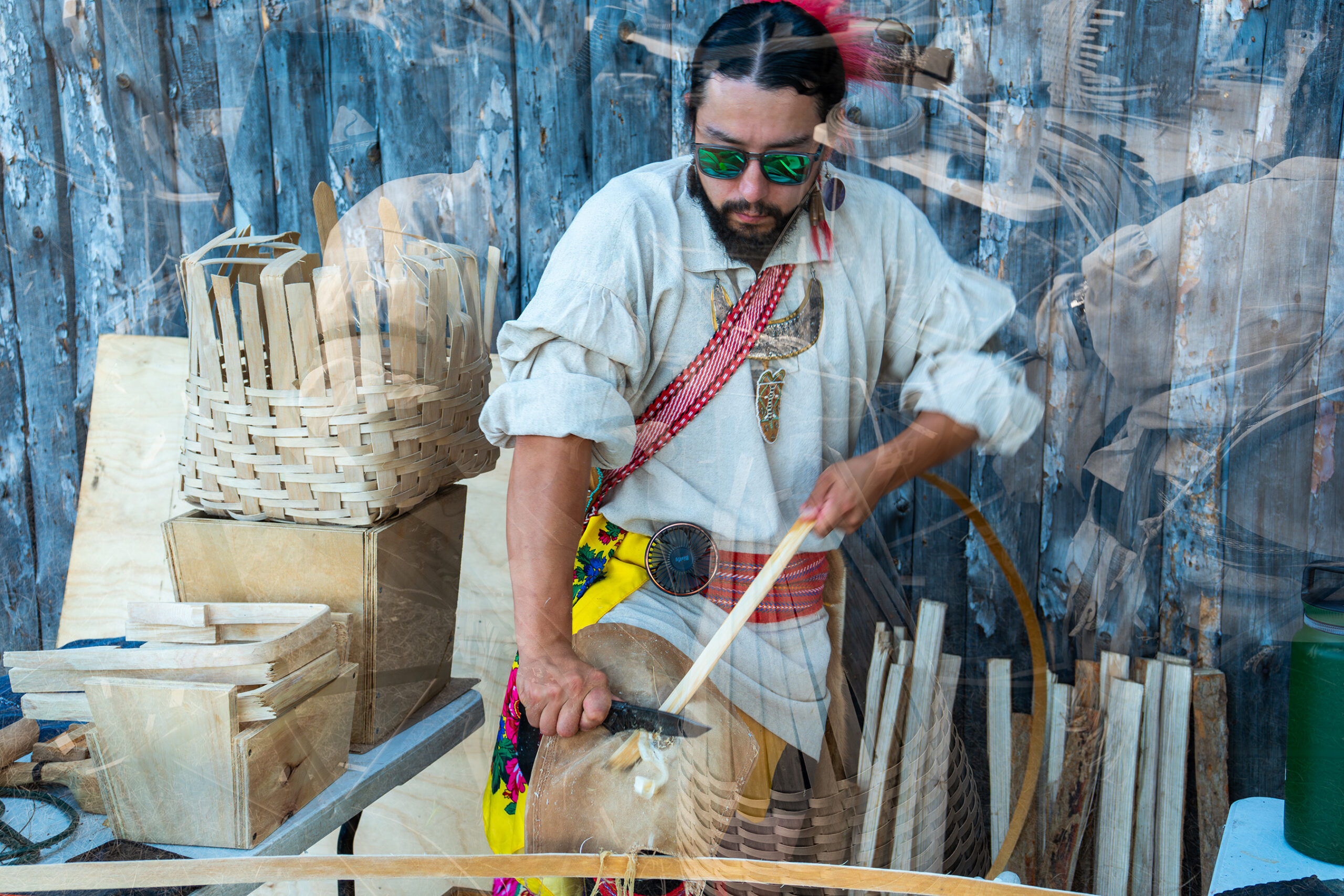
Jared Jock smooths out a wood splint with a knife. Alongside Travis Goff, Jock launched Quills N Baskets, a studio aimed to spread awareness about basketry. Peter Hua Radosh | Asst. Digital Editor
Goff recalled that Henry Arquette, a nationally renowned basketmaker from Akwesasne, had ash logs within walking distance.
“To believe that (Arquette) just went in his backyard, in his neighbor’s backyard, down the road, he just picked up ash logs and just did it right there,” Goff said. “To us, we can’t even see that.”
So, Quills N Baskets is determined to spread awareness about basketry and show the joy that the process brings. In his second year at the Fair, Goff explains the significance of log pounding in the basketmaking process to onlookers.
First, the log is soaked in water to loosen its annual growth rings. Repeatedly striking the trunk further separates the rings. Then Caldwell drags a knife under the split ridges along the log’s grain to separate splints, the thin, flat strips used to weave baskets.
Now that the procedure is finished, both men tie their splints into coils and take the material behind a wood shed; it’s their workplace during the Fair.
Surrounding Goff, Caldwell and Jock are multiple baskets in progress. Quills N Baskets primarily creates utilitarian crafts: pack baskets, feast baskets and corn washing baskets, to name a few.
“This tree has so much that we can use from it. We make it our utilitarian baskets,” Caldwell said. “We use the ash from it for corn to wash it, and it turns that into a protein that helps us through the winters. So this tree right here, it’s interconnected with our people.”
The finished products are being sold at the booth next door. Jock pointed out one type hanging toward the front, a “purse basket.” They’re each around the size of a handbag and equipped with a colorful shoulder strap.
WHAT YOU SHOULD READ NEXT
The Great NY State Fair’s Villages showcase the region’s multi-cultural flair
The Great New York State Fair’s Villages allow local communities to share their culture with visitors. Vendors value their interactions with customers and other businesses.
Jock got the idea to make the purse basket while watching dancers at the Fair. Over the Fair’s 13 days, the Haudenosaunee Village holds social dances three times a day, so Jock thought a wearable basket would help showcase more of their culture.
“Even the fairgoers will come by and get one, just to hold their phones, their keys,” Jock said. “It’s another utilitarian use.”
Jock was the first of the three to become interested in basketry. Growing up, his family worked across multiple crafts, but he decided to focus on basketry after taking a class around six years ago. Goff grew fascinated after a phone call with Jock, around a year after Jock began concentrating on basketry, and the two started Quills N Baskets together.
Since then, Goff has shared his basketry interests with his family, and alongside Jock, he mentored Caldwell. Now, Goff says Quills N Baskets has five active basketmakers on its team, with nine people overall.
Each part of the basketry process is rooted in Haudenosaunee culture. The sound of the pounding process on a fresh log is akin to a water drum.
Some older members in the region grew up hearing that rhythm of splint pounding, which the community calls medicine, Jock said. Goff found that the sound was something that people missed. They’d flock as they heard the rhythm.
It creates an almost indescribable feeling for Jock, one he can only word as appreciation for the present, since it won’t always be there.
“It’s a really nice frequency,” Jock said. “I feel like it has the healing properties that go along with sound therapy. That’s a real thing. Music brings laughter, brings other emotions. It’s just about keeping people up in their spirits.”