Recapping Syracuse’s relationship with Flock after common council ‘breakup’

Get the latest Syracuse news delivered right to your inbox.
Subscribe to our newsletter here.
Although Syracuse Common Council experienced a “breakup” with surveillance company Flock Safety in March, cameras remained on Syracuse University’s campus, according to DeFlock, an advocacy group that maps the cameras.
Flock has faced rare bipartisan backlash amid an increased amount of Automated License Plate Readers across the United States. The company claims the technology helps law enforcement find missing persons and stolen vehicles.
The cameras, also called ALPRs, received increased scrutiny since their expansion. Police officers have also been accused of using the network to track former partners and the company has faced criticism for sharing data with U.S. Immigration and Customs Enforcement, 404 Media reported.
Although the cameras’ intended use is to track vehicles, many have questioned its privacy.
Sidney Thaxter, a senior litigator at the National Association of Criminal Defense Lawyers, said the “excuse” of vehicle tracking is misleading because of how easily they’re associated with people.
“They have this massive network and that’s why they are valuable to law enforcement, as you can track somebody anywhere at any time,” Thaxter said.
Syracuse’s relationship with Flock has fluctuated over the past 5 years. Since the beginning of their partnership in 2021, the city evaluated and changed Flocks’ presence drastically, but the cameras remain a point of contention both locally and nationwide.
2021 – 2022
In 2021, former Syracuse mayor Ben Walsh appointed a 13-person Surveillance Technology Working Group to review surveillance proposals. The group eventually approved the tech in 2022.
During that year, Flock cameras were installed in over 1,400 cities nationwide — today, it’s over 6,000 communities. There were around 21,000 Flock cameras on September 10, 2025, according to DeFlock. One year later, the number of Flock ALPRs has grown to just under 140,000.
ALPRs use an AI-powered network to capture images of passing vehicles, taping footage and storing details, creating a “Vehicle Fingerprint.” The fingerprint consists of a vehicle’s make, model and features such as bumper stickers and dents.
2023 – 2025
In August 2023, Destiny USA announced the installation of Flock cameras at every entrance to the mall. Pyramid Management Group, the company behind the mall’s operations, said the technology was a “powerful tool in preventing and solving crime” six months after installation, scanning over 400,000 vehicles per month.
Law enforcement reported a 50% drop in property crime at the mall, with the building now hosting 10 Flock cameras along the perimeter, Spectrum News reported. PMG expanded the use to its other malls following the tech’s effectiveness at Destiny.
In addition to Destiny, SU installed eight ALPRs on campus in 2025. Although the cameras are part of Flock’s wider network, SU’s Department of Public Safety controls the data, which can be provided to other law enforcement or Flock, an SU spokesperson said in September 2025.
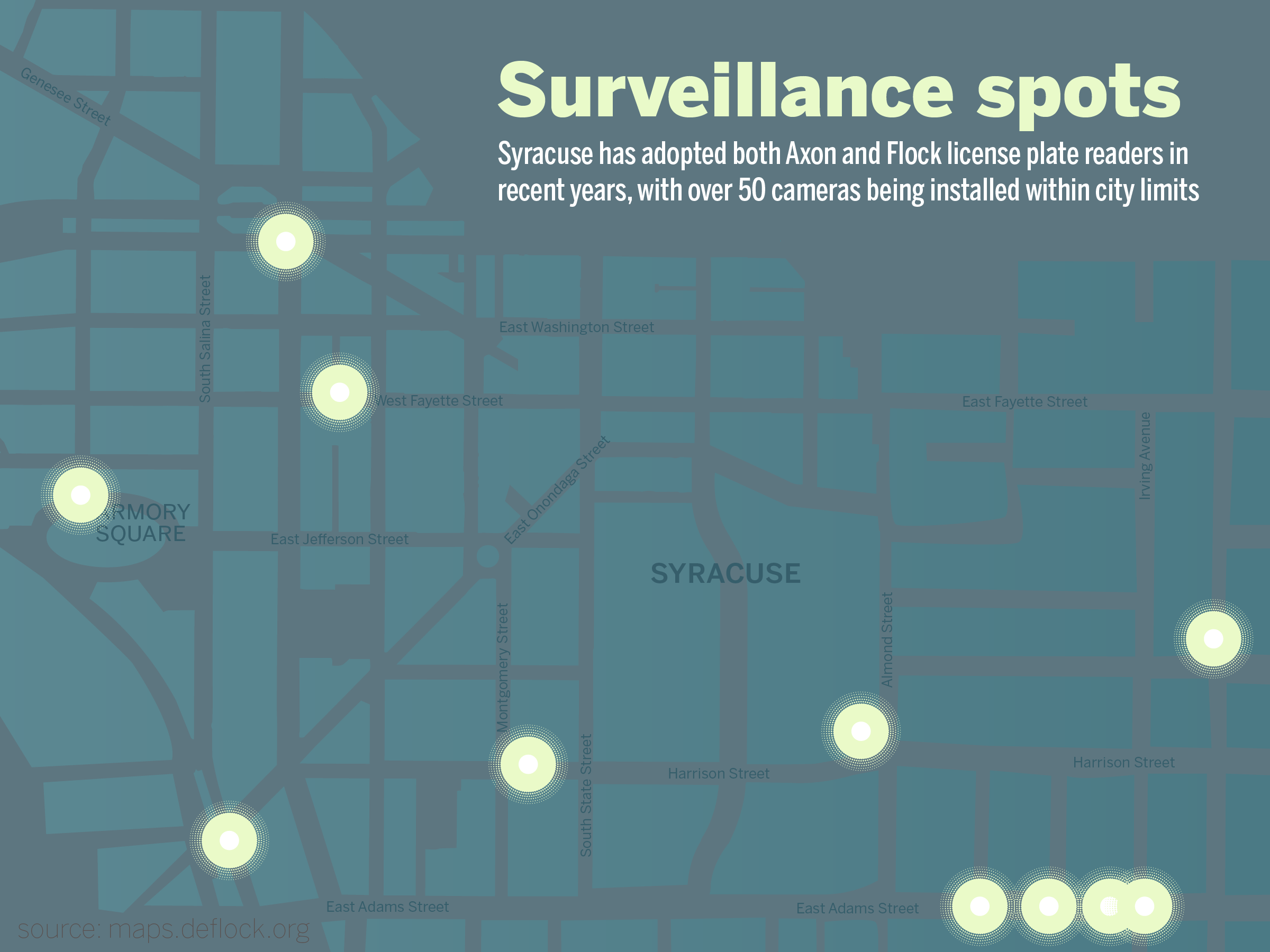
Abigail Aggarwala | Digital Design Director
The camera’s AI-powered network allows the algorithm, as well as investigators, to detect patterns between vehicles seen in similar places and at similar times, a recognition that Thaxter described as a “convoy analysis.”
The potential of that, Thaxter said, could allow investigators and Flock to draw indirect connections between people who may know each other, such as friends and family members.
“These are, at this point, incredibly powerful mass surveillance tools that track the movement of every citizen around the country, whether or not you’re suspected of a crime,” Thaxter said.
Joon Park, a cybersecurity professor at SU’s School of Information Studies, said those indirect connections can become revealing when Flock’s data is combined with other widely used databases used by officers and the government.
“The license plate database is only one database away from being able to pull up a profile of that person,” Park said.
However, Park said he feels the main cause of backlash is due to “bad actors” and not the cameras themselves.
“It can help investigators connect the dots when they’re investigating a crime,” Park said. “The technology itself is not necessarily the problem, it’s how you use it.”
Following Syracuse Flock data being privately shared with ICE in September 2025, the city’s Common Council began reconsidering its relationship with Flock in November 2025.
2026
Part of the reconsideration was a resolution revoking permission for SU to install Flock cameras near campus. In March, the Council fully revoked Flock’s permission to operate, with the city beginning to seek an alternative to Flock’s ALPRs.
Axon Enterprise, which produces police body cameras and makes the same ALPR technology, signed a five-year, $422,000 agreement to replace the city’s Flock cameras.
Axon gives the city more control over data access and auditing. Park said Axon requires officers to provide specific documentation on who is accessing the database and why.
In response to nationwide protests, Flock changed its stored footage to be automatically deleted after a week unless it’s involved in an active investigation.
“It’s less intrusive than 30 days, but it doesn’t solve privacy issues or illegal misuse,” Thaxter said.
Most city cameras have since been transitioned to Axon, and Flock removed all of its 13 readers from the city in July, Central Current reported. Despite the terminated Flock contract, Destiny USA and SU still stand as the only locations in the city that host Flock ALPRs, according to DeFlock map data.
Jimmy Monto, a key Common Council member who helped propel the Flock revocation, regrets the company’s adoption by the city.
“In hindsight, Flock was a bad idea for Syracuse. Time will tell us how we feel about Axon, I myself am skeptical of the technology as a whole,” Monto said.
A Flock spokesperson said the company doesn’t conduct mass surveillance, and that agencies own all data collected by the cameras. In addition, the company defended the tech’s legality, pointing to “more than 40” court decisions that concluded license plate readers don’t violate the Fourth Amendment.
Regarding several cities’ decision to walk away from Flock, a spokesperson wrote that the company respects decisions made by elected officials.
“Flock respects those decisions and believes public safety and privacy can – and should – coexist,” the spokesperson wrote. “We participate in public forums, answer questions from residents and share information about accountability, oversight and policy.”