‘Rich Harrington: Fissure’ exhibit addresses pop culture’s societal impacts

Get the latest Syracuse news delivered right to your inbox.
Subscribe to our newsletter here.
Walking into the Everson Museum of Art’s “Rich Harrington: Fissure” exhibit greets guests with a colorful array of artwork, images and displays. On first look, the collection may be interpreted simply as art in a gallery.
However, upon blinking, the exhibition becomes something entirely different. For artist Rich Harrington, his exhibit is important because it challenges predetermined societal roles of gender, family structure and personal identity, he said.
“I think it’s really important to have this show up right now,” Harrington said. “And I think it’s really important for students to see it and get involved in making sure that we’re still able to do this in the next 10 years.”
Rich Harrington, a Binghamton-born artist with a Bachelor of Fine Arts in illustration from Syracuse University in 1980, gave a tour of his selected works on Sept. 19 as part of the museum’s CNY Artist Initiative Gallery Talk series. Basing his displays on his own experience, Harrington addresses the effects of pop culture on societal normalcy and the reassignment of established roles. The exhibition will run until Oct. 25.
“We feel it’s really important to provide the artists in our community with a space to show their work, but it’s also really important to show people that visit the Everson that there are artists living in our community,” Steffi Chappell, Everson’s Director of Curatorial Affairs, said. “We’re showing artists who are from all walks of life, all different backgrounds.”
From amplified depictions of paper dolls to a model resembling a standard family living room, Harrington brought guests on a journey through roughly six of his selected works, challenging curiosity about his life and society.
WHAT YOU SHOULD READ NEXT
‘Syracuse Style’ models city’s diversity to fund CNY food bank
On Friday, the Everson hosted “Syracuse Style,” a fashion show with 11 designers and 80 models in support of The Food Bank of Central New York.
Starting with Harrington’s piece “Family of Four,” the life-sized acrylic-painted cut-out figures were inspired by dolls he found at a thrift store. He then magnified them to stand on the same floor as museum guests. A paper doll book allows you to decide what clothing you’re going to put on them. The clothes the person chooses are a projection of who they are, Harrington said.
“They’re commanding a presence that we also do, and I think that’s really important because it gives them some legitimacy,” Harrington said. “What ends up happening is, when the manufactured rules and expectations of pop culture are stripped away, what remains is a family that’s rooted in love, visibility and confidence.”
Sandra Hurd, a financial supporter of the CNY Artist Initiative, said it’s important to champion local artists and their work, like Harrington.
“Local artists of all kinds, musicians, painters, graphic artists, need support as well,” Hurd said.
Shifting to a collection of three photographed pieces, Harrington described how he chose photos from important moments in his family and personal life. He handpainted the photographs with acrylic three times, which transformed the canvas pieces “Hiding in plain sight,” “Richy jumps for joy” and “Father/son weekend.”
“What I like about these pieces is they’re allowing me to step into the frame,” Harrington said. “As an adult, I can make some adjustments that the camera can’t see. I’m adding, I’m subtracting and I’m manipulating just to bring you a little bit closer to my experience.”
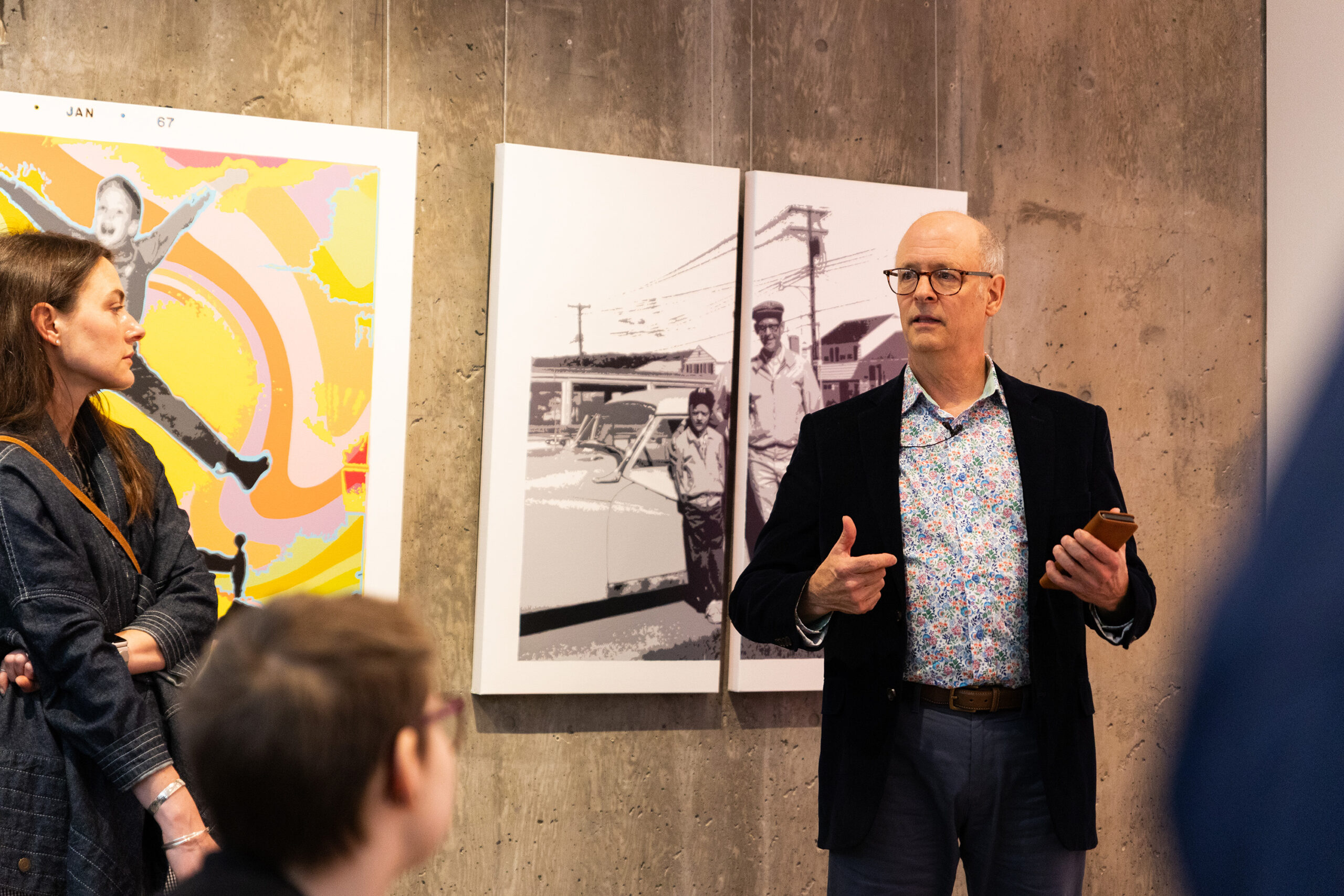
Syracuse University alum and artist Rich Harrington discusses his work, “Father/son weekend,” during the CNY Artist Initiative Gallery Talk series. Harrington’s exhibition will be on display at the Everson Museum of Art until Oct. 25. Kedar Nair | Contributing Photographer
Much of this “experience” was centered on Harrington’s emerging personal identity and expression during his childhood. In “Hiding in plain sight,” Harrington juxtaposes rainbow hues against the otherwise black-and-white photo of his 3-year-old body.
“I wanted to give myself permission just to be who I was going to be,” Harrington said.
The name of the exhibit was established in Harrington’s discussion of “Father/son weekend.” The “fissure” was the gap between his corporate, intense father and the more introverted person Harrington was during his youth.
“It was a very strong dynamic,” Harrington said. “And that was the reason I added this fissure. Mom’s taking the picture of this idealized father/son relationship that really didn’t exist the way she wanted it to exist.”
Further discussing the roles of gender, society and family is his piece “Nuclear.” The work includes enlarged versions of board game family pieces with pink LED lights behind them.
Harrington described the game pieces that players choose as reflections of self — a way that gender propaganda is instilled into peoples’ minds. The way culture feels safe is by putting a label on things in society, he said.
To challenge viewers, Harrington brought the exact labels from the game “Go to the Head of the Class” and reassigned them. For instance, the female character was called “Daddy” and the young boy was called “Sis.”
Next to “Nuclear,” visitors are brought to a living room setting in “Who are you, where do you live?” Complete with a television playing home videos, a rug with books, a framed portrait of Harrington’s family, a bowl of fruit and a vintage antenna, the viewer is immersed in the artist’s living space. The TV set aimed to underscore the media’s promotion of different identities, Harrington said.
Another one of Harrington’s pieces, “Winners and loser,” touches on the artist’s battle with winning and losing in the context of his upbringing, he said. On the surface, the unvarnished acrylic on canvas looks like a strategically painted collection of sports trophies, but it actually includes a photo of Harrington as a high school senior in the background.
The trophies represented the idea of masculinity and what it meant to be a boy or man, Harrington said. Describing his senior photo’s significance, Harrington said it alluded to how he felt invisible and overpowered by masculine figures and what they represented.
The final work of the collection, “Queen of Jacks,” captured the anxiety of trying to survive in a game where the rules weren’t written for you, Harrington said. Testing the expectation of a female to be on the queen card, Harrington hid symbols in the designs of each of the paintings that gave nods to LGBTQ+ culture. The pieces depict hearts, clubs and spades from a deck of cards with the representation of different races as well.
No matter when the art was made, Harrington said they span his whole life.
“The journey itself has been lifelong, and I feel really good about where it is and where I am right now,” Harrington said.