SGA addresses previous ICE sightings, campus concerns at town hall
Get the latest Syracuse news delivered right to your inbox.
Subscribe to our newsletter here.
Amid an increase in United States Immigration and Customs Enforcement arrests in central New York, Syracuse University’s Student Government Association hosted a town hall meeting on Thursday to respond to student concerns.
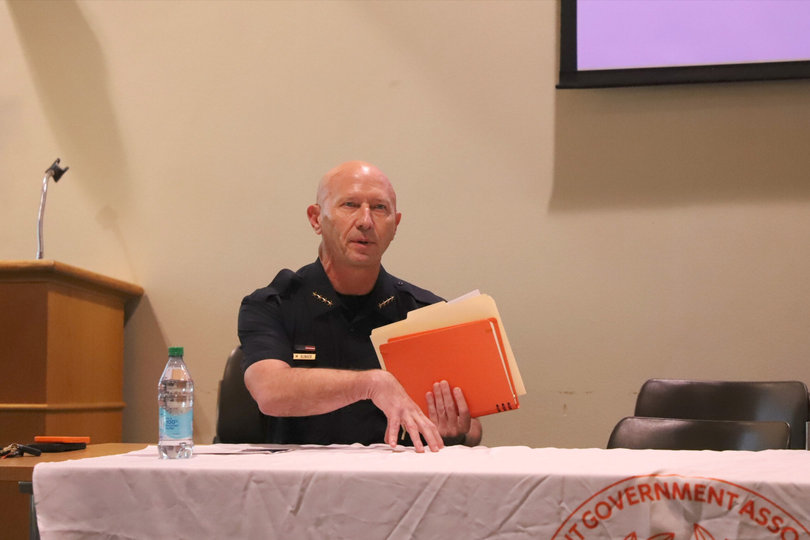
During the town hall, Department of Public Safety Chief Michael Bunker answered student questions regarding ICE and provided steps for those on campus to take if approached by an ICE officer. Bunker was joined by SGA Vice President of Diversity, Equity and Inclusion Nasya Bellard, as well as representatives from Art Warehouse and La L.U.C.H.A., adding a student perspective to the discussion.
If a law enforcement agent presents a warrant for a student, faculty or staff’s arrest, without a clear reason, Bunker said they should call him to verify the warrant with the Office of University Council.
Bunker said OUC has the “expertise” to look at a warrant and make sure it’s signed by the “right” judge. Students or others on campus can contact Bunker at any hour by email or phone, he said.
Last year, there were three ICE sightings in the university neighborhood area, Bunker said. There were also several claims circulating in February on social media that there were ICE agents on Marshall Street, but DPS quickly confirmed they were U.S. marshals.
“I feel very comfortable with what (DPS) put into place and where we’re at right now,” Bunker said. “(ICE has) still yet to come onto our campus.”
Bunker noted that despite the presence of ICE in Minneapolis, “They still did not go on to the universities in Minnesota.”
If encountering law enforcement, people can ask for their badge number, name or ID, Bunker said. Filming and taking photos is also allowed as long as “you’re not impeding your arrest.”
It’s important for students to equip themselves with relevant information, Bellard said, and that students need “continuing reassurance” that they are safe.
Jesús Tiburcio Zane, president of La L.U.C.H.A., said he knows international students who have fears about being out late at night or early in the morning, given the rise in ICE presence.
“It’s very difficult to know how we can navigate this world, especially as college students,” Tiburcio Zane said.
If ICE arrests happen off-campus, Bunker said there’s nothing he can do to stop it as it’s not part of his role. However, Bunker added that there are county officials who have said they won’t work with ICE, citing Syracuse Mayor Sharon Owens as an example. In January, Owens told CNY Solidarity Coalition that the Syracuse Police Department would not “act as ICE agents.”
DPS is also taking steps to avoid causing immediate alarm when any law enforcement officers are present on campus, Bunker said. Law enforcement on campus usually isn’t a reason for concern, and agencies like the FBI visit SU to do “good work” for the community.
Tiburcio Zane said it was reassuring to know that Bunker is taking student concerns seriously and collaborating with student organizations.
“We have a good figure who is leading,” Tiburcio Zane said. “He was very firm and confident in knowing when and where ICE is present near Syracuse University campus.”
Bellard also said Bunker has made a diligent effort to come to SGA assembly meetings and encouraged students to be a part of future conversations.
“We’re calling out to students to show up for topics that are really important to you as a student,” Bellard said.
Students, faculty and staff can contact Chief Bunker and DPS at mjbunker@syr.edu and 315-443-2224.