SGA introduces committee to improve university software at 1st meeting
Get the latest Syracuse news delivered right to your inbox.
Subscribe to our newsletter here.
Syracuse University’s Student Government Association opened its 70th session with a fresh cycle of uncontested elections and the introduction of a student initiative focused on improvements to campuswide software at its regular Monday meeting.
The meeting focused heavily on procedural matters for the upcoming session while also highlighting future events and initiatives across campus, including its Student Technology and Innovation Board. Assembly members also had the opportunity to publicly question nominees for several elected positions about their visions for their roles.
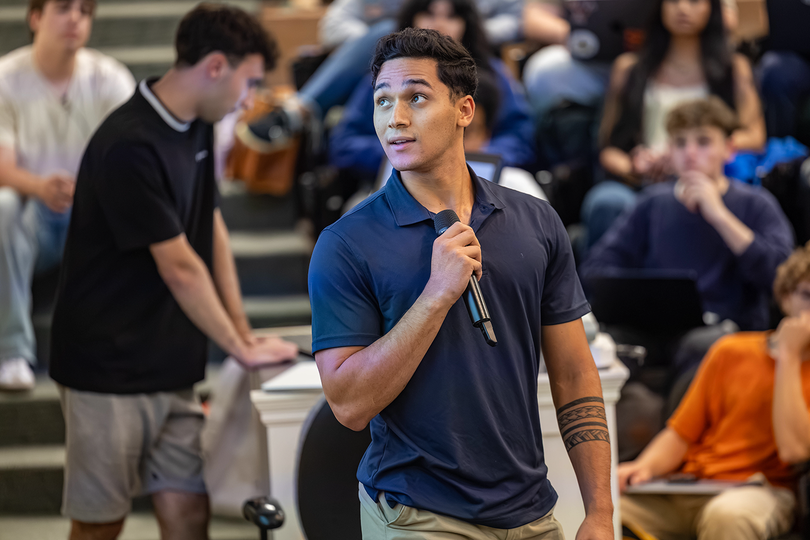
Senior Julian Hernandez, SGA director of student technology affairs, encouraged assembly members to apply to the board, a new committee focused on improving critical campus software used by students daily.
“Do any of you guys get pissed off with MySlice, DegreeWorks, AI at Syracuse?” Hernandez said while speaking to the assembly. “Would you guys like to complain about it to Mike Haynie, all the senior leadership, so something actually changes?”
Many SGA members responded by expressing their frustrations with the operating systems of the software, calling it inefficient. The new committee said it plans to solve these issues by streamlining the software into a more united, accessible front. The Student Technology and Innovation Board aims to educate students and faculty about artificial intelligence and integrate it into all aspects of campus life.
The committee looks to gather 15-20 students from “across schools, disciplines, and backgrounds” to bridge the gap between daily student experiences on the front end of these operating systems and faculty and administration members working on the back ends of software used by SU.
“I know I just presented (STIB) to (SGA), but I’m really open to having anybody on campus that’s interested in AI,” Hernandez said. “We’re focusing on MySlice and AI first, but anything on campus that people want to communicate with the school and be a part of changing that, I’m really interested in.”
SGA Vice President of Academic Affairs Beckam Polis noted the inconvenience of the current software and said he wants the committee to serve as a useful liaison for connecting offices vital to SU operations. He also mentioned hopes for implementing a system where students can easily access necessary campus software from their phones.
Polis and Hernandez said they want to create a united front across multiple departments and schools to gain as much insight as they can about how AI policy differs across campus.
“I myself am STEM-focused. I do a lot with research, and that’s what my focus is going to be in AI, but someone who’s in Newhouse may not use AI as much as I would in a research setting,” Polis said. “I want to hear where they want to use AI and see how they can integrate (it) into classes.”
SGA also nominated seven students into appointed positions in uncontested elections:
- Darren Murphy, director of internal operations
- Kempton Bohn, board of elections chair
- Thalia Benton-Dinneen, board of elections commissioner
- Peyton Tapp, board of elections commissioner
- Subhin Park, Finance Board
- Micol Ceccarini, Finance Board
- Megha Iska, Finance Board
Eight additional students were elected into the student caucus of the University Senate’s three-pronged system, which includes staff and faculty members. After elections, two student senate seats will remain vacant.
The Finance Board, with its three new elected members, enters the academic year with the new challenge of managing its place in the 1.5% operating budget deficit that SU is running on this academic year, as outlined by Chancellor Mike Haynie.
Before being elected, assembly members asked the Finance Board nominees about their ideas on how to manage the deficit, which includes a decreased student activity fund, something SGA directly manages. All three nominees agreed that having prior experience dealing with fiscal matters will be a positive factor in the board’s ability to efficiently manage the reduced budget.
Nominees also cited the importance of continually adhering to fiscal codes used when the board wasn’t operating with a deficit and minimizing bias when determining how funds are allocated to different organizations.
Following its budget cut in April, representatives from the New York Public Interest Research Group presented during the public comment segment of the meeting to share some of their current campaigns, including an anti-data center proposal in Baldwinsville, NY and voter registration efforts ahead of the upcoming midterms.
Other Business:
- SGA will not hold an official meeting until September 14 due to Labor Day.
- SUNY ESF assembly members began a conversation about the possibility of SU student organizations holding tabling events at ESF to bring greater awareness of the relationship between the two schools.
- SGA plans to partner with OttoTHON on September 13 to co-host a pickleball tournament benefiting the cause.