SU alum debuts ceramic collection, examines Black identity through collage
Get the latest Syracuse news delivered right to your inbox.
Subscribe to our newsletter here.
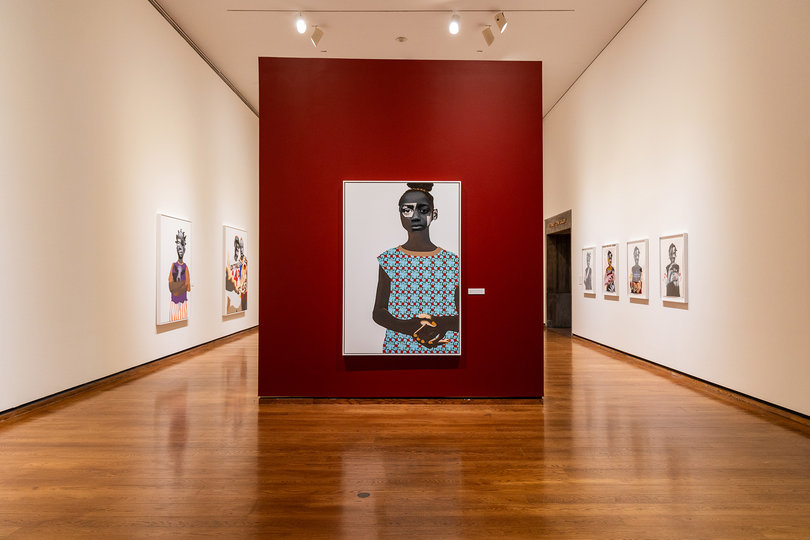
Inside Deborah Roberts’ “Consequences of being” exhibit, Everson Museum of Art visitors lingered around large collaged canvases. Hung on stark red-and-white walls, mismatched eyes and oversized hands created pieced-together works across the room, sparking conversation about perceptions of the Black body.
Roberts, who received her masters of fine arts from Syracuse University in 2014, combined drawings, paintings and signage to communicate the adolescent Black experience at her exhibit, which opened in May at Everson.
Though “Consequences of being” closed Sunday, it marked yet another feat for Roberts’ art. Her first solo exhibition in Syracuse and ceramic debut was a homecoming of sorts.
Since graduating from SU, Roberts’ work has been displayed in exhibits across the United States and Europe. Recent exhibits include “What about us?” at the Stephen Friedman Gallery in New York City in 2023 and “A look inside” at The Bluecoat arts center in Liverpool, England in 2021.
“I would say it’s my victory lap, but I’ve already had one,” Roberts said.
Seventeen mixed media portraits were displayed alongside two ceramic busts of children, commenting on the adultification of Black children in society.
The exhibition’s name grew out of conversations Roberts had with her peers about the Black body and its place in the world, she said.
Syracuse local Mia Bullock, 62, also creates mixed media art and was struck by Roberts’ ability to build unity from different fragments.
“How she’s portrayed her perspective, it’s incredible,” Bullock said. “It shows that togetherness as a people, smaller pieces together with one whole. These are really beautiful people that she’s created, they all show some kind of triumph.”
WHAT YOU SHOULD READ NEXT
‘Rich Harrington: Fissure’ exhibit addresses pop culture’s societal impacts
The Everson Museum of Art exhibition “Rich Harrington: Fissure” challenges predetermined societal roles of gender, family structure and personal identity.
One piece, “I come as one but stand as ten-thousand,” references the brutalization of a young Black child who was aboard John Kimber’s Recovery slave ship. The central figure’s clothing draws on an old political caricature by 18th-century Scottish painter Isaac Cruikshank, depicting the same atrocity.
Roberts originally came across the caricature by chance. The scene depicts a 15-year-old Black girl who was repeatedly whipped and then hung by her leg after refusing to dance for Kimber. She died shortly after in 1791.
Roberts didn’t want the piece’s story to end with its tragedy. Roberts surrounded the girl’s body with roses, purposefully including “something beautiful, something we cherish,” in the piece, she said.
“It was a conversation I’m continually having with brutality and luxury,” Roberts said.
Two ceramic busts mark a divergence from Roberts’ well-known work. After creating in the 2D space for over a decade, Roberts wanted her portraits to be tangible.
“I wanted to see these kids like a 3D model. I did so much work,” Roberts said. “I wanted to see them, where it’s something that you could touch, that you could actually put your hand on.”
Everson’s Director of Curatorial Affairs Steffi Chappell said the physical scale of Roberts’ figures changes how the viewers encounter that history.
“One of the things I love about Deborah’s paintings is that the children are so large that when you stand in front of the painting, you have to look up to them,” Chappell said. “That’s not an experience that you get in the real world very often.”
For other visitors of Robers’ exhibit, like Syanis Yarí Vargas-González, 26, the messages were less clear-cut.
“It is not my style,” Vargas-González said. “I know that, at the end of the day, art is expression. So I’m trying to ask, what is this person trying to tell me with all these elements?”
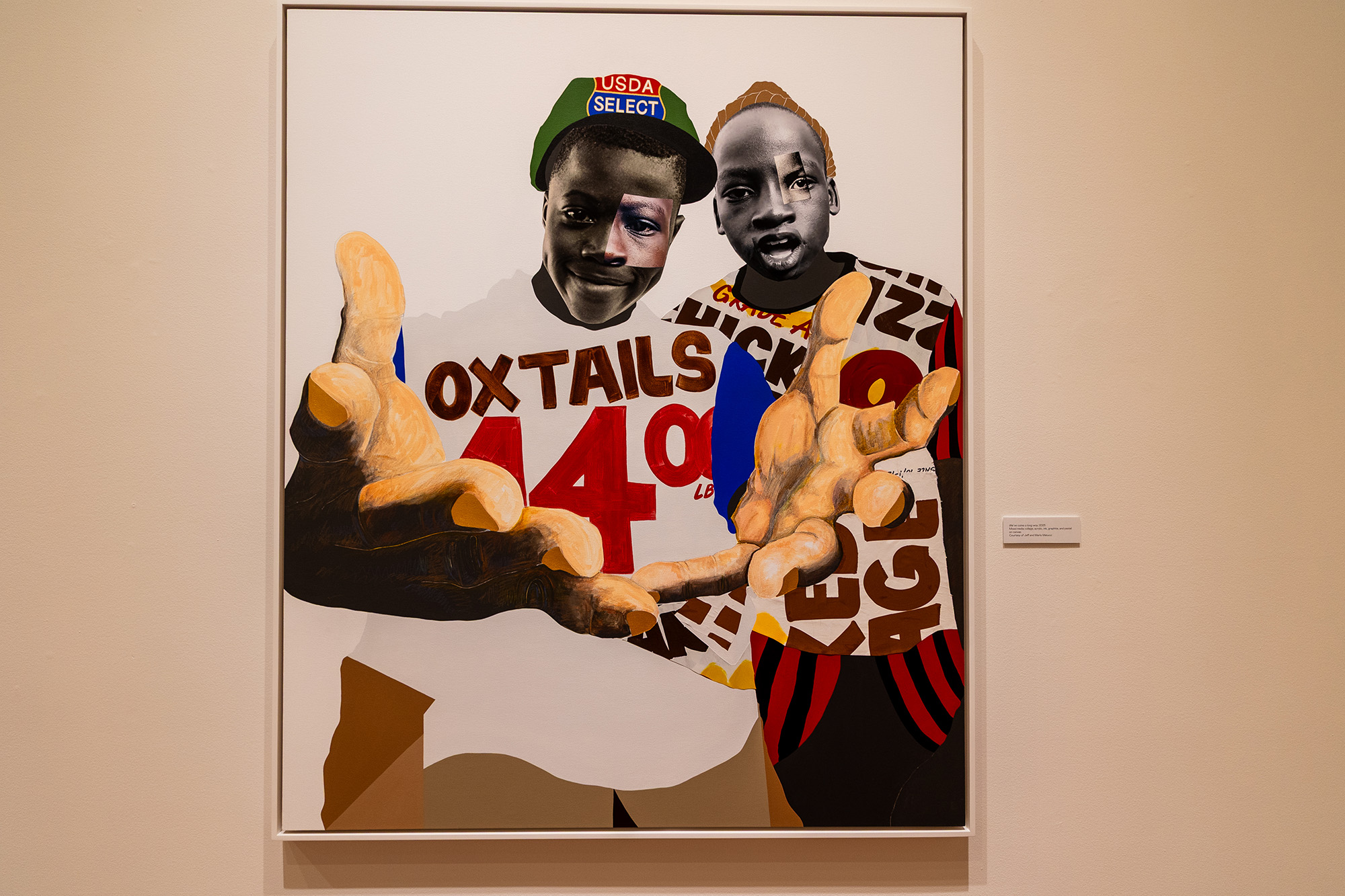
“We’ve come a long way” is one of 17 mixed media portraits in Deborah Roberts’ exhibition “Consequences of being.” Roberts, a Syracuse University alum, makes her first appearance at the Everson Museum of Art with this exhibition. Eli Schwartz | Asst. Photo Editor
Roberts credits SU for laying the groundwork and helping her hone in on her larger creative vision. Her experience taking African-American studies inspired the incorporation of literary and historical references into her work.
“Once that muscle started to mature and get stronger, the work became stronger,” Roberts said. “Once the work was based in literature and history, then it was easier to tell that story in visual language.”
Instead of any particularly influential mentor or peer, Roberts said her MFA fellowship at SU gave her the time to research. That space was hard-won, she said, encountering resistance from faculty who didn’t understand what she was building.
Even so, Roberts said she spent her early years as an alum advocating for SU’s Visual and Performing Arts program. She emphasized the importance of art programs and constructive, contemporary professors.
Roberts places herself among a larger lineage of Syracuse-trained female artists, naming Marilyn Minter, Barbara Kruger and LaToya Ruby Frazier as other talented examples.
“All the real successful artists have been women, and Black women,” Roberts said.
Chappell said Everson had wanted to show Roberts’ work for some time. For Catherine Winger, a member of the Everson Board of Trustees, Roberts’ exhibit felt timely.
“When I saw that she was going to be having a show here, it really spoke to me,” Winger said. “I’m a little concerned about some of the things that are going on in our country, and I thought that the show really spoke to the experiences of a minority person.”
For Roberts, the themes she discusses in her work extend beyond gallery walls. The exhibition’s focus on history and Black identity is in connection with current national conversations.
“With the current projection of the way things are going, with the dismantling of Black history and history in general, it feels like we’re going backwards,” Roberts said. “I hope my work challenges those ideas.”