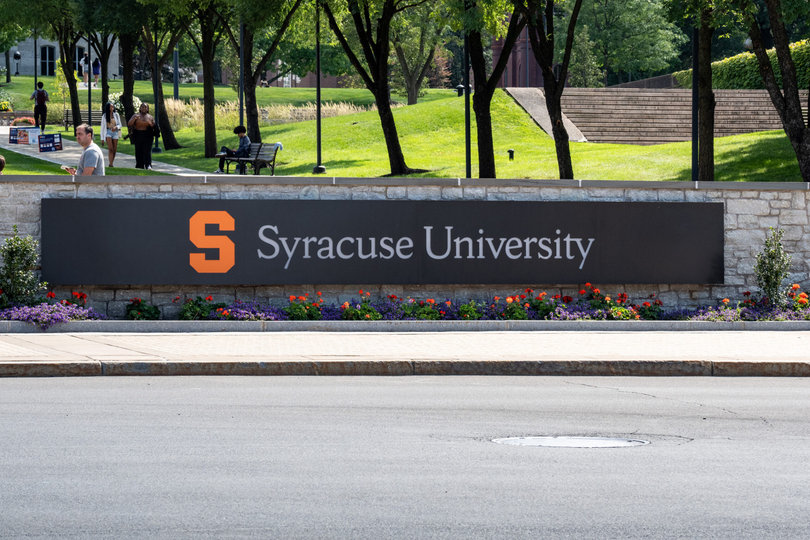
Syracuse University opens feedback period amid reaccreditation process
Get the latest Syracuse news delivered right to your inbox.
Subscribe to our newsletter here.
Every eight years, Syracuse University examines its compliance with the Middle States Commission of Higher Education’s seven accreditation standards and accepts feedback from students, staff, faculty and alumni through a self-study. The comment period is open through Oct. 12.
The self-study is a part of the reaccreditation process, a series of evaluations ensuring the university is compliant with the standards of higher education. The study acts as an overview of the process in which university administrators create a self-analysis after discussions with stakeholders.
“The institution is responding to the Middle States standards and requirements of affiliation,” Jerry Edmonds, chief of staff for academic affairs, said. “So in the process, we do not determine the findings, Middle States determines the findings.”
There’s a “series of required evidence” that the university has to collect, Edmonds said. The university reviews the standards and evidence and then describes how well SU meets the standards.
The seven standards within the study are Mission and Goals, Ethics and Integrity, Design and Delivery of the Student Learning Experience, Support of the Student Experience, Educational Effectiveness Assessment, Planning, Resources and Institutional Improvement and Governance and Leadership and Administration.
The report lists “key factors” that have impacted the university since its last self-study report. The university’s chancellor transition was the first factor listed, explaining the process was sped up after former Chancellor Kent Syverud ended his tenure early after announcing he had been diagnosed with a form of brain cancer.
“As is typical during transitions of this magnitude, changes to the senior leadership team are
anticipated and have begun to take shape,” the report reads. “The University is managing this period of leadership renewal with deliberateness, and the composition of the senior leadership team will continue to evolve as Chancellor Haynie establishes his administration.”
Other factors mentioned include the academic portfolio review, changes in SU athletics and unionization on campus.
The impact of Micron Technology’s semiconductor facility was also listed as a factor. The university, in collaboration with Onondaga County, created the Center for Advanced Semiconductor Manufacturing to prepare students “for careers in semiconductor manufacturing.”
In addition to the key factors, SU identified three institutional priorities to be addressed in the self-study. The priorities — labeled student focused, research excellence and welcoming to all — stem from the fall 2022 academic strategic plan, which centered on the ideas of research and creative excellence; educational excellence and student success; and public impact.
Seven groups composed of SU faculty, students and staff worked to gather feedback on the ideas and led to the development of the Leading With Distinction academic strategic plan and the institutional priorities.
The report includes a five-year enrollment summary, saying that total enrollment remained “mostly flat” from 2021-25, increasing by less than 1%. However, in June, SU announced that it failed to meet its fall 2026 enrollment targets, causing the university to face a budget deficit.
Middle States would be less interested in the enrollment decline and more focused on what the university is doing to address it, Edmonds said. SU will have an opportunity to “clarify anything” to Middle States during their campus visits, he added.
Despite a decline in enrollment, the first-year student retention rate has continuously increased since 2019 and hit 92% in fall 2024. In the report, the university wrote that it has implemented some of the recommendations from the 2017-18 report, notably “progress in assessment and the Shared Competencies.”
“There has been a marked increase in the engagement of faculty and staff in reflective
assessment processes to enhance student learning and campus operations,” the report reads.
The university stated in the report that it was compliant with each of the seven accreditation standards.
“The self-study process reaffirmed many of the University’s considerable strengths while also surfacing a set of themes that cut across multiple standards,” the report reads. “These cross-cutting findings indicate areas where sustained, institution-wide effort will yield the greatest returns in quality, transparency and mission effectiveness.”
Edmonds said while SU may comply with the accreditation standards, people are still entitled to disagree with how the university meets them. For example, someone may not agree with SU’s mission statement, but as long as Middle States sees SU has one, the requirement is fulfilled.
After the open comment period ends, the final submission will be sent to Middle States on Dec. 15. There will be an in-person visit in April 2027 followed by commission action in June 2027. Edmonds, along with other members of the Office of Institutional Effectiveness, read all of the comments and identify which will be included in the report. Some of the comments may include ideas for the university that the institutional effectiveness team will also include, Edmonds said.
“We really do want people to comment. We read all the comments, we take it… and it’s an important part of the process,” Edmonds said.