SU should provide students more opportunities to engage with the city
Get the latest Syracuse news delivered right to your inbox.
Subscribe to our newsletter here.
During my sophomore year, I befriended one of my coworkers who was a Syracuse resident. She was a biracial young woman who worked incredibly hard. During our time at Chipotle on Marshall Street, she told me about growing up poor with a single mother in Syracuse, surrounded by instability, substance abuse and death.
When I found out she was working two jobs and had been picking up extra shifts because she was staying at a shelter, my stomach filled with rage, guilt and resentment.
I felt guilty because we were the same age, yet she still showed up to every shift with intentions to improve her life. I felt rage and resentment because I witnessed every weekend what Syracuse University students do with their money, not considering how isolated our University Hill experience is from the city of Syracuse.
I haven’t seen her in two years. I don’t know how she’s doing. Years later, I decided to explore how SU students can live here without interacting with the greater Syracuse community.
I think the disconnect is bigger than just students, and I wanted to explore why.
To understand the disconnect, I compiled a list of questions to ask SU students, a Syracuse native, an SU administrator and a representative from Connect315, a student-run organization that aims to bridge the gap between students and the city of Syracuse.
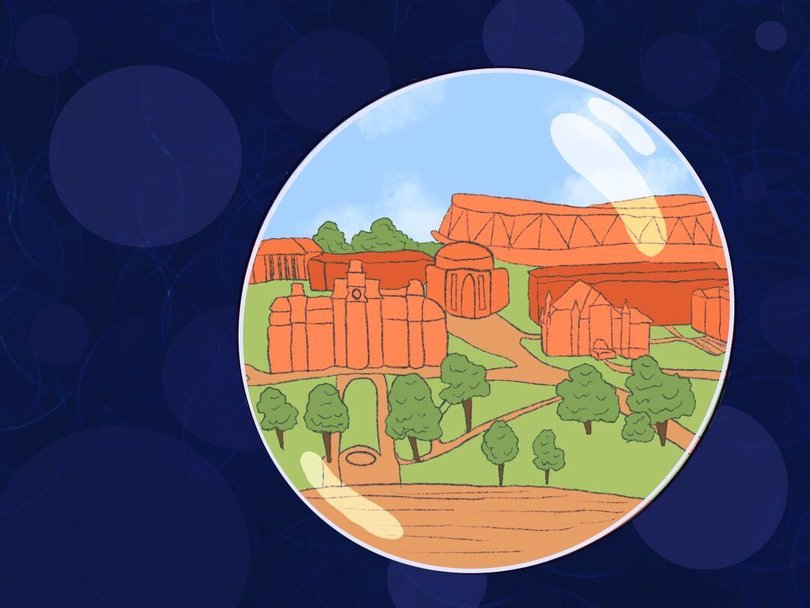
Across these conversations, one idea continued to surface: the bubble. Oscillating between SU and home, I’ve realized how different the two are. The college bubble feels like a wonderland of parties, a place where students can do whatever they want without real-life implications. Outside of this bubble, at home, I feel like my actions have higher stakes.
In the context of SU, students repeatedly referred to University Hill as a bubble. They described lives largely centered around the immediate campus, while several admitted they knew little about the city beyond University Hill.
“Everything is confined in a bubble on top of a hill,” said Alexander Mathis, an SU student from Syracuse.
Fel Edmond, a sophomore studying business management, estimated that he spends about 90% of his time around campus.
“Marshall Street becomes your downtown,” Edmond said.
When I was a freshman, I could definitely relate to Edmond’s experience, especially when SU makes it nearly impossible to bring a car on campus.
Transportation is another barrier. Naz Endogan, a senior studying film, said she doesn’t feel like she knows Syracuse due to limited transportation and the cost of Ubers.
For some students, the barrier was psychological. Some students aren’t from big cities, so seeing homelessness and poverty might startle them. I’ve experienced homeless people wandering the streets all my life, so it doesn’t faze me much whenever I’m off the Hill, but I still remain cautious.
Students’ relationship with the city is only as strong as our leadership’s relationship with the local community of Syracuse.Trayson Blain, Columnist
“I feel like there’s definitely a persona of Syracuse being unsafe,” Syracuse native Valentino Indelicato said.
Indelicato recalled receiving a nasty look when he told a group of women during his freshman year that he was from Syracuse.
That perception exists alongside a very visible economic divide between SU and the city surrounding it. Syracuse’s median household income is $47,819, while 28.8% of residents live below the poverty line, according to United States Census Bureau estimates from 2020-24. This is about half the yearly tuition for an SU undergrad living on campus.
I can understand this may raise safety concerns for students. But just because you haven’t been exposed to poor neighborhoods before doesn’t mean it should stay that way — being able to navigate multiple rooms will translate well beyond college.
In my interviews, leaving the Hill didn’t necessarily mean engaging with the Syracuse community. Students often discussed trips to places such as Green Lakes State Park, Skaneateles or specific restaurants.
I think students who have greater economic privilege tend to treat college like a vacation instead of trying things that can shift their perspective.
But we should care about the city that calls SU home. This desire to know Syracuse more deeply is part of the gap Connect315 is trying to address.
“We are very much in our own bubble,” Connect315 Outreach Coordinator Christa Bromfield said.
She said the separation isn’t intentional, but interacting with Syracuse residents isn’t normal for many students.
Connect315 strives to make that interaction easier through volunteer opportunities and partnerships with local organizations. This semester, Connect315 plans to host a community involvement fair with about 20 Syracuse organizations and has also worked with groups like the Rescue Mission and Syracuse Tenants Union.
Connect315 is doing essential work. Its existence shows students are taking initiative and making efforts to connect with the community. This shouldn’t only be on students, though.
Jenny Dombroske, executive director of SU’s Office of Community Engagement, said the university is committed to creating access points between students and the city through off-campus events, internships and other community-based experiences.
“The university and city of Syracuse are linked through a shared commitment to the region’s growth and vibrancy,” Dombroske said.
She encouraged students to take advantage of Syracuse’s music, art, cultural scene, local businesses and community organizations.
SU must focus on bridging this divide from the administrative level. Students’ relationship with the city is only as strong as our leadership’s relationship with the greater Syracuse community.
SU’s Office of Community Engagement already lists partnerships with organizations across Syracuse, while existing transportation such as the Connective Corridor links campus with parts of the city. But relationships between SU and the greater Syracuse area aren’t permanent.
Local businesses change and economic conditions shift. Maintaining a connection requires the university to keep rebuilding it.
Other universities show how deeply this relationship can be built into a community.
Rutgers University generated $13.3 billion in statewide economic impact in 2025 through its operations and student and visitor spending. Furthermore, Rutgers estimates that students at its New Brunswick campus contribute about $337 million annually to the surrounding economy.
SU isn’t Rutgers, and the two institutions operate at different scales.
But Rutgers highlights what can happen when a university treats its relationship with the surrounding region as part of its institutional identity rather than something students are expected to discover on their own.
SU should build on the partnerships it already has by making local organizations and businesses more visible to students, making transportation beyond the Hill easier to navigate and creating consistent pathways for students to see Syracuse throughout their college experience.
I don’t know how my former coworker is doing today.
But I still think about how two people the same age could work behind the same counter and experience Syracuse so differently.
She was already doing everything she could to improve her circumstances. I still think about how easy it was for students like me to live only a few blocks away from realities like hers and barely recognize they existed.
SU can’t erase the economic differences between its students and the city. But it can make it harder for us to remain strangers to one another.
We spend nine months of the year calling Syracuse home. By the time we leave, we should know more than the Hill.
Trayson Blain is a senior majoring in psychology. He can be reached at tblain@syr.edu..