Speaking Mandarin got Garvin St. John more Instagram followers than Syracuse
Get the latest Syracuse news delivered right to your inbox. Subscribe to our sports newsletter here.
The Range Rover slows to a standstill at the corner of Erie Boulevard and Columbus Avenue, stopped by a red light that couldn’t have been timed much better. The Syracuse linebacker looks out the window, sitting behind the wheel on this September afternoon. There’s a ghost from his past to his right. As he talks, he points at the restaurant in the adjacent lot with an orange roof and a fluorescent yellow sign, which reads:
H.K. Take Out Chinese Food
“I was sitting in that parking lot,” Garvin St. John says, pointing out the window. “S—ing myself.”
Consider Garvin: standing all of 6-feet, 235 pounds, an SU walk-on linebacker and burgeoning social media star. It’s been less than a year since he began creating content, yet his Instagram account, @guccigarvin, has gained over 290,000 followers, more than the university he attends and the football team he plays for. Its notoriety has little to do with the sport. His brand of content — “POV: Speaking Chinese as an African American male” — succeeds online when he goes into restaurants, but he still gets nervous to enter them, most of all H.K. Take Out.
Because that’s where everything changed for him.
Toward the end of 2025, Garvin went to H.K. with just a few videos under his belt. Donning his Ray-Ban Meta glasses, he walked in and stuttered while he ordered. “I sold the bag,” he says, recounting it now. He got his food, left the establishment and deleted the video immediately.
Back in June, he returned to H.K. with that flub still fresh in his mind. That’s why he was, in his words, “s—ing himself” in the parking lot. He took a few minutes to relax and told himself to consider the positives that could come from the video. Then, he went in.
“I just built up the confidence to go inside,” Garvin later said. “Did what I do best.”
It became the video that put him on the map. Before he posted it on June 15, he had 20,000 Instagram followers. Two weeks after, he passed star SU linebacker Antoine Deslauriers: 50,000 followers. He passed five-star freshman Calvin Russell III — 77,000 — on July 16, and crossed the 100,000-follower threshold six days later. When he did, he went on Amazon and purchased a black-and-rainbow T-shirt with “100K” emblazoned on it. As he sits in his car, off to the destination he personally selected, he’s at 216,000. The day before, he hit 200,000.
The light turns green again. Garvin accelerates about a half a mile down the road and turns into another lot. This one belongs to another Chinese establishment, Yang Di Chun BBQ. As he pulls into the lot, he notices someone standing next to a Ford truck.
“That’s the guy,” Garvin says.
He’d been to this place once before, back in March, and he recognized the Asian man in this lot. The video’s still on his Instagram. It was a bizarre interaction, one he began by ordering lamb soup in English before trying to surprise him with his Mandarin.
Garvin St. John shows off his Instagram profile. The SU football player’s account has totaled nearly 300,000 followers since he started consistently posting content last November. Zoe Xixis | Asst. Photo Editor
The language switch barely registered with the man, who gave a faint smile and continued responding in English. The man gave Garvin a hot tea while he waited for the soup and didn’t respond when he thanked him in Mandarin.
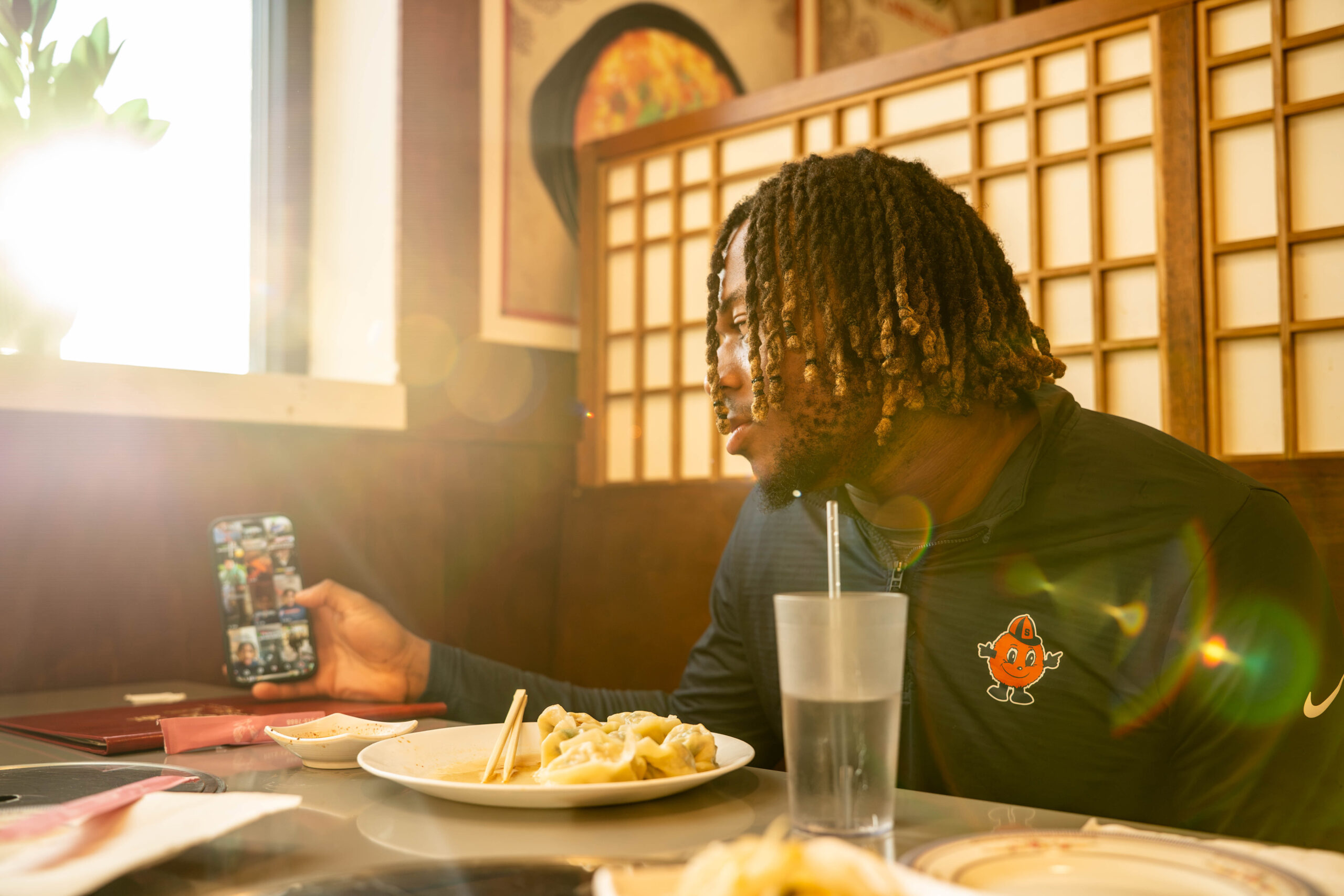
As a rule of thumb, Garvin tries not to return to the same restaurant. He’s breaking that rule today. Most Chinese restaurants are takeout only, so he came to Yang Di Chun because it has seating. Donning a navy blue Syracuse Nike Tech Fleece, Garvin walks in and slides into a wooden booth.
A man — as a matter of fact, the man — takes the order. The table leads off with a serving of egg, pork, chicken and shrimp fried rice noodles. Mmm, delectable. Next up? Just chicken fried rice noodles will do, please. Thanks.
The ball works around the horn to Garvin. All eyes are on him. No one knows what he’ll order, and no one knows how he’ll order it. The possibilities are endless. The Meta glasses aren’t on, but he could try flaunting his Mandarin regardless.
“Do you guys have pork dumplings?” he asks in English. “I’ll have your pork dumplings.”
Back in the car, Garvin said that, when he makes videos in Chinese restaurants, he gives the meal to homeless people. All he keeps are the dumplings.
The man returns to the kitchen.
“Last time I came here, I don’t know if he actually speaks Mandarin,” Garvin whispers. “I don’t know if he does. Because, like, when I spoke to him, he was confused as f-ck.”
He proceeds to explain that the man might know Cantonese and not Mandarin, because they’re two very different things. He uses his arms to hand-sign the different tones and minutiae that separate the languages, as if anyone who wasn’t placed in a Chinese immersion program could possibly understand what he was so valiantly trying to explain.
But Garvin can, because he was placed in a Chinese immersion program. From kindergarten until about fifth grade, he says, his school days consisted of roughly 80% Mandarin instruction and 20% English. The split evened out after that. By high school, he took just one Chinese course to prepare for college.
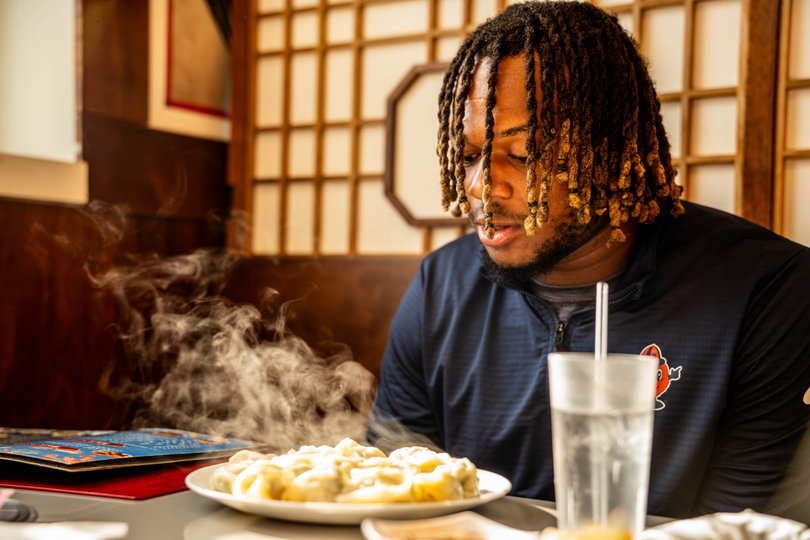
As he explains, the noodles come out. Garvin says something in Mandarin — “Thank you, this looks really good,” he translates — and the man doesn’t acknowledge it. Right behind him, a second man donning an apron brings out Garvin’s dumplings. Steam rises off the plate. Garvin thanks him in Mandarin, and this time, a smile breaks out on his face.
“I’m not gonna lie, these are really authentic,” Garvin says. “These are authentic dumplings. It’s just by the way they’re wrapped. I’m pretty sure that’s homemade.”
But it’s not like he’d know from experience. Growing up in Barrington, Illinois, a Chicago suburb, he says he had maybe one Chinese neighbor. Neither of his parents — Keisha and Alfred St. John — knew Mandarin. They placed him in the program because China’s economy was booming, and they figured it might be prudent for their son to learn its language.

Garvin St. John poses outside of Yang Di Chun BBQ with his Ray-Ban Meta glasses. St. John uses the glasses to record his interactions in Mandarin, a language he’s studied since his childhood in Barrington, Illinois. Zoe Xixis | Asst. Photo Editor
They were correct, but not in the way they expected. Inspired by his hometown friend, Blake Wendt, he began posting videos in November 2025. His main objective was improving his fluency. The content was simpler back then: videos of him looking into the camera, reading off a script, with captions like, “Day 1 of speaking Chinese every day.”
“He was just kind of filming with his hand on the phone,” said Layla Stone, Garvin’s girlfriend. “He wasn’t actually doing interactions yet.”
The Meta glasses changed everything. The restaurant videos hopped into the fray, as well as videos where he’d go to the mall and challenge random passersby to speak Mandarin for $20. His content has evolved so much, he says, that he now categorizes each video into one of three buckets: low effort, medium effort and high effort.
Low effort videos, for example, would be Chinese history videos. He can make those in five minutes — recording, editing, posting, all of it. Medium effort videos would be mall interaction videos. He can go to Destiny USA, talk to 20 people and crank out multiple videos from one trip. High-effort ones, he says, are restaurant videos. He has to go to a restaurant, order, wait for the food, then go back and caption it with English translation.
One video can take over an hour.
“He’ll just find time,” Stone said. “He stays up really late working on stuff.”
It’s a hard lifestyle, and Garvin knows it. Sure, there’s perks. The other day, a viewer recognized him at the New York State Fair. He says he’s made over $10,000 off TikTok alone. He’s had one-off video agreements with companies like Temu and Block Blast. Rainbet, a gambling company, offered him a deal that would’ve paid him several thousand dollars for eight videos a month, although he declined due to his student-athlete status.
But there’s also plenty of times when he’s reconsidered if this — both football and social media — is worth it. He says he feels burnt out sometimes. He says he feels burnt out right now. There’s some free time in his schedule. A lot of it goes to schoolwork. But the plate of pork dumplings before him has sat unfinished for hours, and he’s far from finished, too.
“I can only do this once,” Garvin says. “This is all I dreamed about as a kid.”
Two days after this conversation, he posted a story on his Instagram. The image is the interior of a restaurant. There’s three screens behind the counter, displaying dishes like pepper steak and sesame chicken. The location tag is Fortune Hawaii, a Chinese takeout spot in DeWitt. The caption is New Video !? !? He hadn’t made a new restaurant video in over a month, but there’s no better time to change that than now. The clip is going up the next morning.