Syracuse sticks with Steve Angeli at QB. Psychology might explain why.
Get the latest Syracuse news delivered right to your inbox. Subscribe to our sports newsletter here.
Why do we inflate the value of the rickety IKEA chair we spent an afternoon assembling? Why does a LEGO set become more precious after we painstakingly snap every piece into place?
And why do sports fans continue believing in teams that have given them every reason not to?
Psychologists have a name for it: effort justification. The more we invest in something — time, energy, suffering — the more we try to convince ourselves it’s worth it.
Maybe that explains why Syracuse is sticking with Steve Angeli.
After the bye week and entering a clash with UConn Saturday, Syracuse head coach Fran Brown said Angeli will remain the Orange’s starting quarterback, despite the redshirt senior throwing five interceptions over SU’s past two games, losses to Cal and Pitt.
Although Brown said more than one quarterback will play against the Huskies, he’s invested enough in Angeli “to stick with what we’ve been doing.”
“He’s the quarterback, and after two games of not playing the way that you want to play, or he didn’t play his best football, it’s hard to be able to just turn away from someone like that,” Brown said. “Someone who’s done such a good job, someone who’s fought through injury to come back to be able to play.”
Whether he knew it or not, Brown echoed the crux of effort justification. And, as laid out in L. Jon Wertheim and Sam Sommers’ 2016 book, “This is Your Brain on Sports,” the psychological theory clearly applies to sports.
Wertheim and Sommers’ chapter on the subject summarizes it simply: “We often come to love that which we suffer to achieve.”
There’s no denying Angeli and Syracuse have suffered. The quarterback tore his Achilles on national television in the Orange’s win at Clemson on Sept. 20, 2025. SU released a 28-minute documentary before the season following Angeli’s recovery. He regained feeling in his left foot, comparing it to stepping onto sand for the first time. He assiduously lifted marbles, one by one, from the floor with his foot and dropped them into a container. He learned to walk and run again. He watched SU practice from a seated mobility scooter.
Elise Flannery | Design Editor
“There’s a lot of stuff you can learn when you hit rock bottom,” Angeli told The Daily Orange in December 2025. “Understanding who you are when you hit an extreme low point in your life, there’s a lot of value in that. My mindset is to attack. That’s how I look at it, facing these problems head-on.”
The Orange languished for an extended period, coinciding with Angeli’s injury. They lost their final eight games of 2025 by an average of 27.5 points.
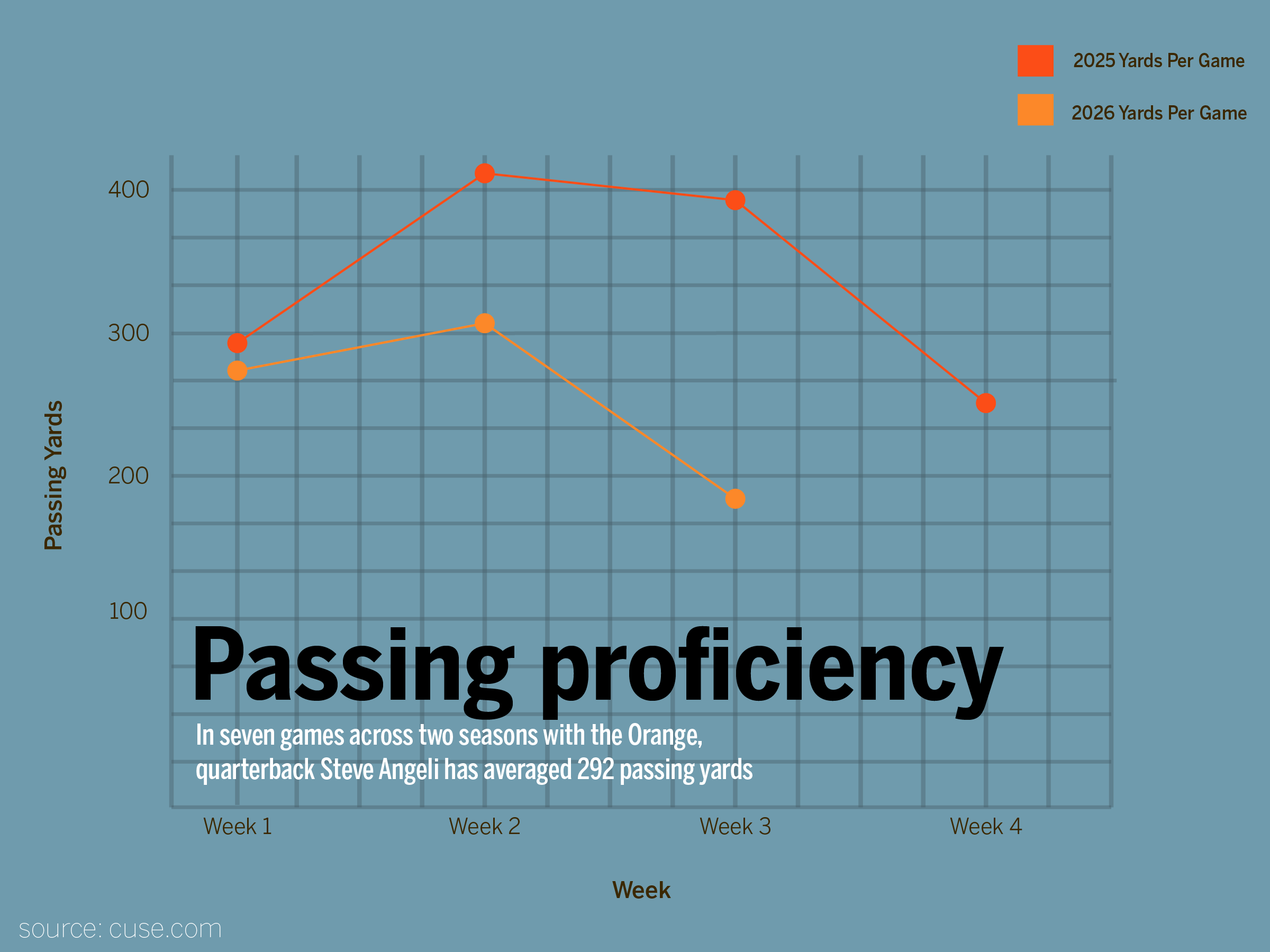
Despite Brown picking up three signal-callers — Amari Odom, Malachi Nelson and Danny Lauter — with starting experience after saying his greatest lesson last season was to have backup quarterbacks, it wasn’t surprising a fully-recovered Angeli started Week 1. He was second in the Football Bowl Subdivision in passing yards through four games in 2025 and picked up where he left off with three touchdowns and 263 yards versus New Hampshire in SU’s opener.
However, Angeli’s form quickly dipped. He’s committed eight turnover-worthy plays, per Pro Football Focus, tied for the most by a player who’s played three games. ESPN released a list Wednesday ranking all 68 Power Four starting quarterbacks thus far. Angeli was dead last.
“For me, really, just everything,” Angeli said after the Pitt loss regarding what he needed to work on during the bye week. “I want to make sure I get the ball in my hands, complete more passes, score more touchdowns. Just figure out how to improve overall, and I’m confident in my ability to go out there and do that.”
Brown is confident in Angeli’s ability, too. It matches real-life examples of effort justification. The extreme lengths we go to obtain a product invariably influences our assessment. Whether that’s stocks in our portfolio we worked especially hard to find, the sweat-soaked, do-it-yourself home improvement project or the backup quarterback you plucked — like Angeli at Notre Dame — who delivered flashes of brilliance as a starter.
“It’s disrespectful to state that there’s going to be a quarterback competition to Steve,” Brown said after falling to Pitt. “I think he’s done a great job there in helping build the culture of being a quarterback.”
Coaches and teams often assign greater subjective value to players who have been especially challenging or labor-intensive, Wertheim and Sommers argue.
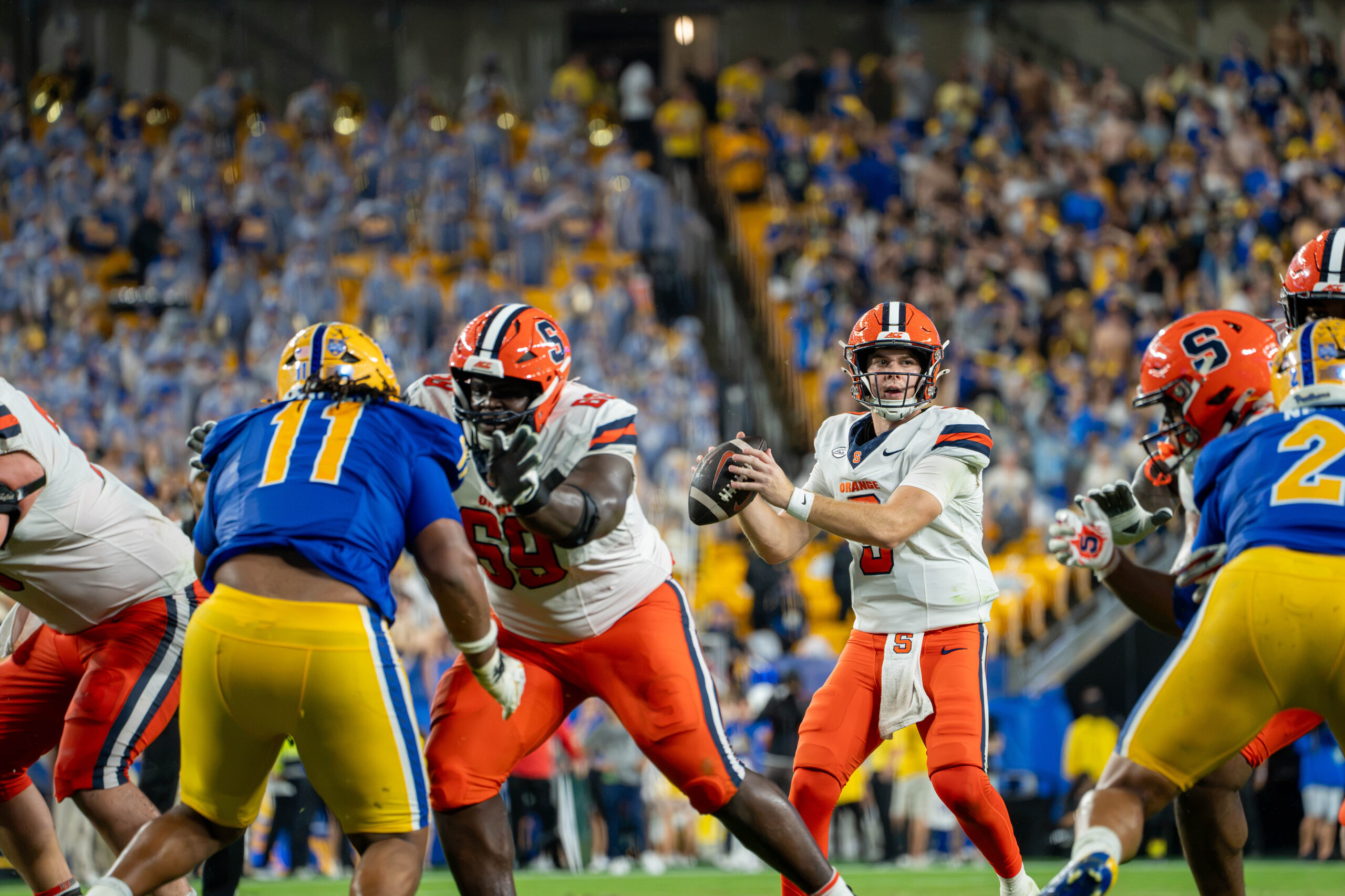
Syracuse quarterback Steve Angeli scans downfield in a 27-13 loss to Pittsburgh on Sept. 17. He was benched in this game, but psychology can explain why the Orange will stick with him Saturday. Zoe Xixis | Asst. Photo Editor
This concept has a precedent involving NFL quarterbacks. Philadelphia Eagles quarterback Carson Wentz was named the starter before the 2018 season, even though his backup Nick Foles had guided the Eagles to a Super Bowl title that February after Wentz tore his ACL late in the 2017 regular season. Foles was even the game’s Most Valuable Player.
Wentz was the No. 2 pick in the 2016 NFL Draft. He had a sparkling start. But despite never reaching the same level post-injury, Philadelphia still named him starter in the 2018, 2019 and 2020 seasons. In that final campaign, he threw 16 touchdowns and 15 interceptions and was benched for rookie Jalen Hurts. The Eagles finished 4-11-1, and Wentz was traded a month later.
Wentz and Angeli’s tales share clear similarities. Angeli had a promising start and suffered a gruesome injury. SU has an experienced backup in Odom, who went 8-for-8 in Syracuse’s final drive against Pitt when Angeli was benched.
An economist might call it the sunk-cost fallacy. Once we’ve invested heavily in something, walking away gets harder.
The Orange made an investment in Angeli and are resolute on sticking with it, even to their own detriment. We might do the same, whether devouring an entire pizza to get our money’s worth or sitting through a terrible movie or lopsided sporting event because we paid a pretty penny for the ticket.
In Syracuse’s case, it’s already suffered abundantly with Angeli. He got injured, and the Orange’s 2025 season was an embarrassment. Then, in the offseason, they hired a new quarterbacks coach, Sean Ryan, with NFL pedigree, to optimize a replenished, deep unit.
Wertheim and Sommers conclude the more we suffer, the more we come to love what we’ve suffered for. Be it an IKEA desk, your favorite team or the player who touches the ball every offensive snap.
Angeli may have said it best in one of his many laconic answers after being asked about trends in his interceptions.
“You just got to make a decision in football,” he said Tuesday.
Brown has made his. He’s decided to stick with Angeli.