


O
STERVILLE, Mass. — The sun was shining when they landed in San Diego. Jim Lee heard it’s like that year-round. He had no choice but to believe it, because no man had taken the Orange basketball program this far from Syracuse and its sub-zero forecasts until then. In March 1975, it might’ve been Mars to those runts making the trip to SU’s first Final Four. They stepped off the plane thinking life would never be the same when they returned, as if they were the first college kids to believe nothing matters more than the present.
“That was the thing,” said Earnie Seibert, a center on that team. “You were just caught up in the tidal wave of activities, interviews, banquets and practices. It just went so quick.”
Everything passed them by, even the man who led them there. His name was Roy Danforth. He coached Syracuse to its first Final Four, left for Tulane a season later and watched his successor build on everything he’d done. Now, the prevailing sentiment among members of that Final Four team is they never received the respect they deserved, even then. Shortly before they left for San Diego, SU’s athletic director told Lee their equipment manager couldn’t travel with them.
The football team needed him for spring practice.
“When we were in school, (the football team) had losing records,” Lee said. “And it was more important than going to the Final Four.”
The history of Syracuse basketball is now told in two distinct epochs. There’s everything that happened in Jim Boeheim’s 47-year Hall of Fame run — over 1,000 wins, five Final Fours, a national championship — and everything that’s happened since. “The feeling is that basketball around here didn’t start till Boeheim took over,” said Steve Shaw, a forward on Danforth’s Final Four team. There’s little room for anything that existed before.
Rudy Hackett was one of the leaders on Danforth’s first Final Four squad. In his words: “No one knows who’s making skyscrapers until the name goes up there at the end,” because people seldom stop to consider how the things around them came to exist.
People seldom stop to consider how Syracuse became Syracuse.
“Roy was the coach when it all got started,” said Tom Green, one of Danforth’s assistant coaches with the Orange. “He’s kind of been forgotten along the way.”
Eleven years ago, after four decades without recognition, Syracuse celebrated Danforth’s Final Four squad. SU’s athletic department hosted the team’s first reunion on Jan. 30, 2016, during an Atlantic Coast Conference matchup.
Thus, the legend of the 41st-anniversary reunion — the most overlooked celebration for the most overlooked team in Syracuse history — was born. “We always laugh about it,” Shaw said.
“Who has a 41st anniversary?”
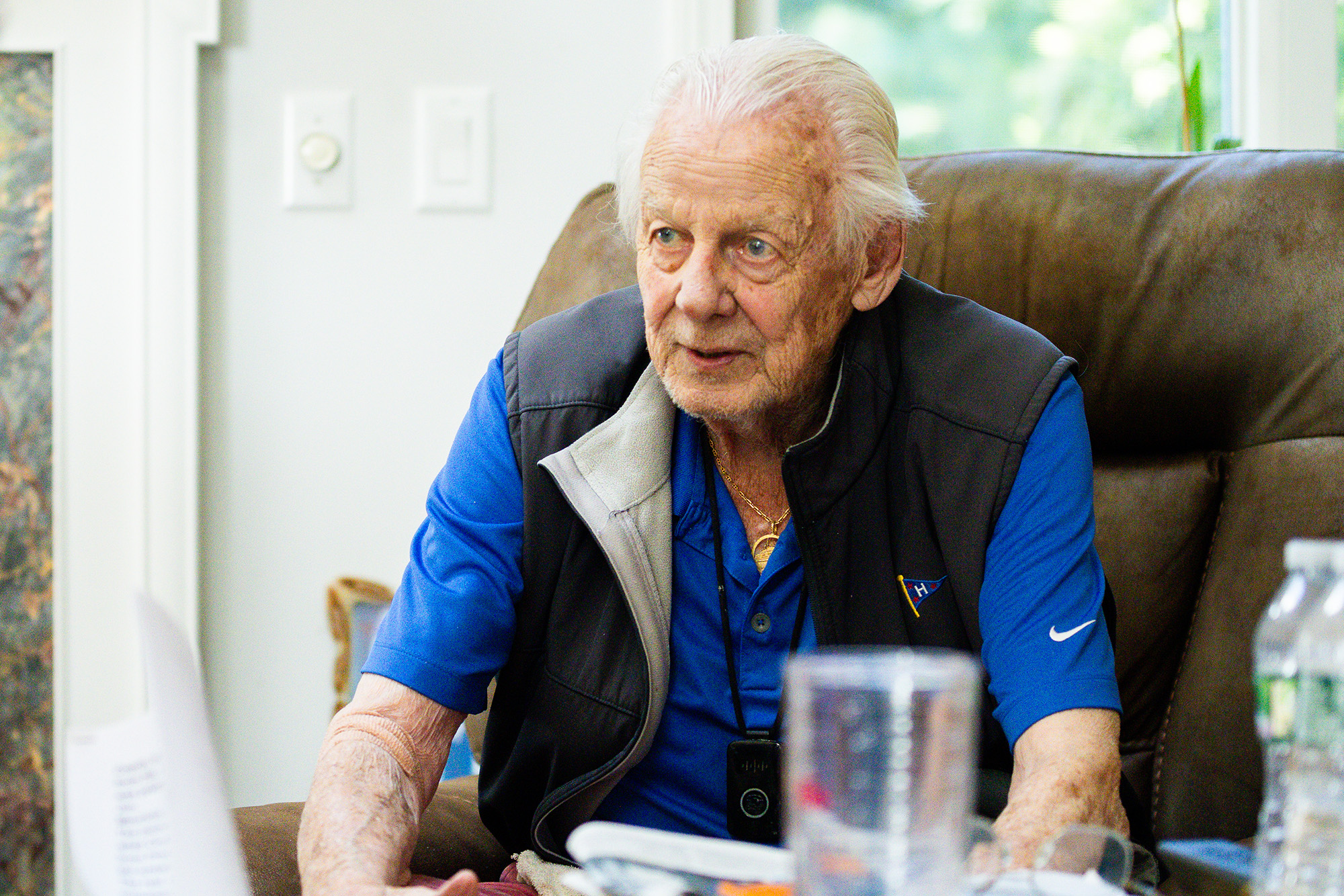
Roy Danforth speaks with The Daily Orange in his Cape Cod home on July 27. Danforth was Syracuse men’s basketball’s head coach from 1968-76, leading SU to four NCAA Tournaments and its first-ever Final Four. Courtesy of Alistair Hennessey
• • •
THE DOOR’S AJAR, but barging in would be impolite. A couple light taps will do.
Knock, knock.
“Come in!” a woman says, knowing her husband is expecting visitors. They’re about 45 minutes late, which would’ve mattered more if it wasn’t a Monday, or if his days consisted of anything other than going to the Hyannis Yacht Club.
“They’re closed on Mondays,” Danforth would later say. “Or you wouldn’t be here.”
Danforth’s second wife, Alicia, walks into the living room, where her husband sits in a brown lounge chair on this July afternoon. There’s a walker to his right, a cane in his lap and a foldable wooden TV tray in front of him. He apologizes for not rising to greet his visitor. It’s been a while since he could walk on his own. He used to be an avid golfer, but he hasn’t played a round in two years. Alicia helps him with just about everything.
She brings out a glass of water and sets it on the TV tray. “Why don’t you bring him it in a bottle?” he asks her.
“No,” Alicia replies, making him laugh. “That’s not nice.”
Danforth’s wearing red trousers, leather loafers and a blue Nike polo with a gray sweater vest over it, which he got from — you guessed it — the Hyannis Yacht Club. He has a relatively full head of hair, just as he did when he manned Syracuse’s sideline. It’s been 50 years since he jumped to Tulane and ended his eight-year run as SU’s head coach. He retired decades ago to spend his days in the sleepy Cape Cod community of Osterville, Massachusetts.
This past January, Danforth turned 90. “I’m not going to be around much longer,” he says.
Lee’s determined to get his coach into SU’s Ring of Honor while he’s still here to see it.
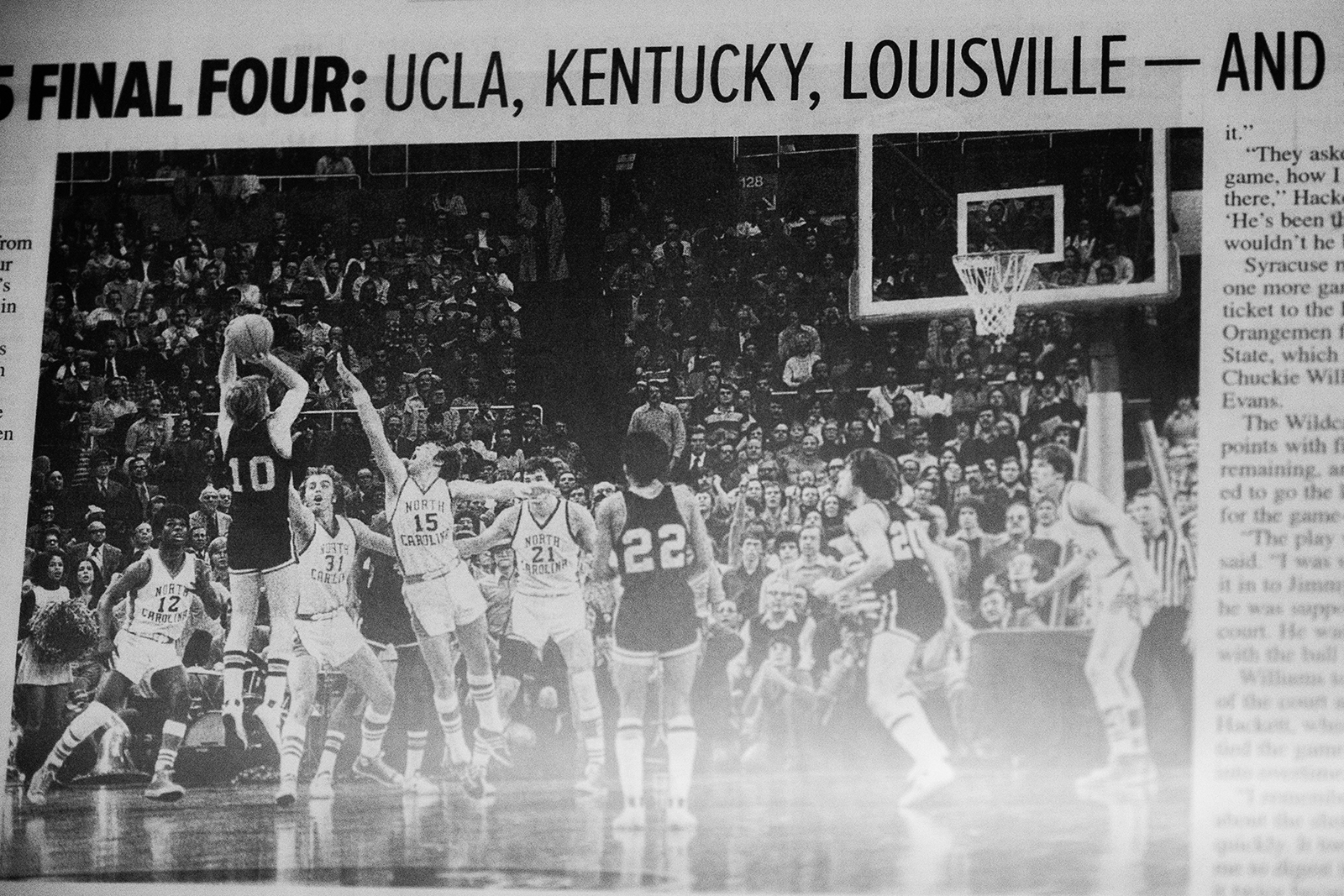
A story from the Syracuse Post-Standard, highlighting SU men’s basketball’s trip to the 1975 Final Four, hangs in Roy Danforth’s Cape Cod basement. The article is one of many pieces of memorabilia scattered around Danforth’s home. Courtesy of Alistair Hennessey
This is the man who took the Orange to four straight NCAA Tournaments, as well as their first Final Four. This is also the man who hired Boeheim as an assistant, inadvertently making the most consequential decision in Syracuse basketball history. There’s little evidence of his achievements in his living room. Perhaps that’s how he’d like it. When he first started going to the yacht club, he tried to hide his past life, but those efforts failed years ago.
“Sometimes, it’s good not to be who you are,” Danforth says.
So, this conversation begins in a place where Roy Danforth wasn’t Roy Danforth yet: Summitville, “probably the smallest city in Indiana,” a town of about 1,000 people. His high school didn’t have enough students to field a football team, which never bothered him. He always preferred basketball.
“If you don’t play basketball in Indiana,” Danforth says, “you can’t get laid.”
“Oh, God, Roy,” Alicia says, laughing from the kitchen.
He didn’t garner much attention from college coaches, though. Danforth was lightly recruited out of Summitville High School, earning two scholarship offers from schools he chose not to disclose. He didn’t like either offer, so he enlisted in the military. After meeting a Southern Miss alum in the army, he ended up with the Golden Eagles, became their starting point guard and played under future Syracuse head coach Fred Lewis.
Out of college, Danforth turned down an offer from The Dow Chemical Company to be a Southern Miss assistant coach. He later accepted a head coaching job at Pearl River Junior College in Poplarville, Mississippi, where he spent a year before joining Lewis at SU.
“I was at Syracuse 13 years,” he begins.
Danforth pauses, then exhales. A few seconds pass. His mind’s elsewhere, recalling memories and stories and faces and places, all at once. Sitting in his chair, he carefully considers his next words.
“… had a great career.”
• • •
THE CONVERSATION DRIFTS to Boeheim, as it tends to do when the topic is Syracuse basketball. The two are now synonymous. Danforth discusses him for just under two minutes — what he was like as a player, how he got hired, etc. — before he stops.
“We won’t talk about Boeheim,” he says.
Almost nothing in this world is the same as it was five decades ago.
It’s been 58 years since Danforth replaced Lewis and hired Boeheim as his assistant. Bill Finney, a Syracuse forward from 1968-72, says it happened after a blowout loss to La Salle. There was tension among players who felt they weren’t getting enough coaching attention, Finney says, and they’d seen other schools use assistants to help.
They felt Danforth should add one, so he did. The players recommended Boeheim.
“If it wasn’t for him,” Boeheim told The Daily Orange, “it wouldn’t have ever happened for me.”
The two complemented each other well. Danforth led practices and in-game coaching, while Boeheim focused on Xs and Os, handling scouting reports and film review. Together, they engineered the 2-3 zone, the same one Boeheim made famous.

During a visit to Martha’s Vineyard, Bill Finney (left) poses with his former head coach Roy Danforth (right). Finney played 61 games for Danforth from 1968-72, averaging 5.3 points and 2.6 rebounds. Courtesy of Bill Finney
Syracuse’s two assistants, Boeheim and Green, shared an office, and Danforth often stopped by to bounce ideas around. Boeheim and Danforth were closer then, often sharing postgame dinners at Danforth’s house. Fifty years later, they fondly remember that first Final Four team and how it felt to return to Syracuse in the dead of night to thousands of fans waiting at the airport.
“It was crazy,” Boeheim recalled. “Just unbelievable.”
But then Danforth recommended Boeheim for the head job, and Boeheim gained five more Final Four teams to remember, including his national championship squad. Their bond faded over the years. Thirteen years ago, Danforth was quoted in the Cape Cod Times saying they hadn’t been in touch since he left Syracuse.
“Boeheim doesn’t talk to anyone,” Alicia jokes from the kitchen.
Lately, those bridges have partially mended. It’s been two years since Green last called Boeheim, but he said they’d previously been calling at least once a year. “I really should think about picking up the phone, even today, and just giving him a call,” Green recently said.
When asked about their relationship after Danforth left SU, Boeheim said, “We’d talk every year, and stuff.” Sitting in his living room, Danforth repeats that he hasn’t spoken to Boeheim since leaving Syracuse. The truth lies somewhere in between.
Overhearing the conversation, Alicia tells Danforth he’s wrong — he last spoke with Boeheim on Feb. 8, 2025, at the 1975 team’s 50th anniversary reunion in Syracuse.
“He came over to you,” Alicia says, jogging his memory. “And you spoke to him first.”
• • •
SPEAKING OF the 50th anniversary reunion, Alicia has another story to tell. That day, they were honored in a halftime ceremony during a matchup between SU and Boston College. As they walked off the court, Alicia swears she heard a fan yell out to her husband.
“They said, ‘Roy Danforth, you should have been our athletic director!’” Alicia remembers.
He thinks so, too. Danforth leans in, adjusting his forearms as they rest on his legs. “He wasn’t real happy with how things turned out for him at Syracuse, beyond coaching,” Green said. In 1973, Syracuse hired Les Dye — its dean of admissions — as athletic director. When Danforth heard the news, he called one of SU’s vice presidents.
“I’m interested in being the dean of admissions,” he said.
“What the hell do you know about being dean of admissions?” they replied.
“Just as much as that guy you hired knows about being an athletic director,” he bristled.
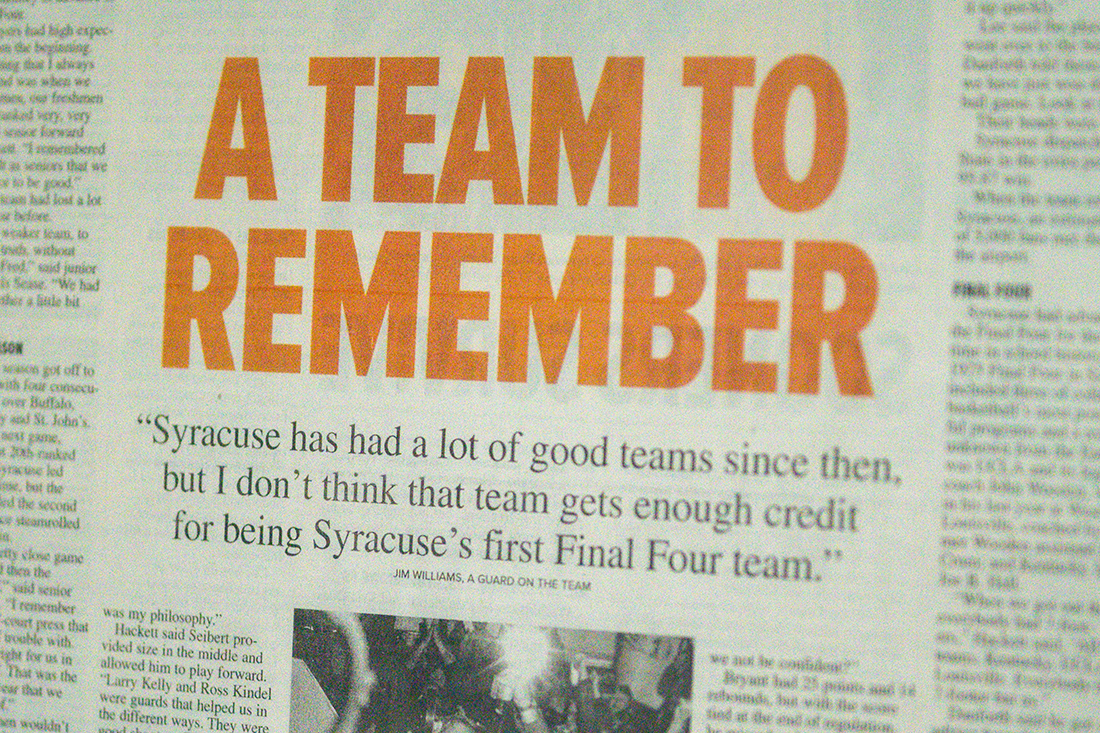
An article about Syracuse’s 1975 Final Four run. The Orange’s trip to San Diego that year was one of Roy Danforth’s favorite memories across his eight-year head-coaching tenure at SU. Courtesy of Alistair Hennessey
Being a Division I college basketball head coach was Danforth’s biggest aspiration, until being a D-I athletic director replaced it. In 1976, he left for Tulane with that goal in mind. His reported $30,000 salary — more than Boeheim’s $25,000 opening pay — was a plus, but he won just 45 games in five seasons in New Orleans. He coached his last game in 1981 and became Fairleigh Dickinson’s athletic director in 1986.
Danforth still doesn’t know what went wrong at Tulane. He says he doesn’t live with regret, that people who do are in bad shape, but he’s also an honest man. He won’t hesitate to admit it.
You don’t wish you stayed at Syracuse a little longer than you did?
The answer, honestly, is yes. He does wish that. He says he doesn’t miss a game. He doesn’t remember what he felt in 2003, watching Boeheim claim SU’s first national championship.
But he vividly remembers 1975, and San Diego, and beating North Carolina in the Sweet 16 before that. He doesn’t break eye contact as he recounts it: Bobby Parker came in off the bench to guard the inbound, causing a turnover with five seconds left; the ball got to Hackett, who kicked it out to Lee, who sank his shot and the Tar Heels at once. Everybody asked Hackett how he knew Lee would be where he was.
“He’d been there for three years,” Hackett said. “And I expected him to be there then.”
Danforth eases back in his chair, sinking into its cushions. “Time gets away from you,” he says.
• • •
ASK ANYONE. Fifty years later, they could never forget Danforth’s pithy one-liners.
Entering the Final Four, Lee says, Danforth likened SU’s appearance to Jesus walking on water. After giving up a then-NCAA record 68 points to Niagara’s Calvin Murphy in 1968, Finney remembers Danforth joking that Murphy could’ve had 136 if they let him go to both his right and left. Shaw recalls Danforth once telling reporters that instituting a shot clock would be unfair to Seibert, who couldn’t make it down the court in 28 seconds.
“He liked to be on stage with his jokes,” Seibert says. “Sometimes, I would become the brunt of those jokes. You just gotta get to the point where you ignore them.”
Danforth is a people person. He’s always been one. He proudly says he was the president of Summitville High School’s class of 1954. It is who he is, just like how a basketball coach was who he was. He says, above all, he wants to be remembered as a “nice guy.”
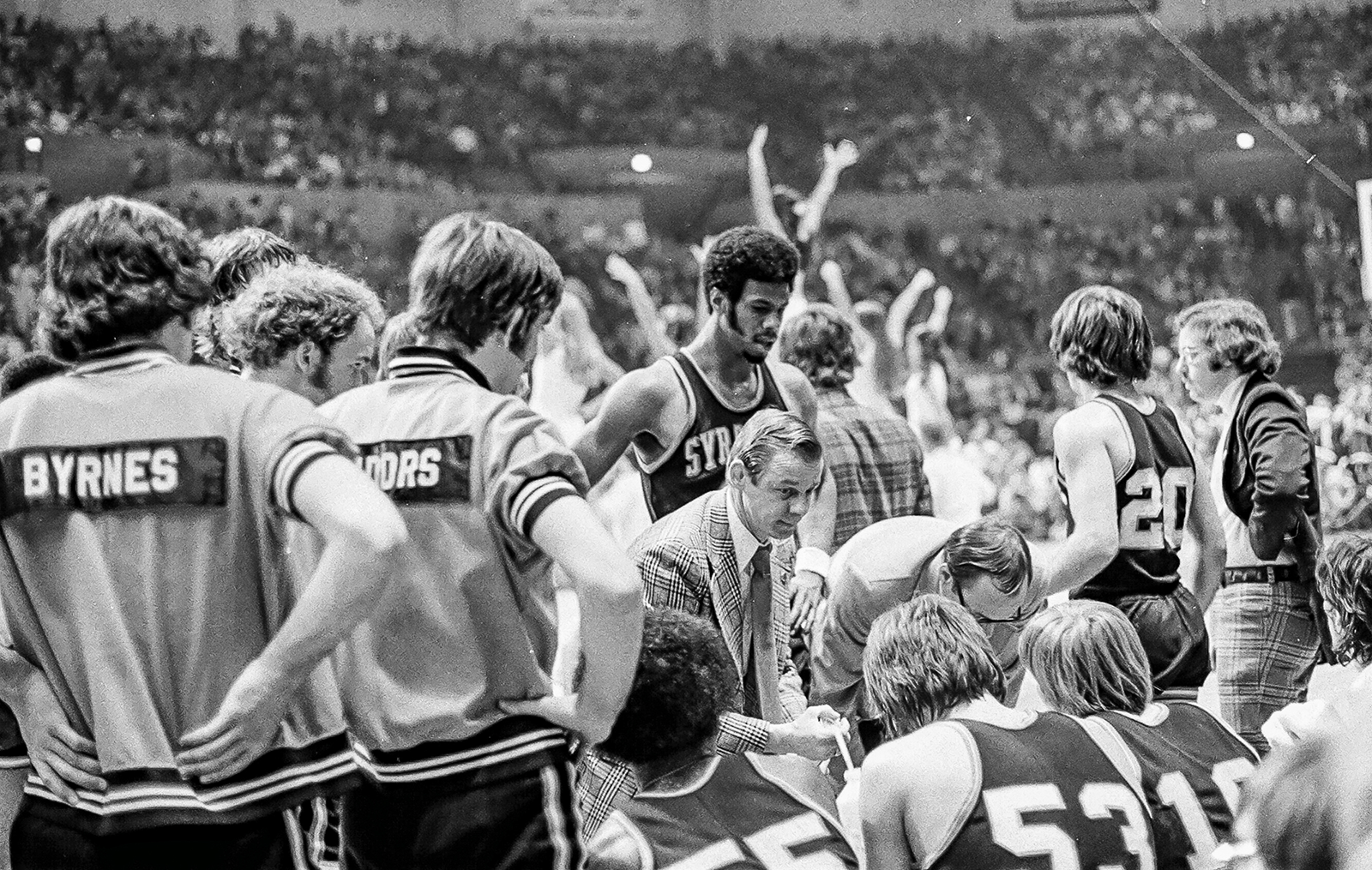
Roy Danforth huddles his Syracuse team during its 1975 Final Four game against Kentucky. The Orange lost that matchup, but Danforth’s tenure shaped the future of SU men’s basketball. Courtesy of SU Athletics
“I love Syracuse, still love Syracuse,” Danforth says, before briefly pausing. “Although …”
He stops again. It feels longer than the two seconds it is. Danforth’s in a boxing match with himself. The urge to say it all sits in one corner, the urge to say nothing at all in the other. Lee said Danforth has previously wished he received more credit, both for his accomplishments and hiring Boeheim. During a 2017 visit to Martha’s Vineyard, Danforth told Finney he “felt that his Final Four team never got anything from Syracuse.”
But it’s been a while, and a lot has changed since then. Lee and Hackett had their jerseys retired last February. Danforth brims with pride as he talks about it. His achievements currently live in his basement, a room littered with paintings and plaques and almanacs and a framed 2016 story from the Syracuse Post-Standard reliving his Final Four run. He could remember Syracuse for what it didn’t do for him, or he could remember it for what it did.
The decision is his to make.
“I’m not going to say this. I don’t want to say that,” Danforth says, letting out a chuckle. “I don’t want to say anything derogatory — I’m not a derogatory kind of guy. I’m all positive.”
Right then, he pulls out two packets. They’re copies of a long text from Finney, full of memories and musings about their time together. The message is best summarized by this excerpt:
Roy Danforth didn’t build the dynasty, but he built the runway that allowed the next 50 years of Syracuse basketball to take flight.
“I got a few thoughts,” Danforth says, flipping through his legacy for the first time.
There’s wonder in his eyes, like a child on his first visit to the zoo. All of this information is new to him. If pages are like portals, these ones take him to a time and place he should visit more often than the two occasions he has in the past half-century. The stories come easier here, so Danforth begins another one: On March 20, 1972, he left Madison Square Garden upset after a loss to Maryland; he ducked into a hotel bar down Lexington Avenue, surrounded by fans, and forgot his first wife, Carolyn, in the stadium.
One thought runs into the next, and now he’s talking about Carolyn. He still remembers how Syracuse gave her a free car, and allowed her to host a TV show. It was supposed to be about basketball; Danforth says it was about “bullsh-t.” But that’s inconsequential, anyway. Shows run their course, and cars break down. Feelings don’t come with expiration dates.
The first thing he said about Carolyn, before he called her show “bullsh-t,” was that Syracuse loved her. A few minutes before that, he said he thinks Syracuse loved him then, too.
He’d like to believe it still does now.
Collage by Ilana Zahavy | Senior Staff Designer
Courtesy of Alistair Hennessey, SU Athletics