‘Syracuse Style’ models city’s diversity to fund CNY food bank
Get the latest Syracuse news delivered right to your inbox.
Subscribe to our newsletter here.
Upon entering the Everson Museum of Art, different expositions of style came to life as faces of models were concealed by reflective masks, and blankets were turned into jackets.
“You see Syracuse in diversity. I mean, people from all over the world. It’s kind of beautiful.” said Lisa Butler, former executive director of Syracuse Fashion Week.
On Friday, the Everson hosted “Syracuse Style,” a fashion show with 11 designers and 80 models in support of The Food Bank of Central New York. Presented by Syracuse Fashion Week, the event not only marked the end of the organization’s current fashion season, but also the conclusion of Butler’s tenure as executive director after over a decade.
When Butler started Syracuse Fashion Week in 2014, she knew she wanted philanthropy to be at the forefront of its mission.
After watching “A Place at the Table” about hunger in America, Butler was struck by the number of working families, young people, children and senior citizens that had been deeply affected by food insecurity, she said.
In hopes of connecting her love for food and fashion, Butler took a chance and reached out to the food bank, signifying the beginning of a special partnership — one that would last over a decade.
“When she started this all, Lisa could have chosen any charity in central New York,” Michael Benny, the host and emcee of the show, said.
In the early stages of developing Syracuse Fashion Week, Butler watched as other fashion weeks in central New York, from Rochester to Buffalo, took shape. However, Syracuse wasn’t exactly known as the fashion capital of New York.
Still, Butler said she took a chance and hasn’t looked back since.
“When you create a fashion week out of nothing, you just hope that people are gonna show up,” Butler said. “And they did.”
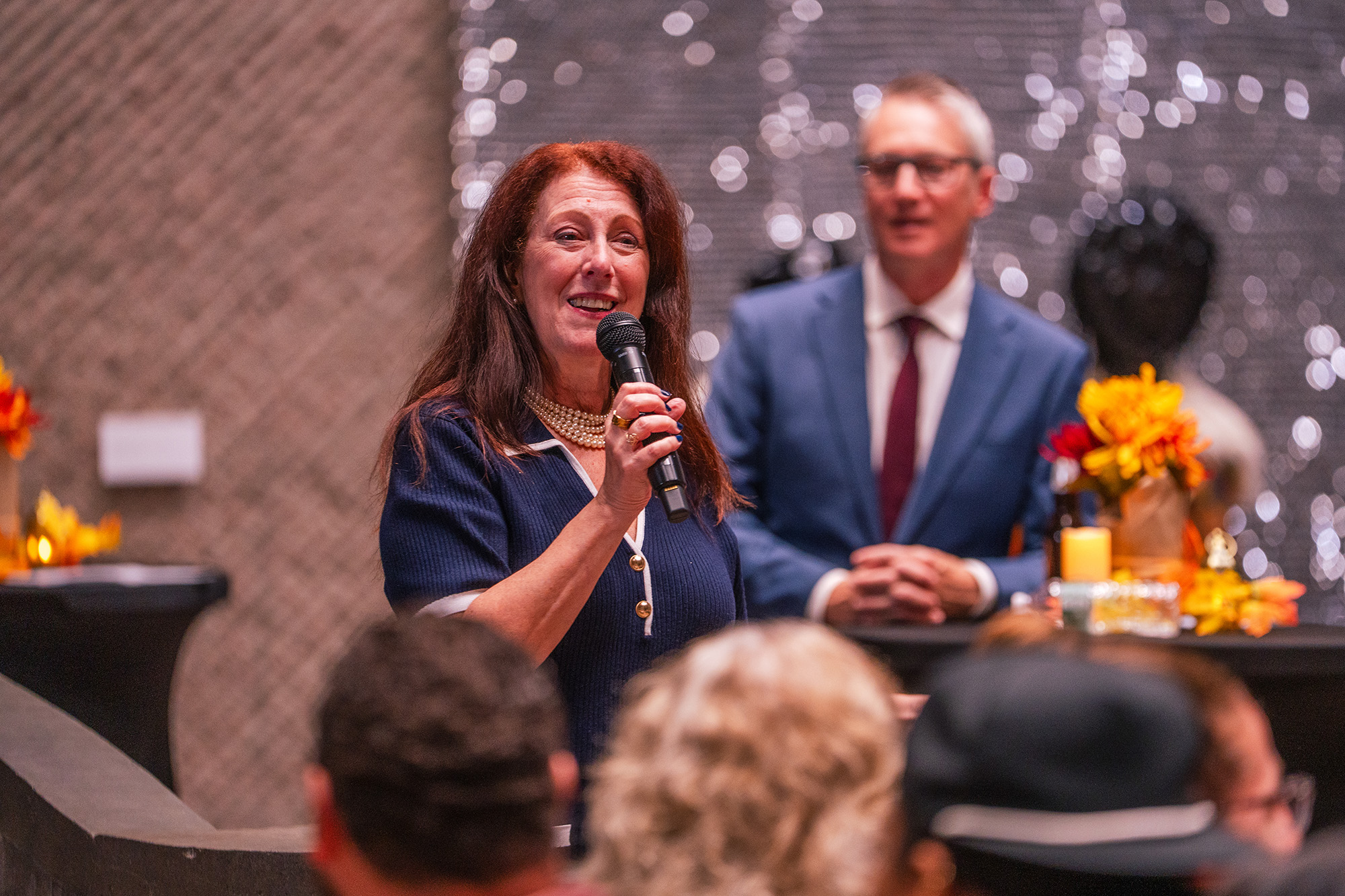
Syracuse Fashion Week Executive Director Lisa Butler delivers her final speech to the crowd. After 10 years, Butler is stepping down from her position. Courtesy of Dennis Fernando
Over time, the Syracuse community began to embrace the yearly event. Even after the disruption of the COVID-19 pandemic, Syracuse Fashion Week continuously attracted more people year after year. Every hiccup only propelled Butler to keep working, she said.
During her final show as executive director Friday, Butler’s longstanding relationship with the Food Bank of Central New York reached one of its most meaningful milestones.
Across their partnership, Syracuse Fashion Week has raised over $25,000 for the Food Bank, providing 75,000 meals to people across central New York, Benny said. Butler became emotional when Benny described her as a “hunger hero” during his remarks.
Even more than its charitable commitment, Syracuse Fashion Week has always been about showcasing a standout value of this city — its diversity, Butler said.
“Syracuse is such a multicultural city,” Butler said.
Butler made sure the designers chosen for her final show reflected that. Some designers include Salt City Wearhouse’s American styles, QueenRi’s Boutique latest in African fashion and the avant-guard storytelling of Maison Mariella Sheree’s designs, each interpreting what it means to possess style in the most authentic form.
“Picture someone fashion-forward, culturally aware, and unafraid of presence, someone who treats getting dressed like an act of authorship,” Mariella Sheree said.
Pieces from Sheree’s collection and Stiletto Love Boutique embraced the show’s theme of authenticity. From oversized bows and leopard print to fabulous fur and embellishments, some pieces from Stiletto Love’s “Cocktail Gone Wild” collection sparkled down the runway.
For model Rosalinde Ziporah, who walked for Stiletto Love, the eccentricity made the clothes even more exciting to wear.
“There’s so much expression that is possible in how we dress and how we put ourselves out in the world,” Ziporah said.
WHAT YOU SHOULD READ NEXT
Syracuse Fashion Week struts 9 brands to thunderous applause at new venue
Models strutted the runway at the ninth annual Syracuse Fashion Week’s fall fashion show on Saturday evening.
For some fashion designers, inspiration can come from anywhere. Some choose to pull from their daily observations and the world around them while others look inward at their own experiences.
Michelle DaRin of Michelle DaRin Jewelry chose the latter.
For her graduate degree at Syracuse University, DaRin depicted herself and her five siblings through six life-size sheep made of wool, steel and bondo. Five were white, while the sixth was black, representing DaRin, who was described as the family’s “black sheep” by her sister when she was 9.
“My work has been sort of a catharsis for a lot of emotional being that I have endured,” DaRn said.
DaRin combined her SU undergraduate and graduate specializations in sculpture and metalsmithing into her clothing. Rather than simply designing for the sake of putting more clothing into the world, DaRin posed an approach to the inevitable consumerism that comes with being a lover of fashion, she said.
From blankets and bedspreads, to vintage textiles, leathers, furs and other materials, DaRin utilized items that may have at one point been discarded and gave them new lives.
Even after her portion of the show had concluded, DaRin’s storytelling never stopped. Her black sheep sculpture was displayed alongside one of a lion, representing a duality of qualities that can coexist in a person. DaRin described contrasts of light and dark, power and softness, as well as predator and prey that can be explored. It’s about “figuring out your lamb and lion,” she said.
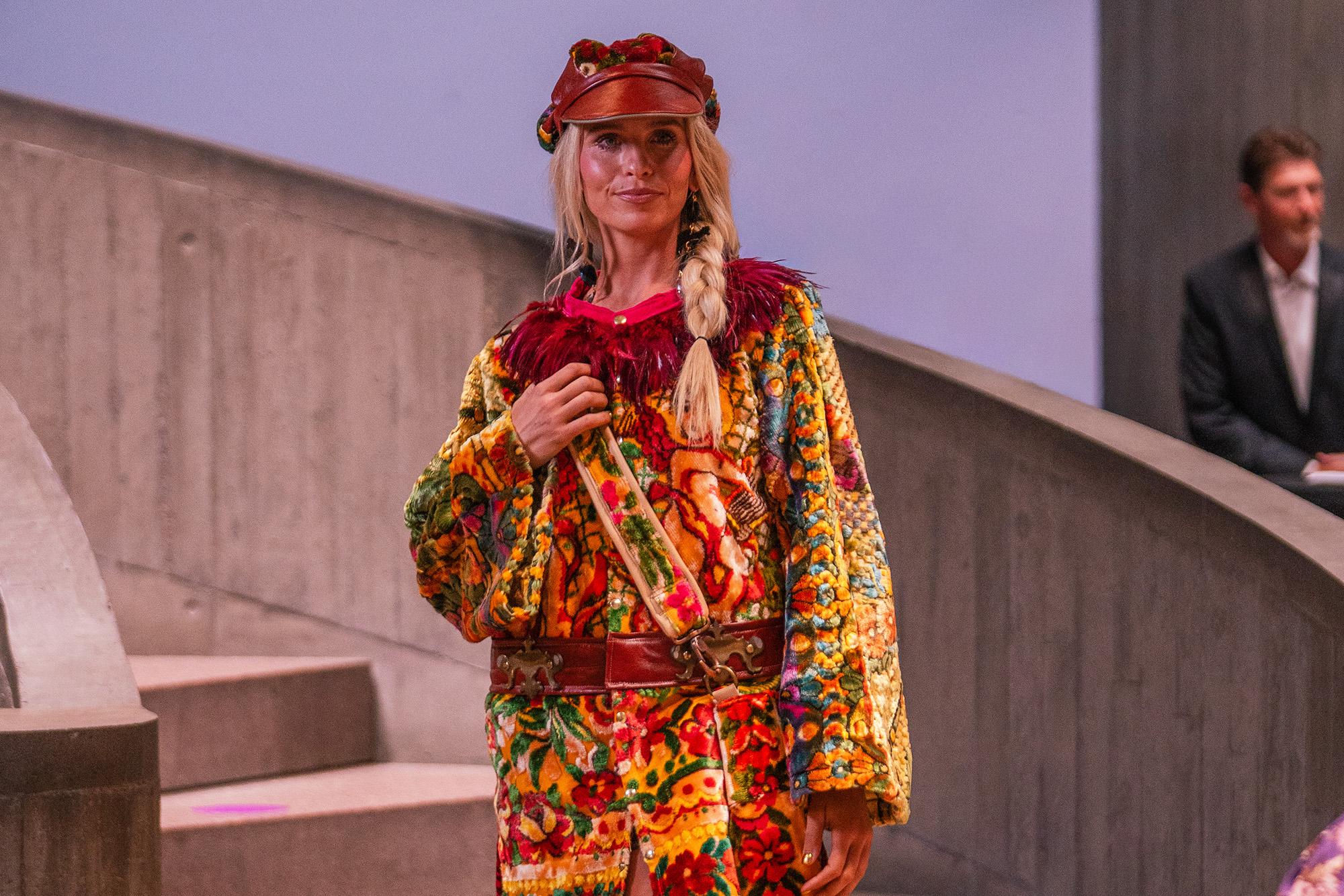
A model wearing a design by Michelle DaRin walks down the steps of the Everson Museum of Art. Darin’s collection represents herself and her five siblings. Courtesy of Dennis Fernando
As the night approached its finale, Maison Mariella Sheree closed the show with her “Emotions in Color & Form” collection. Sheree treated the body as a “canvas,” using her models as only an extension of her art while creating tangible emotion that was felt throughout the audience, Benny said.
The avant-garde looks had the ability to command the attention of every patron in the room. The models came down the Everson’s steps in reflective silver masks, directing all the attention to the captivating silhouettes displayed on their bodies. Whether it were the exaggerated collars rising behind the heads of the models or the whimsical, multicolored butterfly appliqué, attendees were entranced in the world of Sheree.
As the models’ faces were covered, it forced the audience to focus on the clothing, rather than their appearances. Once the masks came off and the matching avant-guard makeup was revealed, the look could be understood in its entirety.
For Sheree, this collection struck on a deeply personal note. She described herself as a “fashion engineer and storyteller” and said her designs are a combination of heritage, emotion and her lived experience while having the structure and precision from her background as an artist.
“Every piece is engineered like a sculpture, but it’s meant to be lived in like a memory,” Sheree wrote to The Daily Orange.
For many of the designers, fashion has never been just clothes. From the exhilarating feeling Ziporah gets modeling them, or the emotional catharsis felt from Darin, to the artistic confluence of Sheree, these pieces are reflections of lived experience. And the perspectives, emotions and questions that stick in the minds of attendants from the moment they leave the show is why.
“For me, fashion isn’t just decoration; it’s a language.” Sheree said.