

W
hen George Saunders first arrived at Syracuse University as a graduate student, he was in his late 20s and had just finished reading Douglas Unger’s “Leaving the Land.” On Saunders’ first day of school, he wandered up the Hall of Languages’ fourth floor. Then, Unger walked over to him.
“I’d never really met a writer who published at that level before, and I walked in, and he introduced himself,” Saunders said. “Immediately it wasn’t teacher to student. It was writer to writer.”
Little did Saunders know, his own presence would later have the same influence on SU creative writing students decades later. That interaction between Saunders and Unger is a prime example of why Saunders returned to SU to teach creative writing.
In a time when some SU humanities programs have been threatened and artificial intelligence is advancing, Professor and Director of SU’s Creative Writing program Jonathan Dee said SU has valued the writing community, even when “it feels like a dangerous world” for humanities programs, he said.
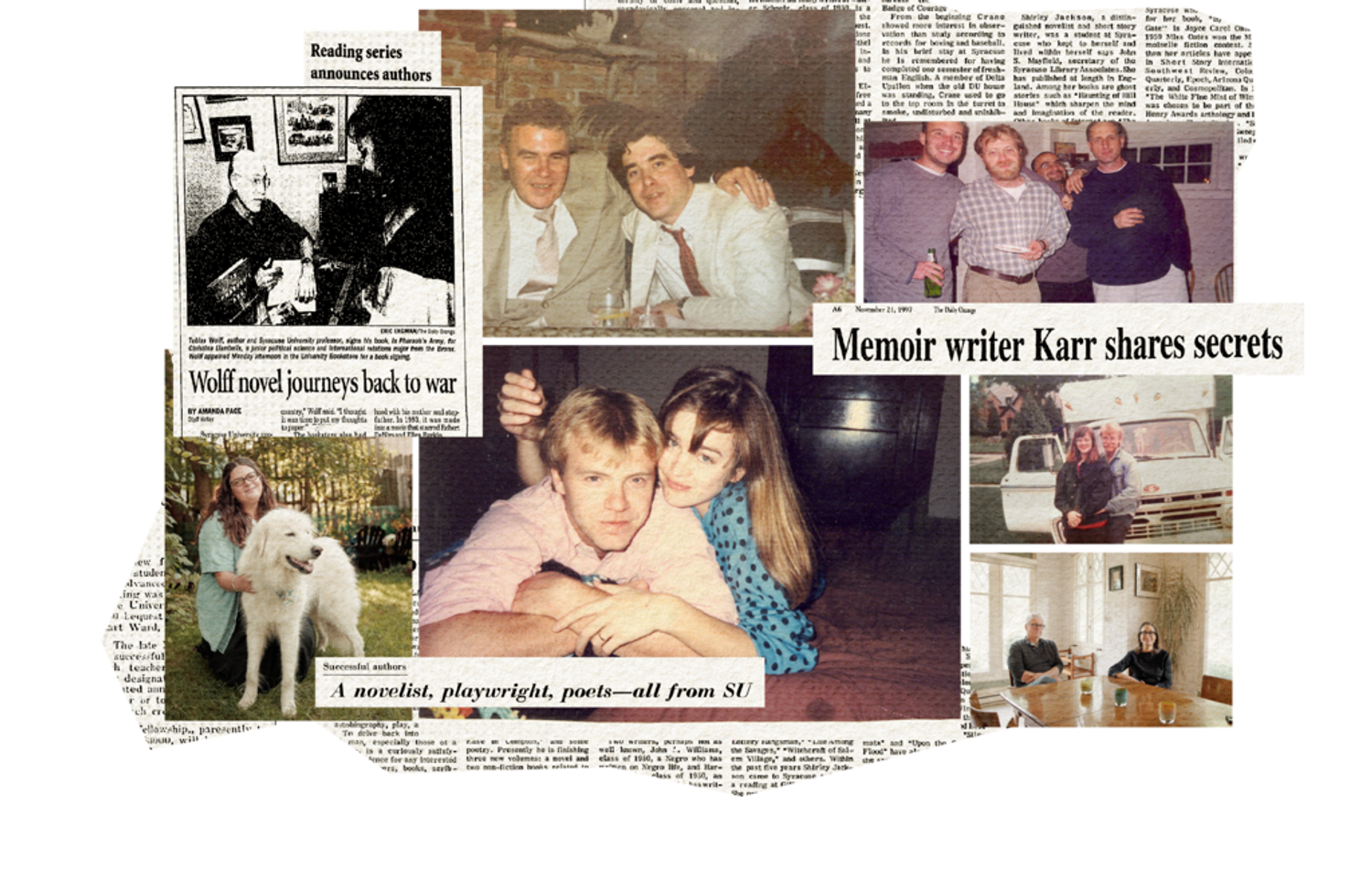
SU’s creative writing folklore dates back to 1891, when some argue the creative writing program unofficially began from poet Stephen Crane’s bedroom in the Delta Upsilon fraternity house.
It wasn’t until 1963 that SU officially launched a master’s degree in creative writing. In the following years, the university recruited prominent professors like Raymond Carver, Tobias Wolff, Philip Booth (a co-founder of the program), Mary Karr, Unger and Saunders himself.
In 1994, the creative writing graduate degree changed from a master’s of arts to its current master’s of fine arts. Today, SU’s creative writing program has been dubbed one of the top creative writing graduate programs in the United States, accepting roughly 1% of the more than 600 applications received each year, Dee said. In 2021, SU began offering a major and minor in creative writing.
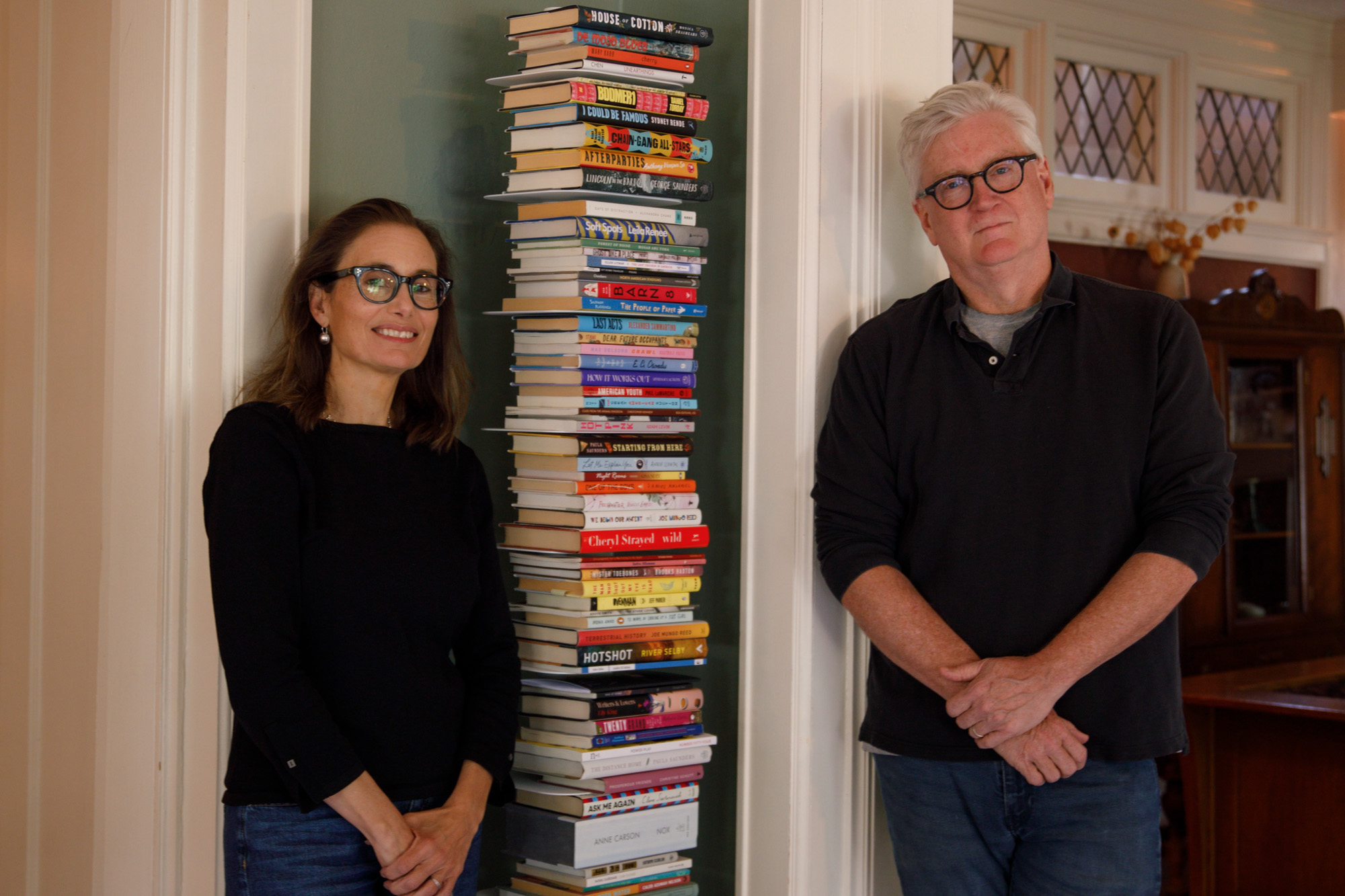
Husband-and-wife Jonathan Dee and Dana Spiotta showcase a stack of books published by Syracuse University creative writing alumni and professors. Writers Dee and Spiotta both currently teach creative writing at SU. Avery Magee | Development Editor
Many creative writing graduates stay in Syracuse following their studies; Jay McInerney spent three to four more years in Syracuse after his graduation.
Syracuse felt like an incubator for writers, McInerney said. He began writing “Bright Lights, Big City” while studying at SU’s creative writing graduate program. Within McInerney’s first six weeks at SU, he finished the first draft.
Like many fellow literati, McInerney lived in the Westcott-University neighborhood while in Syracuse.
McInerney, on Allen Street, lived up the street from Carver (who was “Ray” to McInerney). Carver and his wife, Tess Gallagher, lived on Maryland Avenue while Saunders first lived on Ackerman Avenue and later Scott Avenue (in a house occupied by Wolff earlier).
Samuel “Sam” Gruber has lived in the Westcott-University neighborhood since 1993. Gruber, a former SU professor, is the co-president of the Westcott Neighborhood Association. During the COVID-19 pandemic, Gruber began noticing the sheer scale of writers in Syracuse. That’s when he began researching the city’s literary history.
Gruber compiled a spreadsheet with 180 writers affiliated with the city. That spreadsheet inspired a public art display in Forman Park called “The Syracuse Writers Project,” with quotes from authors like F. Scott Fitzgerald and Joyce Carol Oates who had associations with Syracuse.
While aspiring writers like Carver and McInerney were living in the Westcott-University neighborhood, it became an ideal place to live, Gruber said.
“It was a pretty easy place for a graduate student to get cheap digs,” Gruber said. “There was a lively scene on Westcott Street. It’s a very literate community.”
It’s unclear when and how the Westcott-University neighborhood became a milieu for Syracuse’s literary community, but for some, it’s where they blossomed.
Upon graduating from SU’s undergraduate program in 2015, Alexander Sammartino lived on Westmoreland Avenue and stayed in Syracuse to attend SU’s creative writing MFA. program, where he graduated in 2018. For the last two years of graduate school, Sammartino lived in the Westcott-University neighborhood, within close proximity to many creative writing peers, he said.
Some of Sammartino’s friends lived in houses that were passed down from previous generations of creative writing students; it was a way the “history of the MFA program was always kept alive,” he said.
Sammartino, who now lives in Brooklyn, also said the social aspect of the program — dinner parties at professors’ homes, like Sarah Harwell’s, and cocktail parties with guest writers — also made him a better writer.
The parties made former MFA students, like Paul Griner, feel like they were part of the professional literary world before they even entered it. Griner, 66, recalls a dinner he attended at Karr’s home where everyone at the table — Karr, Stephen Dobyns and David Foster Wallace — had published a book; everyone but Griner.
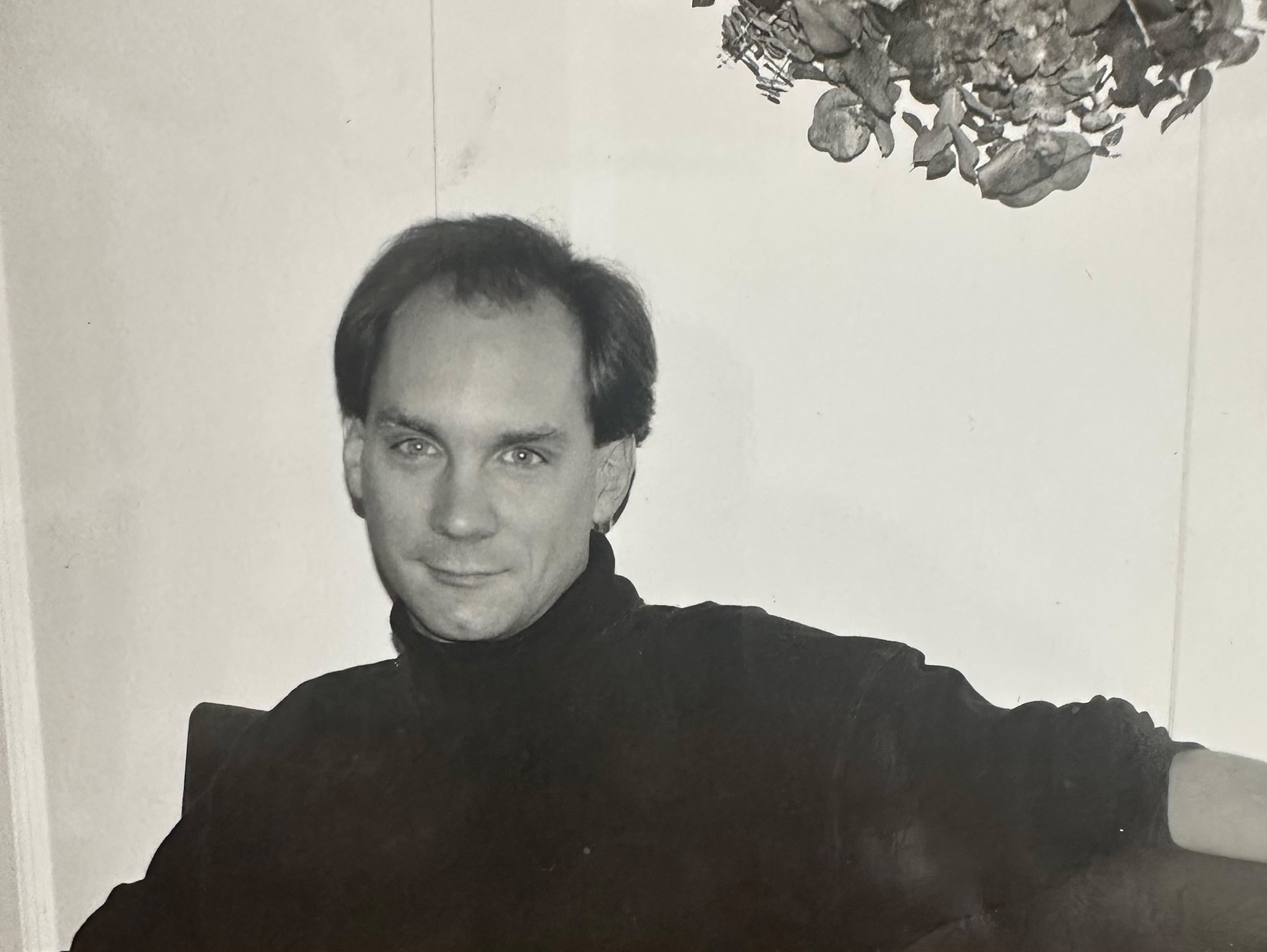
Paul Griner smiles for a photo. After Griner graduated from Syracuse University’s creative writing program in 1989, he spent over six years teaching at SU and SUNY ESF. Courtesy of Paul Griner
“Nobody treated me any differently than anyone else at that table. Nobody cared whether you didn’t have a book out,” Griner said. “They cared that you liked writing and that you knew you were good conversationalists.”
Griner’s writing career in Syracuse didn’t stop at his 1989 graduation from SU’s creative writing program. He spent more than six years after graduation teaching at both SU and SUNY ESF.
Teaching gave Griner the flexibility to write. That’s the same reason why Molly Jo Gorevan, 37, still lives in Syracuse following her 2025 graduation from SU’s creative writing program.
Like Griner, Gorevan has taught at SU part-time since her graduation, writing whenever she’s not teaching. Gorevan never thought it would be possible to have a life where she could continue her craft, she said.
“What else is there to do but write and read?” Gorevan said.
Compared to living in New York City — where Gorevan grew up and attended college — Gorevan said Syracuse was easier to make a living in while still being creative.
SU’s creative writing MFA program is fully funded, meaning each student in the 36-person graduate program (12 per cohort year) receives a scholarship for their full tuition and a stipend of $24,000. In each cohort, six students study poetry and the other half study fiction.
Teaching students in SU’s creative writing program has made Dana Spiotta, an English professor, a better writer herself, she said.
When Spiotta began working at SU in 2009, she had two published books. Since then, Spiotta has written three more books to her anthology, with another forthcoming; she credits the speed to working at the “iconoclastic” writing program. But that wasn’t always the case.
“I was very intimidated when I got here because of the history of it,” Spiotta said. “Because so many great writers have taught here and so many great writers have graduated from this program, you just don’t want to mess it up, it’s a big responsibility.”
In the home of husband-and-wife Dee and Spiotta, a vertical bookshelf invites visitors to a small fraction of books published by SU creative writing alumni and professors. The spines of texts — like Sydney Rende’s “I Could Be Famous: Stories,” Christopher Kennedy’s “Clues from the Animal Kingdom,” Anthony Veasna So’s “Afterparties” and Arthur Flowers’ “De Mojo Blues” — remind Spiotta of the talent that SU’s writing program breeds, she said.
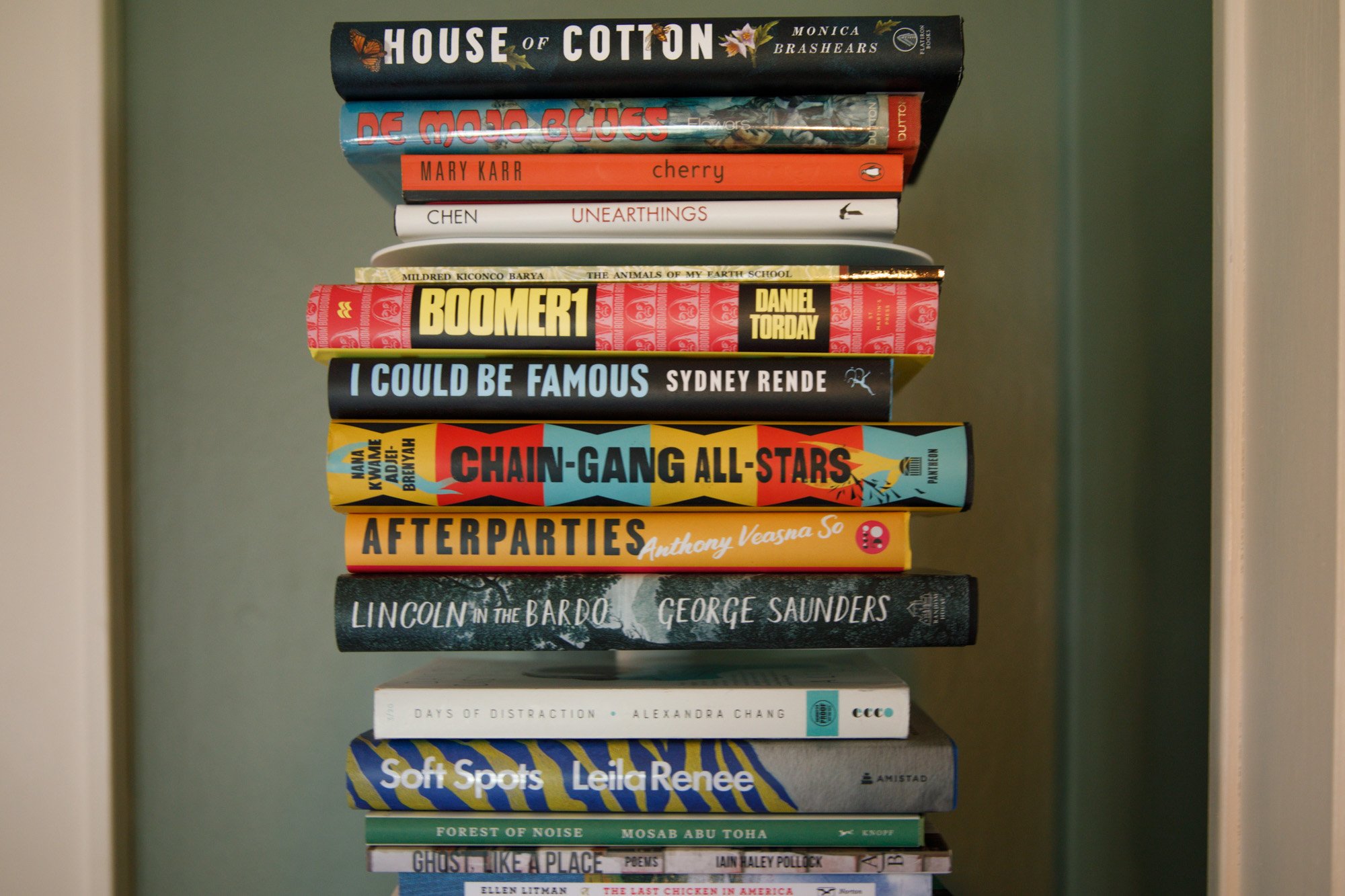
Jonathan Dee and Dana Spiotta collect books written by alumni and professors in Syracuse University’s creative writing program. The titles include Arthur Flowers’ “De Mojo Blues,” Sydney Rende’s “I Could Be Famous: Stories” and more. Avery Magee | Development Editor
Some of those authors return — if they’re not already working at SU or living in Syracuse — for the Raymond Carver Reading Series. The annual series welcomes prominent writers to SU for a Q&A session about their works.
Beyond SU, some people may know Syracuse for its long winters, the home of the Great New York State Fair and a place with Italian American roots. But it’s also been coined the “Salt City” and a lesser-known nickname, the “Typewriter City.”
Around the late 1890s, at the same time when Crane was enrolled at SU, Syracuse produced nearly half of the typewriters in the U.S. The close proximity to typewriter factories like Union Typewriter Company and L.C. Smith & Brothers Typewriter Company might’ve made writing in Syracuse more desirable for Toni Morrison to move to Syracuse or residents like Eric Carle to begin writing, Gruber said.
But what made writers like Bruce Smith — who’s been a poet and professor in SU’s creative writing department since 2002 — stay in the relatively budget-friendly market is SU, he said.
“So when I came to Syracuse, I really loved the fact that I could afford a house,” Smith said.
In Syracuse, Smith, 79, and his wife regularly go on “Syracuse appreciation walks” to Salt City Market and Parthenon Books, which allow them to “appreciate this waning industrial Rust Belt city and find the virtues of it,” Smith said.
A shared phenomenon among writers like Smith and McInerney, who’ve both lived in Syracuse and other cities, is the influence that Syracuse had on their creative stimulation.
McInerney, 71, graduated from SU in 1986. He called his seven years in Syracuse “the most formative time” of his writing career, McInerney said.
In fact, to make extra money during his time at SU, McInerney worked as a clerk at the Westcott Cordial Shop. It was there that he got a call in the fall of 1983 that Random House would publish his novel. It was also when McInerney received a phone call from Paramount Studios saying they would like to turn “Bright Lights, Big City” into a movie, before the book had even been published (the movie debuted in 1988).
But Carver ensured McInerney would find success by moving to Syracuse. During a trip to New York City in the early 1980s, Carver had some extra time between a book reading, which was when he met McInerney for the first time at his Greenwich Village apartment.
McInerney had just been fired from The New Yorker as a fact-checker after claiming he could speak French, which was then discredited by a heft of inaccuracies in an article. So, he turned to a different writing style.
Already a fan of Carver’s, McInerney said the two hung out for so long that Carver was late for his reading at Columbia University, so McInerney took the subway with him.
“Then he wrote me a letter and called me. He basically said, ‘Look, your life in New York doesn’t seem very conducive to becoming a novelist, you should come to study with me,’ which I pretty quickly did,” McInerney said.
Carver’s advice proved to be right once he enrolled in SU’s creative writing graduate program. And he’d then become one of McInerney’s closest mentors in his writing career, up until Carver’s 1988 death.
For Sammartino, the most challenging part of being a writer is experiencing doubt about the craft. But those feelings evolved once he joined the graduate program.
“You join this part of history. It’s a reason for faith because you see these people have come through the same space and produced this great work, and you think maybe there’s something here that I can soak up to and contribute,” Sammartino said. “It’s a source of continued inspiration.”
One of the catalysts of Sammartino’s career was Saunders — who was his thesis advisor in graduate school.
Saunders, who’s been a professor at SU since 1996, said the creative writing program’s lasting legacies still show up in his teaching. Now, 67-year-old Saunders still teaches a workshop every semester to graduate students in the creative writing program.
For Saunders, if there’s somebody people admire, whether they are family or friends, they can be channeled. For him, those people are Wolff and Ungar. Oftentimes, when Saunders is working with a student, he asks, “What would Doug do? What would Toby do?” he said.
If it wasn’t for Saunders, Griner said he probably wouldn’t have had his first book published as early and fast as he did.
Working with students like Griner and Sammartino has informed Saunders’ view of “what human beings are all about,” he said.
“The talent here is eternal. Every generation is just as talented as one. They manifest it in different ways, but talent is a constant and so is enthusiasm and love,” Saunders said. “So to see that in students, you also start seeing it in the world around you.”
Collage by Abigail Aggarwala | Digital Design Director