Ukrainian Syracuse native gives SU insights on war’s impact, developments
Get the latest Syracuse news delivered right to your inbox.
Subscribe to our newsletter here.
In a small conference room, Syracuse University professors and students simultaneously bowed their heads to hold a moment of silence for the Ukrainians who have died during the ongoing war with Russia.
This act is something Mykolaj Suchý, a scholar at the Harvard Ukrainian Research Institute, said isn’t an isolated event. Millions of Ukrainian residents, he said, similarly pause every day while waiting in grocery lines, dining at restaurants or getting coffee, to honor the Ukrainian lives lost.
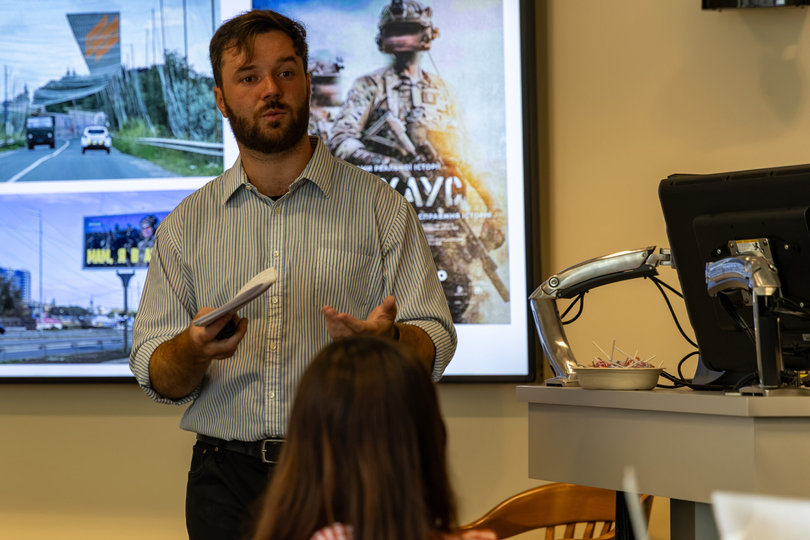
This moment was part of a larger exclusive talk on Tuesday within the Maxwell School of Citizenship and Public Affairs, led by Suchý. During the lecture, Suchý provided insight about war developments, military tactics and technological advancements.
David Loewen, a friend of Suchý, said he didn’t anticipate “feeling a certain way” before attending the talk. However, at the beginning of the moment of silence, he began to cry.
“It’s a really terrible reality that they have to do a moment of silence every day, for everyone dying every day, and the severity of that really hit me,” Loewen said.
Due to the sensitive nature of the information Suchý shared, he asked that the contents of the discussion be kept private and spoke with The Daily Orange for an interview afterward.
Although Suchý is a Syracuse native, his Ukrainian lineage and global affairs degree from Yale University drew him back to Ukraine when the war broke out. Following graduation, Suchý got a job with KI Insights, a media platform based in Kyiv, dedicated to providing live insights about the war.
“The war is affecting millions and millions of people,” Suchý said. “This war is driving a level of technological innovation that I don’t think we’ve seen.”
As the war enters its fifth year, it has become the largest armed conflict in Europe since World War II. Suchý connected the war with his family roots, specifically his Ukrainian grandmother’s experiences during WWII, decades prior.
Suchý said his grandmother was a university student in Ukraine during WWII, which he contrasted with his own experience in college.
“I felt really thankful that I wasn’t going through the same things as a university student,” Suchý said. “And I had a foolish assumption that the world would never look that way again.”
International relations graduate student Zachary Arce, who also attended the lecture, described the war as a “social media war.” He said it allows people to experience the “fog of war,” a phrase used to describe the uncertainty and situational unawareness experienced by military participants.
“The sheer volume of information, of open-source public information, on the war is making it very difficult to figure out exactly what’s going on and how best to address it,” Arce said.
Regarding the influence of the media on the war, Suchý views it as playing a vital role in helping people to better “sort through” the chaos that comes with war.
“When you get attacked from Russia it doesn’t come with a message,” Suchý said. “The only reason we know what is happening or why things are happening is because of the news and because of the media.”
Based on his experiences in Ukraine, Suchý said he doesn’t think the war will end anytime soon and believes it will likely get worse before it gets better. Suchý said he thinks the way it will eventually conclude still remains unclear, and the chance of a complete return to normal following its conclusion is very small.
“I think that this war will be with us for as long as we live. I think this war will be with our children,” Suchý said. “I think this war will linger in ways that are hard to understand and see.”
Despite this, Suchý emphasized the importance of still holding onto hope, even with current circumstances.
“Hope is what people are fighting for,” Suchý said. “As soon as the hope is lost, the fight is lost.”