Advocates hope Syracuse remains landmark in fight for reproductive right

Get the latest Syracuse news delivered right to your inbox.
Subscribe to our newsletter here.
Madeline Thibault grew up an activist, regularly attending protests with her parents. But it was the first one she attended with Planned Parenthood that she said changed her life.
On a cold February afternoon in 2017, 19-year-old Thibault visited Albany, New York alongside hundreds of others advocating for women’s reproductive rights. It was that protest which Thibault described as one of the most “eye-opening” moments for her as an activist, cementing her dedication to the cause.
“It was the amount of energy and the feeling that all these people are here to support the greater good for society,” Thibault said. “To see so many people that supported this organization and what that organization stands for, specifically Planned Parenthood, was really beautiful.”
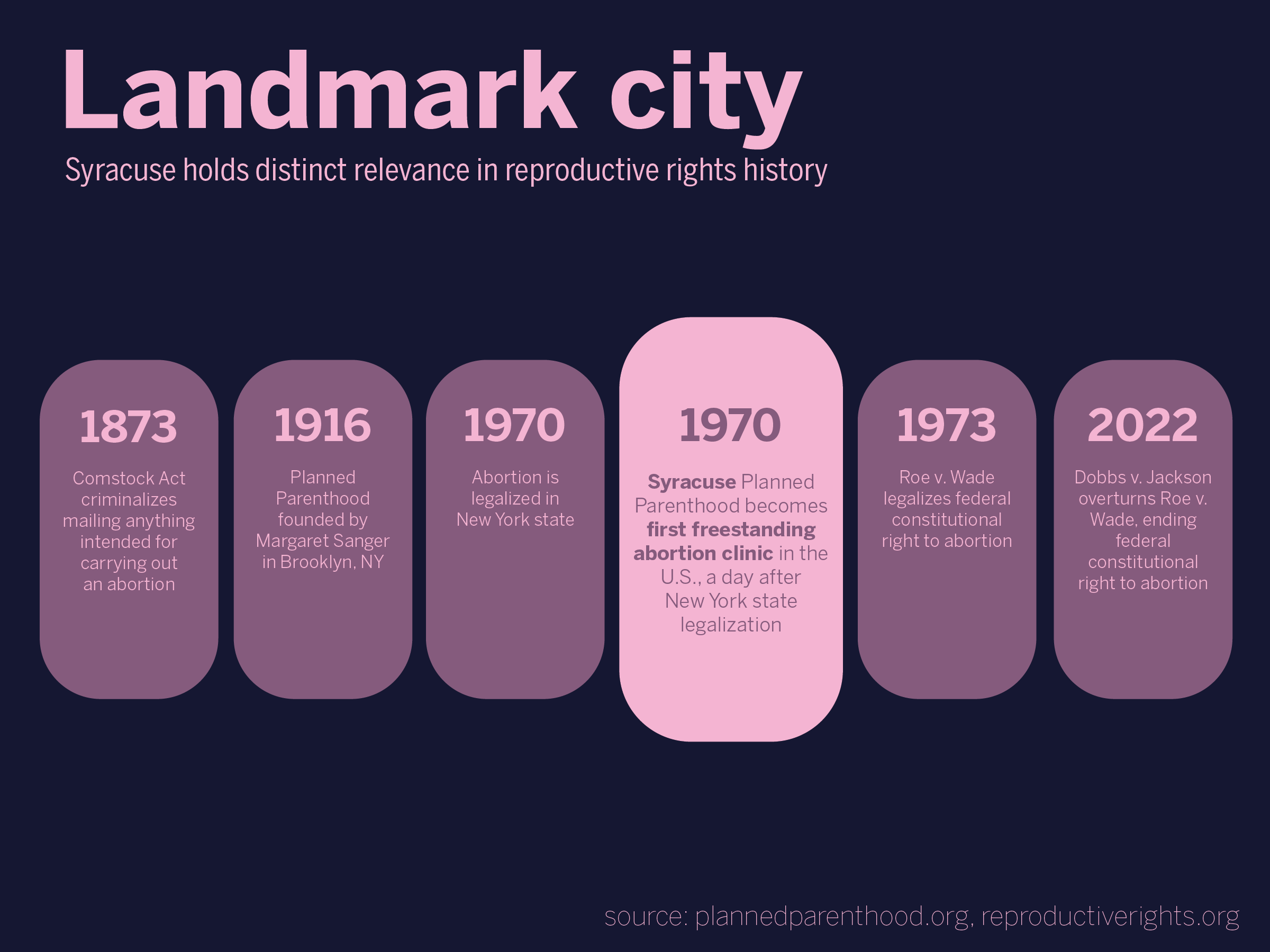
After the legalization of abortion in New York state over 55 years ago, Planned Parenthood’s Syracuse clinic became the first freestanding abortion clinic in the United States. Though much has changed regarding reproductive rights since 1970, one thing has remained the same – activism.
Since the 1970s, New York state has continued to introduce legislation, including the SHIELD Act and Proposition One, to protect abortion access.
On Sept. 24, Rep. Alexandria Ocasio-Cortez, along with five other politicians, reintroduced the bicameral Affordability is Access Act, requiring all insurers to fully cover over-the-counter birth control without any additional fees.
Meredith Ouderkirk, director of public affairs at Planned Parenthood of Central and Western New York, said legislation like this is in response to federal attacks on rights nationwide, not just on abortion.
“We’re also seeing basic pieces of family planning under attack too,” Ouderkirk said. “In a way that is kind of reminiscent of the early 1920s when Margaret Sanger was being arrested for starting a birth control clinic.”
For Ouderkirk, advocacy has also been a constant in her life.
Growing up passionate about securing rights for those in marginalized communities, Ouderkirk said her “guiding star” is creating a safer place for teenage girls, which she fulfills through Planned Parenthood.
“What we really want is for everyone to have all the resources to be able to make the best decision for them,” Ouderkirk said. “Not just making the decision because they can’t get time off of work or they can’t secure child care to be able to attend an appointment for a procedural abortion.”
One in four women in the U.S. who are able to have children will have an abortion by the time they turn 45-years-old, Outerkirk said, citing a 2024 study from the Guttmacher Institute.
Zoey Grimes | Design Editor
Ouderkirk cited the aftermath of Dobbs v. Jackson, which reversed Roe v. Wade, leaving abortion decisions to the states, rather than the federal government. Though New York state remains a place where women continue to have access to legal and safe abortion clinics, the same is not the case for other states.
Thibault, who graduated from Syracuse University’s College of Law in 2022, said she was “horrified” when Roe v. Wade was overturned.
“Seeing those decisions, Roe v. Wade, specifically, come down, there’s writing on the wall. It’s been there and it’s scary,” Thibault said. “It’s frustrating and angering to know. I don’t even have words. My mom had more rights than I do standing here today.”
During her undergrad years after the 2017 protest, Thibault used Planned Parenthood’s services for the first time herself.
Scared and ashamed, Thibault said she felt she had nowhere else to turn, but Planned Parenthood gave her support, making her feel safe, seen and heard.
“It was not my fault, and being able to talk to them and feel safe with them, I knew that they were going to respect me and my choices throughout the whole ‘what to do next,’” Thibault said. “They got me the care I needed at that moment.”
Growing up in a family that could provide for her and having the privilege of going to undergrad and graduate school, Thibault said she worries for those who may not have the same access she did.
“I think it is so incredibly important that folks have access to reproductive health care and reproductive choice,” Thibault said. “It is life-changing.”
Though abortion remains legal in New York state, Ouderkirk explained the country is moving backwards policy-wise.
Passed in 1873, the Comstock Act allows the government to regulate items sent through the mail, including birth control, abortion pills and other contraceptives. Though its current impact has been weakened, Ouderkirk said, public officials, such as Attorney General Todd Blanche, still hint at using it to police abortion pills sent through the mail.
Junior Nicole Donahue, president of SU’s Planned Parenthood Generative Action, said it can be easy to get caught up in the “doom and gloom” she sees in recent headlines. But through the club’s volunteer work at the clinic and supportive community, Donahue feels that she’s helping make a difference.
“It’s been so nice to know that there are people that care about myself and my future and our neighbors’ future,” she said. “It’s nice to get off campus and have a real-world impact and like to be able to go outside of ourselves.”
Though Donahue is from Massachusetts and attends school in New York, where she still has access to care, she said she worries about others across the country who don’t have that same privilege.
Judy Jerome, who attended SU from 1967 to 1973, said she remembers “very clearly” discussions surrounding reproductive rights on campus and the struggle for those around her to access safe abortions.
When she was living at her sorority house, Jerome said she remembers one of her sisters suddenly disappearing from the house. After asking around, Jerome realized she had left the country to get an abortion elsewhere, since it wasn’t yet legal in New York state.
Jerome said she felt “incredible compassion” and sadness for her sorority sister.
“Why should she have to suffer this? She should have control over her own body,” Jerome said. “What is wrong with this world that women cannot control their bodies and their own sexuality?”
At the same time, at 19-years-old, Jerome said she was also nervous about her own future.
“It was a wake-up call for women about our bodies and how we control our own bodies and our own sexuality,” Jerome said.
Carol Faulkner, an SU history professor who specializes in 19th-century women’s movements, said seeking abortions in other countries or at unregulated abortion clinics was fairly normal. Many companies often planned trips for women to travel to get abortions, she said, functioning like “travel agencies for abortions.”
“Obviously, you had to have money to be able to afford those kinds of services, and so less wealthy women, poorer women would definitely struggle, and that was where you would get more desperate situations as well,” Faulkner said. “So, (that led to) a lot of self-induced abortions and a lot of practitioners that may not necessarily have the women’s best interest at heart.”
After its legalization in New York state and beyond, Faulkner said it wasn’t uncommon to see ads in college newspapers nationwide advertising where women could access abortion services.
“College campuses were viewed, for obvious reasons, as a target for these people who were selling these services,” Faulkner said. “‘If you need an abortion, call this number and we’ll help you get one.’”
It's frustrating and angering to know. I don’t even have words. My mom had more rights than I do standing here today.Madeline Thibault, organizer for NOW Young Feminist group
Karen DeCrow, former president of the National Organization for Women, attended SU’s College of Law from 1969 to 1972, and continued to serve as a prominent activist in the community after her graduation.
In a 1969 piece called “The right to abortion,” which DeCrow published in The Daily Orange, she wrote: “There is perhaps no more fundamental human right, save the right to life itself, than the right to one’s own physical person, a basic part of which is the right to determine whether or not one will give birth to another human being.”
DeCrow continued her work in Syracuse and beyond until her death in 2014.
Annaleigh Porter, who worked as a clerk for DeCrow, said she served as the “perfect example” of how student activism, specifically in the realm of reproductive rights, can have a widespread impact and grow into something more.
If DeCrow were here today, following the overturning of Roe v. Wade, Porter said she would “be loud.”
“I know she would not be quieted. She would not rely on a single way to get the word out,” Porter said. “She would be rallying others. She would be meeting with people. She would be writing to people. She would be speaking at any forum available to her.”
Caleb Slater, who works with Life Matters Training Center, said he often visits SU’s campus with his team to speak to students about other options outside of abortions.
Though Slater said he doesn’t agree with the practices at Planned Parenthood, he said Life Matters, as a whole, welcomes conversation and the “free exchange of ideas,” whenever students see them on campus.
The focus on student activism is something Donahue and SU’s Chapter of College Democrats President Tomasz Saarloos both emphasized.
“When young people realize that there is change, that there needs to be change, we speak up, we go out, we organize, we protest, and we create real, concrete change,” Saarloos said.
Thibault has started organizing locally to form a NOW Young Feminists group within central New York’s chapter. The group is open to anyone under 35-years-old, including college students, who want to get involved with NOW.
Being able to help rally young people gives Thibault “hope” for the future.
“It makes me feel like we have a fighting chance again,” Thibault said. “We don’t want to live like this. We don’t. We see what’s on the horizon, and I don’t think anyone wants this. We want to have freedom.”
Though Ouderkirk said she knows not everyone agrees with the message of Planned Parenthood, she emphasized that those are not the widespread opinions, they’re just the “loudest.”
Through student activism, Ouderkirk said, real change will occur like it always has.
“Progress doesn’t come from people aligning with the status quo,” Ouderkirk said. “Progress comes from people pushing the status quo to a different place.”