Author Kelly Hayes urges activism vigilance at Syracuse Peace Council
Have you had an experience with Syracuse University’s Title IX office? Share your story with The Daily Orange’s anonymous tip line.
The Syracuse Peace Council first began in 1936 as an anti-war and social justice organization, but its organizers and activists today say it’s as important as ever.
On Sunday, members of the SPC and other political organizers and activists joined at the ArtRage Gallery to hear “A Conversation With Kelly Hayes,” hosted by the council. The event was the council’s “capstone” of its five 90th anniversary celebrations.
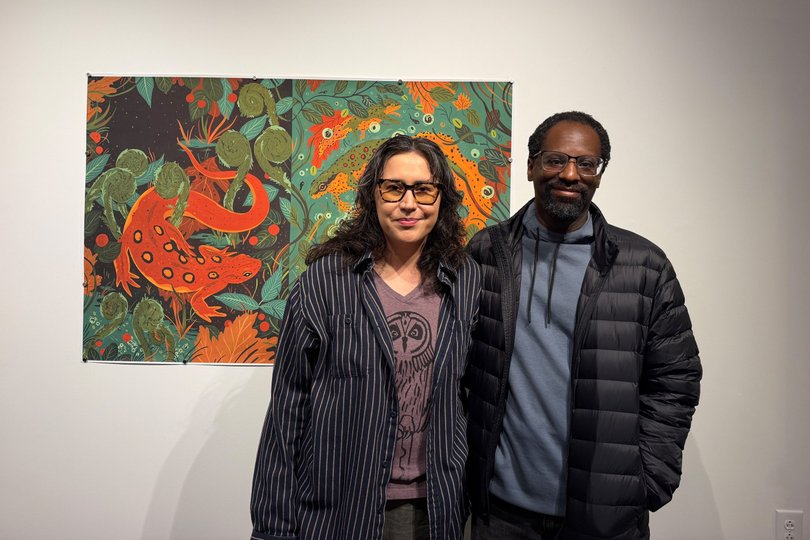
Hayes, who co-authored the book “Let this Radicalize You” with Mariame Kaba, co-facilitated the conversation with activist Aly Wane, discussing lessons they’ve learned throughout years of organizing movements in moments of crisis.
Together, Hayes and Wane have decades of activism experience, and reflected on those experiences to give advice and insights at the event Sunday, especially in what they described as today’s “apocalypse.” They also offered advice on how to stay vigilant and navigate difficult times impacting activists’ causes today.
“At this point, there’s no being ‘in between.’ There is no such thing as kind of sitting it out,” Wane said. “The very basic concepts of American democracy are at stake… so I think it’s really important for anyone who cares about America to really get involved right now.”
Hayes and Wane opened the event by addressing key issues affecting activism today, including interpersonal tensions with organizing. Both discussed the importance of learning to cooperate with people with slightly different political ideologies, and emphasized that today’s activists need to trust that working together helps movements move forward more efficiently than anything else.
“Organizing is necessarily meeting people with different viewpoints,” Wane said.
He explained that in his work he’s learned how to separate activism from a time to release emotions.
Hayes agreed that collaboration is necessary for successful activism, and organizers need to “do the work of collective survival.” She said sometimes this involves working with people whose ideologies don’t align with her own, or working with people she didn’t choose.
Hayes tells her colleagues today that everything they’re doing falls under a concept of mutual aid.
“A network of people is a potential lifeline,” she said.
Both Hayes and Wayne also highlighted that while being able to speak, interact and work with people of all different opinions is important, it’s also necessary to provide and facilitate spaces for people to express their opinions and “be human.”
Feelings need to be put where they belong, Hayes said, citing her past experiences working to protect immigrants from U.S. Immigration and Customs Enforcement agents that were “excruciating.” She said during this period she didn’t have an outlet for her anger, which subsequently caused harm to herself and others.
“I was so angry at ICE that I wanted to scream and cry,” Hayes said. “It’s easy to resort to that kind of satisfaction.”
Wane and Hayes opened the conversation up to other participants, who raised contemporary topics like a fetishization of a culture of overworking and discussed how it’s common in activism to “give everything to the cause.” Hayes cited past experiences in her own work to explain why it’s important to stray away from overwork and prioritize self-care.
“I was moving in a way that felt right to me at the time,” Hayes said, referencing her activist work in 2016, “But I was destroying myself.”
She explained that a friend helped her realize that she was setting a poor example for younger activists.
“People won’t work in the movement if they wear themselves out,” attendee Diane Swords said, who’s been an activist since 1979. “Part of the reason we do this work is because the prospects are gloomy, but we have to have a positive prospect.”
WHAT YOU SHOULD READ NEXT
Environmental panelists criticize Micron’s local impact at ArtRage Gallery
Article description. Environmental advocates spoke out against Micron Technologies’ $100 billion semiconductor plant in Clay, New York, during a panel hosted by SU’s NPR affiliate WAER at the ArtRage Gallery on Wednesday.
Wane also emphasized that it often feels like activist work doesn’t get accomplished in one person’s lifetime. Hayes agreed, stressing that some early abolitionists never saw their goals become reality themselves. It’s easy to feel marginal and small, she said.
“In these troubling times that we live in, it’s often difficult to maintain your ability to go forward,” attendee Anthony Belltier said.
But Hayes said she realized after the 2020 Black Lives Matter movement that a lot of the framework allowing the movement to take off had been laid by activists years before.
But, she said, that framework only happens through mutual aid, connectivity and self-care.
Wane has been involved in activism for 20 years now. He said it’s taken him years to realize that the purpose of life is making sure the next generations’ lives are better, but it shouldn’t come at the expense of your own life. Wane said he makes conscious choices every day to meditate, go to therapy and spend time with friends.
“Remember that life is good,” he said. “We have to love life more than these people hate it.”
Wane and Hayes said longevity in activism is about creating and remembering joy, a value that reverts back to Indigenous values, where an individual’s wellbeing is dependent on the group’s, they said.
Event participants said the event itself reinforced that message of togetherness, mutual aid and dependency.
“Just to see all these people gathered together, supporting each other and having those positive feelings gives you more strength to go on,” Belltier said.