CNY Arts Gallery maps progression of Yoichi Okamoto’s political photography
Get the latest Syracuse news delivered right to your inbox.
Subscribe to our newsletter here.
Inside City Hall Commons Art in the Atrium, a black-and-white photograph shows former United States President Lyndon B. Johnson sitting on his bed beside his wife and two daughters. Unlike other presidential photographs that are clearly curated, no one is posing. The camera’s presence isn’t felt in the room.
“He tried to be invisible,” Laurence “Larry” Bousquet said.
Bousquet, who serves on the library advisory board at Syracuse University, acted as the local liaison for “Yoichi Okamoto: Photographer in the Service of Democracy.” The photograph is one of dozens on view through Nov. 15. The exhibit explores the work of Yoichi Okamoto. Born in 1915, Okamoto was the first official U.S. presidential photographer. Visitors move through a series of large white display panels mapping the progression of Okamoto’s life and work.
From scenes of the Marshall Plan in Austria to the Civil Rights Movement in Washington, D.C., Okamoto’s photographs depart from the formal portraiture of earlier eras in favor of the candid realism still seen in photojournalism today. Alongside Okamoto’s political work, the exhibit also includes photographs that capture contemporary Austrian artists.
“He didn’t come out of the box being this person who could run a photo operation for the Marshall Plan in all of Austria,” Bousquet said. “He had to learn that somewhere.”
Curated by Hans Petschar and designed by Hannes Richter, the exhibit gathers Okamoto’s photographs covering various historical events from the 20th century.
While Okamoto’s work has previously been displayed at the Austrian National Library, LBJ Library and elsewhere, the Syracuse exhibit adds new context about Okamoto’s ties to central New York.
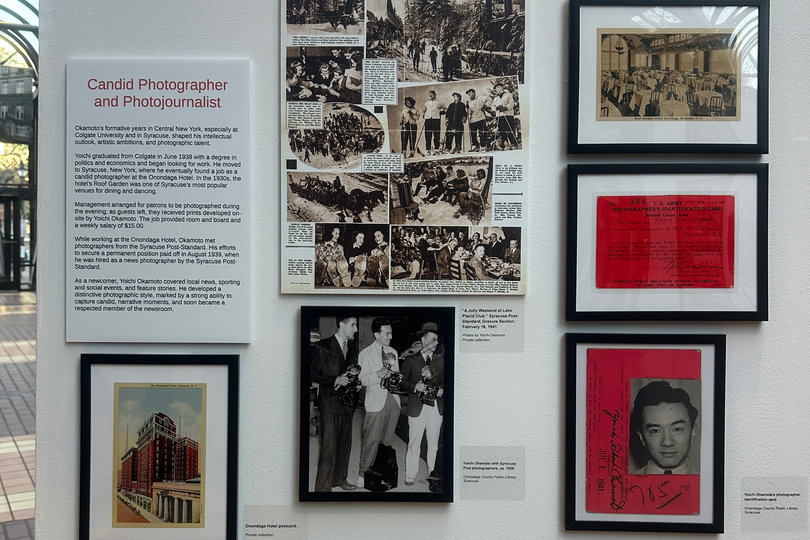
Okamoto graduated from Colgate University in 1938 with a degree in politics and economics. He began his career snapping candid shots of guests at Syracuse’s defunct Hotel Onondaga before getting hired as a photographer for the Syracuse Post-Standard in 1939.
Bousquet said the central New York material “fills in a lot of his personal history” while revealing a little bit of his personality. The Syracuse connection will be used in a forthcoming biography by Petschar and University of Texas at Austin history professor Mark Lawrence, which will be released in 2027.
The exhibit shows how Okamoto’s relationship with Syracuse directly impacted his life path. Shortly after the attack on Pearl Harbor, the Army didn’t allow Okamoto to enlist in World War II because of his Japanese ancestry. The then-Syracuse Mayor Rolland Marvin intervened and Okamoto was sworn in to serve in the U.S. Army Signal Corps on Jan. 6, 1942, becoming the first Nisei enlistee from the New York area. Bousquet said Jerome Barnum, the Post-Standard’s publisher, also advocated for him.
Bousquet pointed to a photograph he found last week that wasn’t included in the exhibit, of Okamoto’s farewell party with the Post-Standard staff, published in Empire Magazine.
“This is within a month of Pearl Harbor,” Bousquet said. “The fact that there was that kind of support for him at that time was pretty remarkable.”
WHAT YOU SHOULD READ NEXT
‘Rich Harrington: Fissure’ exhibit addresses pop culture’s societal impacts
“Rich Harrington: Fissure” exhibition challenges predetermined societal roles of gender, family structure and personal identity.
In World War II, Okamoto served as a Signal Corps photographer and personal photographer for Gen. Mark Clark. In 1948, Okamoto returned to postwar Austria to lead the U.S. Information Service’s photo department, where he documented the country’s rebuilding under the Marshall Plan. At the time, Austria’s political alignment with the U.S. was uncertain, and the country could have fallen within the Soviet Union’s sphere of influence. Part of Okamoto’s work was to counter Soviet propaganda that framed the Red Army as a liberating force.
Following President John F. Kennedy’s assassination in 1963, Johnson named Okamoto the White House photographer, a position he held from 1963 until 1969. Okamoto’s pictures captured strategy sessions, late-night meetings, racial unrest and the Vietnam War.
Retired journalist Julie McMahon, who visited the exhibition, compared Okamoto’s work to Pete Souza, the White House photographer during Barack Obama’s presidency.
“(Souza) really is in the tradition of Okamoto, just in that he was capturing the intimate moments and the candid moments,” McMahon said.
Bousquet similarly emphasized Okamoto’s influence, citing his work in Austria as training for a generation of journalists and pioneering a style of photojournalism used by Souza and David Kennerly.
Okamoto’s work in Vienna extended beyond documenting political life. His photographs of artists were part of a broader cultural mission, Bousquet said.
For attendee Anne Fitzsimmons, a retired SU writing professor, the work was a highlight. She was especially drawn to the section exploring efforts to capture artists in action, including the Vienna Boys Choir, ballet dancers and the touring company of “Porgy and Bess.”
“He beautifully captured artists: their passion, their expressions, their emotions,” Fitzsimmons said.
Fitzsimmons also reflected on photography’s relationship to other art forms.
“You have someone who is a photojournalist who is wanting to capture other kinds of art,” Fitzsimmons said.
For Bousquet, the exhibit’s significance extends beyond Syracuse. Photography, he said, can communicate history in ways that written accounts alone may not.
Many people, he added, remember the Johnson administration for Vietnam and forget the Civil Rights Act, Medicare and the Voting Rights Act. The exhibit’s historical record carries a warning for the present, Bousquet said. Although Okamoto died in 1985, his work continues to resonate with the American public.
“This is a time where people need to remember what you can lose,” Bousquet said. “It’s essential for people to understand how important democracy is and how important voting is.”