Former SU professor converges textiles, photos to relay Indigenous stories
Get the latest Syracuse news delivered right to your inbox.
Subscribe to our newsletter here.
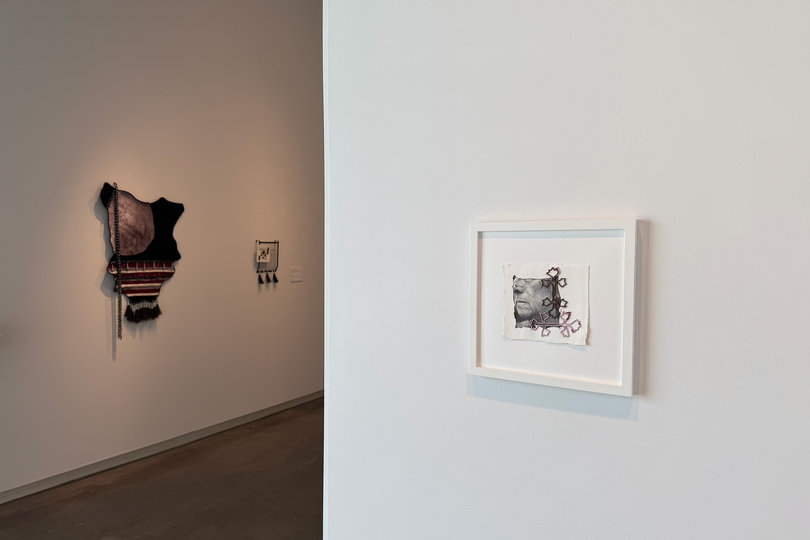
Inside the Nancy Cantor Warehouse, large constructed pieces of animal hide and tartan fabric are mounted to the wall, decorated with ribbon, horsehair and metal jingle cones.
Chiffon tapestry prints hang alongside framed Polaroid lifts that were transferred onto watercolor paper and embellished with beaded designs.
These artworks are a result of Cali Banks’ experimentation with darkroom emulsion transfer and textile materials that reference her Northeastern Lenape roots.
“I didn’t have this strong sense of a Native community until I was an adult,” Banks said. “So this has been really special and healing to me.”
Banks, a former adjunct professor of photography, film, and video art at Syracuse University, launched her collection “The Words Stuck in Your Throat Have Grown Teeth,” which includes a convergence of photography and textile art. It will be on display through Nov. 7. Banks, who earned a Master of Fine Arts in interdisciplinary media arts practices from the University of Colorado Boulder, calls photography her “home base medium.”
The main focus of Banks’ art is experimenting with different photographic formats. Her method is to separate the layers of a photograph and transfer the image-bearing layer onto a new surface, like fabric. She uses alternative darkroom processes and emulsion transfer to challenge the boundaries of what a photograph can be.
Banks, whose mother is Munsee Lenape from Pennsylvania, was born and raised in North Syracuse. Banks describes a disconnected and isolated childhood due to physical distance from the rest of her Lenape relatives. Though she had a strong bond with her family, she said she struggled with cultural integration and finding a community.
“I was always tied to my family heritage through my grandparents and my mom,” Banks said. “But my family was displaced a lot and I didn’t have a Native community growing up.”
Her collection at the Warehouse Gallery serves as a homage to family, kinship and tradition. Themes of age and memory are emphasized through roughly 15 unconventional displays of photographic prints taken by Banks, of worn-in skin, falling hair and baby teeth.
One of the prints was inspired by Banks’ grandmother, who collected her own hair as it fell out. Instead of a hair tie or scrunchie, her grandmother would use those fallen strands to tie her hair back, Banks said.
“It’s kinda like a nod to her and what’s left behind with the aging process,” Banks said. “What’s left emotionally or spiritually.”
WHAT YOU SHOULD READ NEXT
‘Here’s the Thing’ Warehouse exhibition displays varied mediums in phases
Through April 4, “Here’s the Thing” gallery includes the work of eight Syracuse University graduate students and is on display at the Nancy Cantor Warehouse Gallery.
Banks’ exhibition also acknowledges her late grandfather, who she had a close relationship with. From a young age, he instilled the importance of holding onto Lenape stories and customs in her life, Banks said.
He died when she was 13, and Banks honors him with “Grandad,” a standalone Polaroid and an inconspicuous blue bead incorporated in her embroidered pieces. The blue bead is a spirit bead to signify his presence through his favorite color, she said.
“That was my grandfather‘s favorite color, so that’s like him in each piece, too,” Banks said.
Other pieces in the exhibition point to Banks’ parents and cousins, with her father’s Scottish heritage recognized through the integration of their family tartan and her cousins featured in three different photographs.
Banks’ favorite piece of this collection was “Loud Bark Deep Bite,” a piece of tapestry that is interrupted by a row of dyed horsehair tassels. Inspired by Lenape bandolier bags, the tapestry was the catalyst for creating the rest of her installation, Banks said.
Each piece is intentionally crafted with materials resonant with Lenape culture, distinctly reminiscent of traditional regalia, artisan techniques and ancestral ways of life, Banks said.
Before stepping down from teaching at SU in May, Banks taught students in post-production, photography and filmmaking.
Lia Teeuwissen, a photography MFA student, already knew Banks through the art media sphere. When she joined the Warehouse Gallery this semester as a gallery assistant, they crossed paths again during Banks’ exhibition at the Warehouse Gallery.
“(Her knowledge) very much comes out in her show,” Teeuwissen said. “The small details that she uses makes her work intimate.”
Soup Russell, an SU senior and gallery attendant, expressed their admiration for Banks’ incorporation of traditional cultural practices in her collection.
“My first impression was, ‘Oh wow,’” Russell said. “This is something just very different that I don’t think I’ve ever seen this gallery have.”
Russell specifically noted the use of ribbon to represent ribbon skirts, a regalia garment usually worn in ceremonial spaces or as a proud expression of Indigenous culture, which she learned from Banks.
Banks points out the common belief that Native American and Indigenous peoples are extinct or “a thing of the past.” A worldview, she says, often reinforced in museum spaces. Banks hopes her artistry will encourage others to consider the existence of Indigenous peoples outside of exclusively historical contexts.
“There’s Indigenous people everywhere that are still alive and working,” Banks said. “So being able to still relay those stories to show that we’re still here.”
Banks was influenced to merge photo documentation with textile elements when she saw how different fabrics and physical materials were being used in garment design at Indigenous New York Fashion Week in September 2025, and, shortly after, she found a shop that sold scraps of leather, fur and animal hides that she could experiment with.
The movement and three-dimensionality Banks saw in fashion garments became a conceptual guideline as she constructed the works featured in her collection.
Teeuwissen praised Banks’ ability to hold an audience’s attention with both her skillful craft and vulnerable themes regarding identity and displacement.
Banks joins many other Indigenous contemporary artists in engaging with cultural experiences through different traditional art forms. The thoughtful execution of her solo collection has provided healing and catharsis as Banks pieces together missing fragments of her family history, she said.
“I wanted to bring my family in, in a way that shows that they are meant to be in every space,” Banks said. “And I’m meant to be there.”