Merz Trio blossoms through ‘evocative’ Malmgren Concert Series performance
Get the latest Syracuse news delivered right to your inbox.
Subscribe to our newsletter here.
The mundane nature of road trips can sometimes spark someone’s imagination. That was the case for Amy Yang when she was traveling with her fellow Merz Trio members. Yang, a pianist for Merz Trio, recalled the pages of 19th-century German composer Clara Schumann’s diary that she previously saw in a New York City library.
“It’s just so poignant, having any kind of diary, any kind of private notekeeping or letter writing,” Amy said. “It’s such a glimpse into that moment.”
When she realized the diary’s artistic potential, Amy immediately texted photos of the diary to the rest of her trio.
However, this wasn’t a typical young lady’s diary. Schumann’s “Blumentagebuch,” meaning “flower diary” in English, was inlaid with exactly that: dried flora pressed into the pages, each telling a personal story from Schumann’s life.
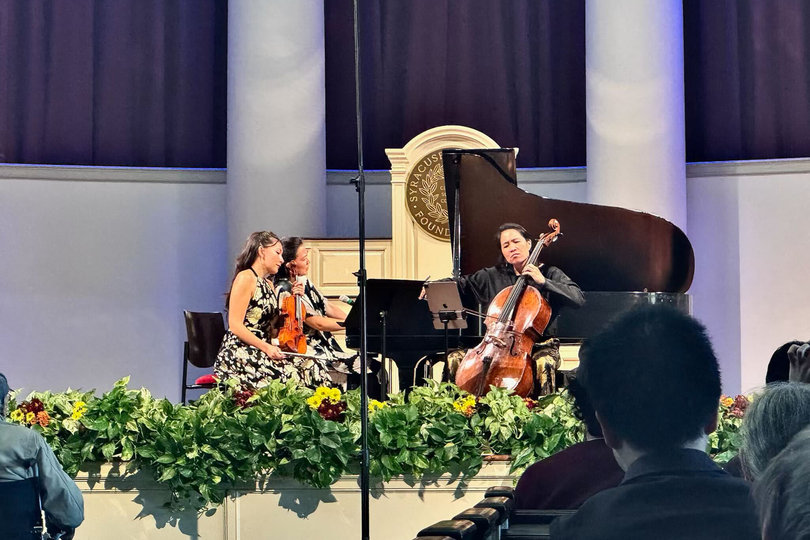
On Sunday afternoon, the Merz Trio — pianist Amy, cellist Julia Yang and guest violinist Isabelle Ai Durrenberger — visited Syracuse University’s Hendricks Chapel for “Clara’s Blumentagebuch by way of flowers.” The program, inspired by Schumann’s “Blumentagebuch,” was part of Hendricks Chapel’s Malmgren Concert Series and included five songs and three instruments.
The diary reflects the golden age of “blumensprache,” the coded language of flowers, in Germany. Merz Trio’s program drew from the diary that was kept by Schumann from 1857-59, detailing her European performances and her grief after the death of her late husband in 1856. These pages also contain memorials for fellow composers Franz Schubert and Ludwig van Beethoven, whose songs were performed in Sunday’s show.
“It’s so evocative,” Julia said. “It’s filled with memory. It’s filled with all these really rich relationships.”
The program also features “Sonatensatz,” a piece written for the group by SU faculty composer Loren Loiacono, which the trio premiered in 2022. The song’s name comes from the German phrase “sonatensatz,” which means “sonata movement” and refers to a movement of a larger, unpublished sonata.
Loiacono approached composing the piece by drawing inspiration from past composers, such as Johannes Brahms, who are close to her heart.
“(‘Sonatensatz’) is very much like a series of blooms,” Loiacono said. “(It) slowly blossoms and unfolds, then you move on. There’s a new idea that blossoms and unfolds.”
Anne Laver, artistic director of the Malmgren Concert Series, learned about the Merz Trio from Loiacono. After listening to the group’s music, Laver said she knew she’d found a great match for the series.
“I love it when a group can conceive of a program theme, and that’s what we have here with the flower diaries,” Laver said. “It’s a really cool and compelling theme, and then the connection with our Syracuse faculty composer.”
The concert opened with “Liebst du um Schönheit,” a love song from Schumann written for a larger collaborative project with her husband. Julia described the piece as “openhearted.”
“(‘Liebst du um Schönheit’) is very much ‘love me for love,’” Julia said. “‘Love me for all these other things like beauty and everything else (and it) is going to fade eventually,’” Julia said.
Franz Schubert’s “Die Blumensprache” followed Schumann’s piece, directly connecting to the theme of coded and unspoken floriography. Durrenberger said the transition bridges the gap between a distinct emotional arc, shifting from an idealistic to a skeptical view of love.
In the middle of Loiacono’s “Sonatensatz,” Amy reached toward the piano and adjusted two key items around the instrument’s strings: clothespins and aluminum foil. A technique known as prepared piano, the pins on the bottom strings give “Sonatensatz” its metallic and percussive sound, while the foil creates a crinkly, brassy tone that comes alive in the piece’s explosive moments.
“I enjoy finding these ways of augmenting acoustic instruments. There’s a really long tradition of it,” Loiacono said. “Something I always really love is the way of getting these really interesting sounds that wouldn’t otherwise be possible on the instrument.”
The composition of “Sonatensatz” is inspired by the wildness of Schumann’s husband’s pieces. Durrenberger highlights the piece’s rich texture that contains many bursting moments of romanticism.
WHAT YOU SHOULD READ NEXT
SU Symphony Orchestra launches new era with ‘Together We Are Stronger’
Syracuse University’s Setnor School of Music and the SU Symphony Orchestra hosted Diego Barbosa-Vásquez’s inaugural SU concert Tuesday.
The trio continued with Beethoven’s “Archduke,” which Beethoven wrote for his close friend, Archduke Randolph. In an introduction to the piece, Julia told audiences that 48 years after it was written, Schumann pressed cypress leaves picked from Beethoven’s grave into her diary.
“(‘Archduke’) spans so many different emotions. This very fullheartedness and (it) reaches toward the sublime,” Julia said. “For us, it feels a little bit like a picture of friendship, of what friendship could be in how dimensional it is.”
The evening ended with a surprise performance of “Morgen!,” a love song from German composer Richard Strauss. While the final piece ended on a “yearning for a better tomorrow,” Amy said, Durrenberger added the trio’s repertoire explores that idea throughout their pieces by oscillating between realities and idealism.
Loiacono said the coded communication seen through Schumann’s dried blossoms has only become more prevalent today.
“How many conversations do we have purely with emojis, or sending memes?” Loiacono asked. “Sometimes words just don’t quite get where they need to be, and that’s one of the beautiful things about music: it’s designed to discuss the things that you can’t actually put into words.”