‘Nothing finer in the land’: Rewinding 125 years of SU Marching Band
Get the latest Syracuse news delivered right to your inbox.
Subscribe to our newsletter here.
UPDATE: This story was updated at 11:16 a.m. EST on Oct. 8, 2026.
When Sean Palmer arrived at college in 1994, joining the Syracuse University Marching Band wasn’t part of his plan. In fact, Palmer had never marched before — he was only an amateur trombone player. But when he attended the New Student convocation ceremony his freshman year, Palmer immediately knew he had to join.
That same night, he attended his first practice.
Palmer, who finished his undergraduate studies in 1998 at the Newhouse School of Public Communications, marched for five years. He even stayed as a graduate assistant for two more during his law school studies. Over 26 years later, Palmer’s still active in group chats with almost 100 former bandmates.
“Nowhere in the entire university do you get 250 friends on Day One,” Palmer said. “I was able to do that through the marching band.”
That bond has remained central to the marching band since its inception 125 years ago, when 23 students gathered at Crouse College for its inaugural rehearsal in 1901.
Since then, the marching band has grown into one of the university’s largest student organizations. Currently, the marching band has about 200 members from more than 80 majors. Band directors, marching patterns and traditions have changed over the past 125 years, but members and alumni say the sense of community hasn’t.
The marching band earned its nickname “The Pride of the Orange” from an announcer at the 1970 World Music Contest in the Netherlands, where it won three awards. Since the marching band’s first season, the band has performed at football games and established a tradition of playing on the Shaw Quadrangle before every home game.
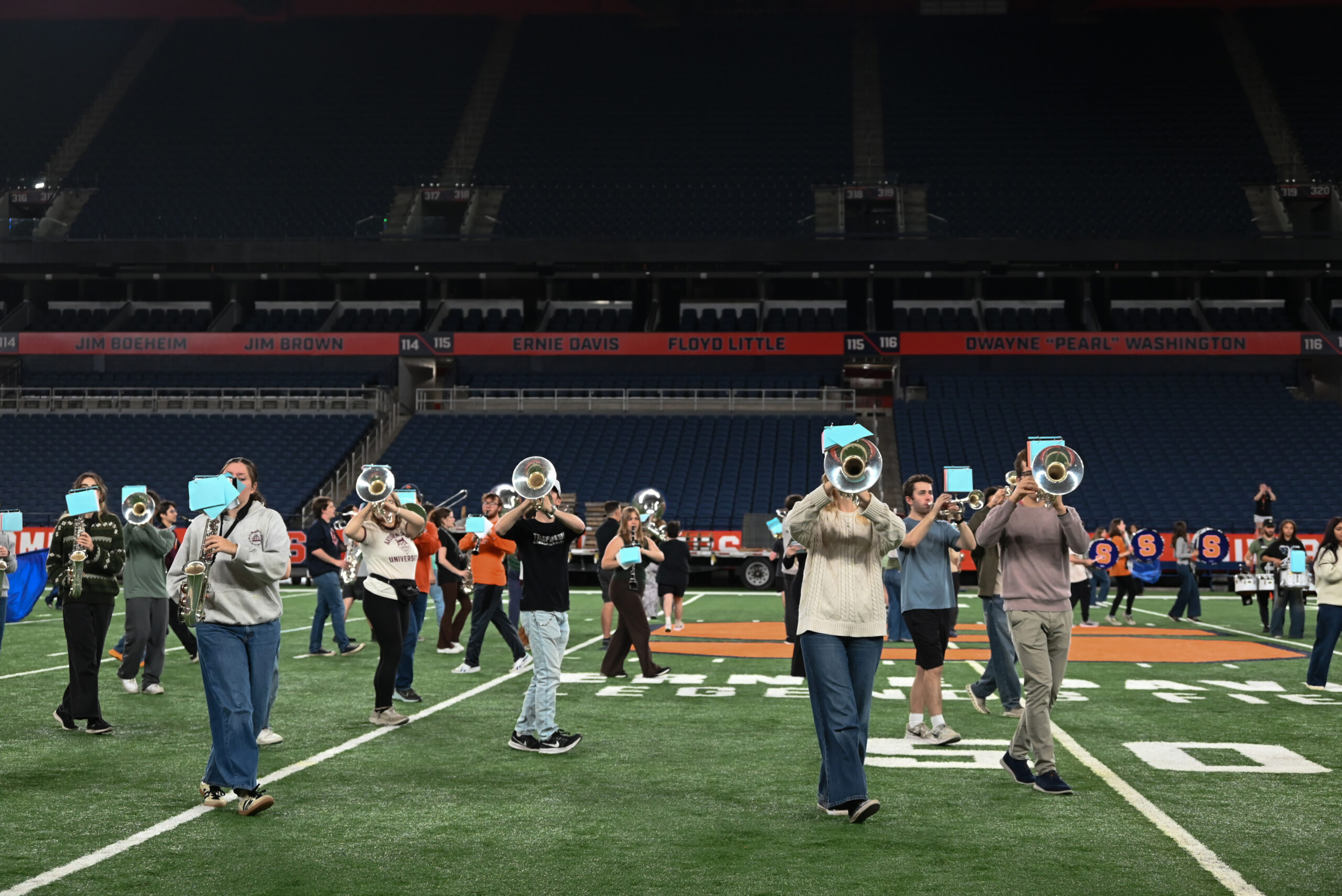
Members of the Syracuse University Marching Band practice their routine inside an empty JMA Wireless Dome. The band rehearses three times a week, with an added practice on Fridays for weeks with football games.Kai Pavola | Staff Photographer
Like Palmer, many members arrive at SU without a focus on music — Palmer estimated that only 30-40% of his bandmates were studying music. Marc Harwitz, a 1997 political science alum who played snare drum, said the range of musical experience levels makes the group so special.
“Most people who are in the band there are not music majors, and that’s great,” Harwitz said.
Regardless of major, the commitment is time-consuming. When Palmer marched, the band rehearsed Monday through Thursday from 6-8 p.m. During the weeks with game days, it held an additional Friday night rehearsal and Saturday rehearsal at 8 a.m. Members also arrived on the Quad 90 minutes before kickoff.
Josh Arndt, a 2023 chemical engineering alum, played tenor saxophone and followed a similar schedule. He rehearsed Monday, Wednesday and Thursday from 7-9 p.m., with extra sessions during game weeks.
“I felt like I was on a different schedule than a lot of my peers in engineering,” Arndt said. “I was kind of cramming stuff in between everything during the day.”
Current members face the same crunch. Laurel Wozniak, an SU junior drummer for the marching band, said the practices are a big commitment, even more so when there’s a game. Wozniak schedules her practice time in a calendar and does homework next to friends after rehearsal.
“I’m a big fan of my calendar,” Wozniak said. “I like to schedule time in my calendar, specific time for band, and it’s all labeled.”
And the marching band’s workload changes every week. Timothy Diem, who served as director of athletic bands for nine years, said the marching band used to perform about three routines per season. Now the band learns a new routine for nearly every game, which Wozniak said means getting used to new music and drills — the movements each marcher makes on the field.
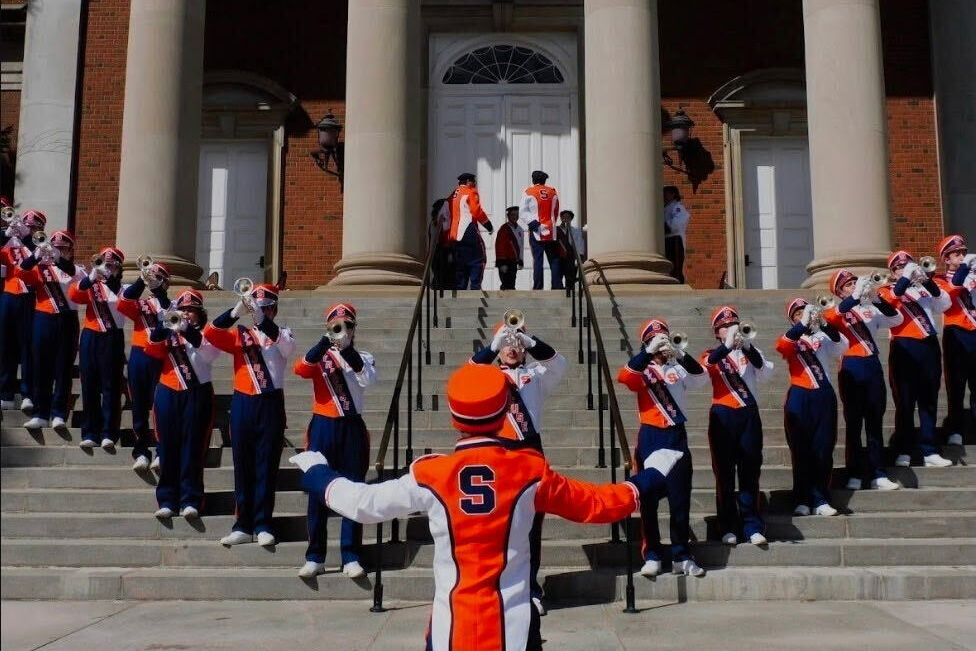
The Syracuse University Marching Band performs on the steps of Hendricks Chapel before a football game. Throughout its 125-year history, the marching band has established many traditions, including performing on tables at Varsity Pizza and tossing a saxophone player into the air. Courtesy of Jess Strausser
“It’s like those coordinate planes from high school where you had to plot the points,” Wozniak said. “Every point on that is a person.”
Distance hasn’t weakened those connections. Arndt now lives in Baltimore, but he drove more than five hours this season to watch the UConn football game with former bandmates.
The community extends beyond SU. Members also come from SUNY ESF, Le Moyne College, SUNY Oswego and Onondaga Community College. Jess Strausser, an ESF senior and marching band trumpet player, said having a good marching band was a major factor in choosing to attend ESF. When she joined during her freshman year, few ESF or Le Moyne students marched for the band, she said, but that’s changed.
“Being in marching band and working together for the same goal, you really get to know these people from the different schools, too,” Strausser said.
Diem, who joined in 2017, said building those bonds is the whole point of being a part of marching band.
“You might think it’s about music and you might think it’s about marching, and that’s part of it, but it’s not really the ‘it,’” Diem said.
The real “it,” Diem said, is the community that forms when students spend about 150 hours together each year. Diem still sees alums who graduated decades ago posting about weddings, children and reunions on Facebook.
WHAT YOU SHOULD READ NEXT
Banner flips, personal stages: 40 years of SU Marching Band’s Varsity tradition
For over 40 years, members of the Syracuse University Marching Band have taken over Varsity Pizza after a football win for a musical, table-topping performance.
Many of the traditions that hold those bonds together have outlasted the people who started them. Tracy Leenman, a 1977 music education alum who played alto saxophone in the marching band, said the chant that members recite while marching to the stadium began with her class. Leenman spent two years in the band, one as assistant drum major. She credits then-director Norbert Buskey with writing the mantra.
“Who’s that marching down the street? A huge machine that can’t be beat. There’s nothing finer in the land but the Syracuse marching band,” Leenman said, remembering the chant.
For more than 40 years, marching band members have gathered at Varsity Pizza after home wins, where they stand on the tables and flip the opponent’s flag upside down, Wozniak said, as long as the restaurant lets them.
Smaller traditions live inside each band section. After Quad shows, Arndt’s fellow tenor saxophones performed a “tenor toss,” where one member lies across six players’ arms and gets launched into the air. Arndt said those section rituals mattered as much to him as the team-wide ones.
“I really cherish the niche ones we would make within our sections,” Arndt said.
Every game day, the trumpet section plays at a tailgate near the Quad hosted by the same family, a tradition that predates Strausser. At the last game of the season, she said, the family wraps and gives the section gloves and socks as gifts.
“There’s like 30 of us, but the fact that they’re taking time to spend money and wrap gifts for us, it’s really sweet,” Strausser said.
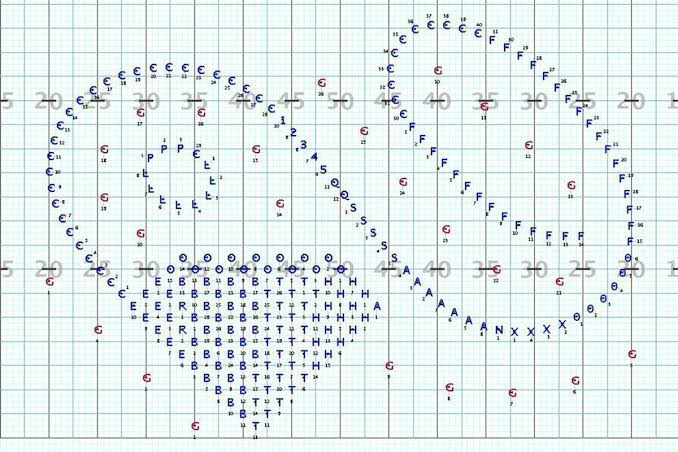
A drill chart shows the formation of the Syracuse University Marching Band during the time Tracy Leenman was in the band in the 1970s. While routines, band directors and traditions have changed throughout their 125-year history, the strong community has stayed the same. Courtesy of Jess Strausser
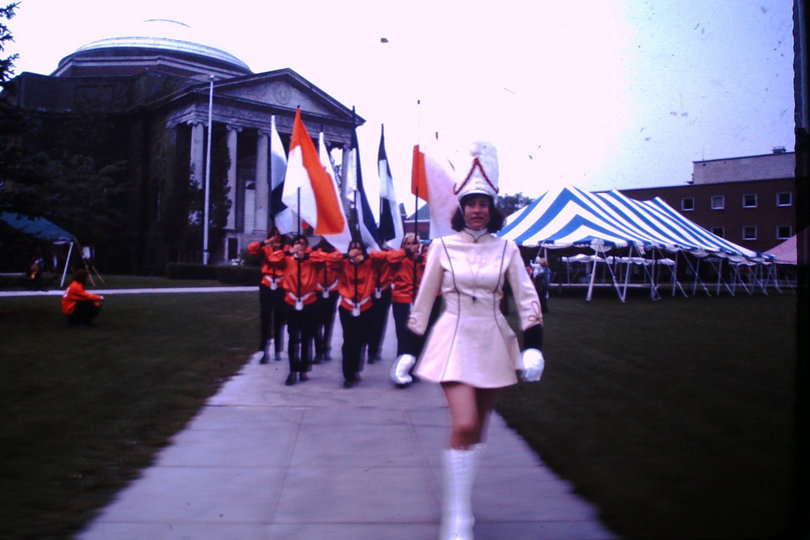
However, not all of the marching band’s history is positive. The band welcomed women for the first time in 1941, when many of its male members had left to fight in World War II. Majorettes — performers who combine dancing, gymnastics and baton twirling — and the band’s first baton twirler, Jessie Anne Harp, debuted in 1945. Women didn’t join as marching musicians until 1966, when 22 women signed up.
By the time Leenman joined her junior year in 1975, women could march, but she said the culture around leadership hadn’t kept up. Leenman said Buskey ran the band like a “military unit” and refused to let members go indoors, even during sub-zero temperatures.
“He acted like he was a drill sergeant, and we were his privates, and it just didn’t go over well with anybody,” Leenman said.
That attitude shaped the drum major auditions the following year, Leenman said. That year, Leenman scored first ahead of Ruth Gerster in second and Joe Dovi in third. Buskey then told the group he’d always meant for the highest-scoring man to get the job. Dovi became drum major, Leenman became his assistant, and Gerster quit.
“(Sexism) was a lot more prevalent back then anyway,” Leenman said. “It’s how things were back then. It wasn’t totally unexpected.”
Today, women hold the band’s top leadership roles. Emma Holman, an SU senior and percussionist, is one of this season’s drum majors.
In the decades that followed, the marching band has also changed in other ways. By the mid-1990s, high school marching bands had grown more competitive, and many students arrived with more drum corps experience than before.
Harwitz and a few fellow percussionists wanted the SU drumline to match that level. Because of this, the snare section shrank from eight or nine players to four as some members dropped out rather than take on the extra work, Harwitz said. Then it grew again, he said, built “the right way,” with more discipline and drive.
Harwitz’s drumline also wrote a new routine for running onto the field. Recently, he saw on YouTube that the marching band still uses it.
“It’s amazing seeing what we implemented is still used,” Harwitz said. “It feels great.”
The group also changed leaders. Longtime SU Marching Band director Bradley Ethington retired this summer. Diem is now the director of bands, and Natalie Smith joined as assistant director.
For Palmer, none of that changes what the marching band gave him. To this day, Palmer calls the decision to join the best of his college career.
“I think that camaraderie, that experience, transcends age. It transcends time,” Palmer said. “And again, that’s the best decision I ever made.”