SU’s Indigenous community reconciles trauma, healing on ‘Orange Shirt Day’
Get the latest Syracuse news delivered right to your inbox.
Subscribe to our newsletter here.
Content note: This article includes mentions of suicide.
The first time Dawn Cheryl Hill held her own beadwork, she couldn’t contain the pride she felt for creating a piece of art that’s true to her ancestry.
Indigenous survivors of residential boarding schools for generations were instructed to reject their heritage and accept a new culture, language and way of life. Hill said that healing is still needed.
“I made this,” Hill, an author, said. “This didn’t exist before I picked up my needle and thread and I thank my mother for that. This I made as an homage to the survivors.”
Syracuse University’s Indigenous Students at Syracuse and Center For Global Indigenous Cultures and Environmental Justice commemorated “Orange Shirt Day” with Hill, sharing a lecture on residential boarding schools and community healing.
Orange Shirt Day is an annual day of “hope” and “reconciliation,” that acknowledges the longstanding legacy of residential schools in the United States and Canada and seeks to commit to building a “better future,” according to the Orange Shirt Society Website.
Hill, an enrolled member of the Six Nations of the Grand River Dawn, focused much of her lecture explaining the history of these schools and the “trauma” students endured while at these sites.
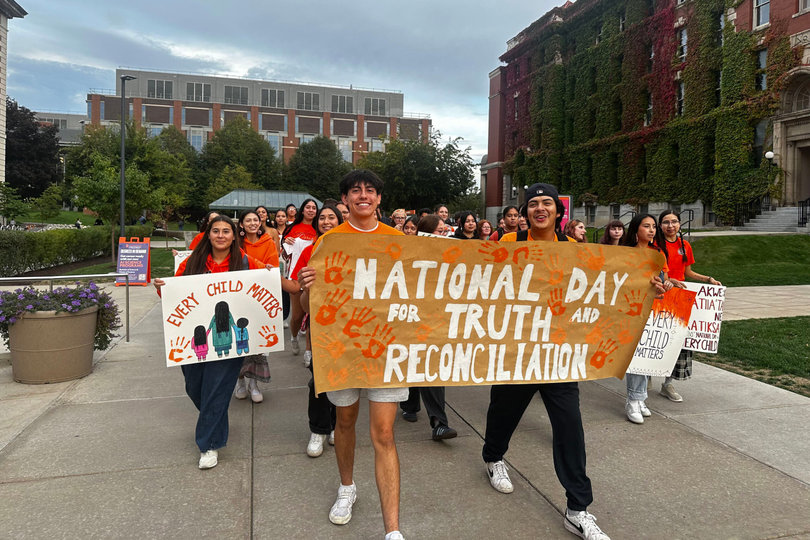
Following Hill’s lecture, dozens of students, all wearing orange, filed out of the classroom and onto the Shaw Quadrangle, where sophomore Jerry Mosqueda and senior executive board member Mac Powless held a banner marking the front of a procession in which each student carried posters that read “every child matters,” the slogan of Orange Shirt Day.
Students marched together across the quad before circling around the “Great Law of Peace” memorial outside Shaffer Art Building for a moment of silence and brief remarks.
Many of the students in attendance said they were linked by a shared lineage that traces back to residential schools.
As the daughter of two parents who had no choice but to attend two different residential schools, Hill said she felt the weight of retelling the history her lineage endured.
Hill said suicides spiked during the fall, with the fear of returning to residential schools being a key reason. Cases of suicide also spiked during the holidays, Hill said, as a result of parents waiting for children who died while at residential school to come home.
“Fall was the season of dread, rupture and loss,” Hill said while recounting a story to the crowd.
Over 6,000 children died while at a residential school in Canada alone, Hill said. She said the reasons for this figure were not a coincidence.
Orange Shirt Day, which is formally named National Day for Truth and Reconciliation, uses the “every child matters” slogan to highlight the experiences of those affected by residential schools. For students like sophomore Issac White Jr., the message is meaningful.
“(It) speaks to us preserving the history of all the children lost in these boarding schools,” White said. “Whether they went missing or were murdered, whatever happened, it’s important to keep in mind that every child does matter.”
Hill said that children were experimented upon while at residential schools, including intentional malnutrition, psychological testing and “widespread” physical, sexual and emotional abuse. That experimentation contributed to intergenerational trauma that requires healing, Hill said.
Schools broke apart families, Hill said, while also forbidding native languages, practices, traditions and spirituality. The institutions replaced their culture with “forced conversion” to the English language, Christianity and white-oriented American values, she said.
“Each and every one person here is either a residential school survivor, the child of a residential school survivor or a grandchild,” Powless said. “All of us are at least one of those things.”
Powless acknowledged that while it may surprise the average SU student, the history of residential schools is not so ancient.
“It’s really not history,” Powless said. “The last (school) closed in Canada in 1998.”
Hill recounted hearing her mother’s stories from her time enrolled at the Mohawk Institute Residential School in Ontario, or the “Mush Hole” as former students and Indigenous communities called it, referencing the “mush” students had to eat for breakfast, lunch and dinner.
When Hill asked her mother the “simple” question of her age when she enrolled at the “Mush Hole,” Hill said that her mother disappeared.
“Her eyes went blank,” Hill said. “It looked like this other memory had unexpectedly swept across her eyes and she no longer saw me.”
The trauma her mother carried, as well as the thousands of other cases of post-traumatic stress disorder, anxiety and depression that others like her faced, inspired Hill to write her book, “Memory Keeper” and the primary focus of her lecture: healing.
While explaining the various holistic methods that seek to heal intergenerational trauma of survivors of residential school and their descendants, Hill described methods like land-based healing, therapy, healing circles and collaborations with elders that “taps into collective wisdom,” anti-racist therapy, art therapy and language revitalization.
“Language revitalization is a process of healing,” Hill said. “The intergenerational transmission of knowledge, which the boarding school system was intended to serve.”
Hill said some of the most important therapeutic techniques, like language revitalization, incorporate relearning the cultural practices of one’s ancestry and passing them on to future generations. She displayed slides showcasing her children and grandchildren’s beadwork and traditional attire, including the Indigenous garments that her daughter wore as she graduated from SU.
Even for those who did not directly attend residential schools, students including White spoke about the reality of intergenerational trauma within their own experience and the persisting effects of these experiences on their children and their children’s children.
“My grandmother actually was in a boarding school… just seeing some of the things she does in her life, I can see that she was definitely affected, and some of that I can see was transferred to my mother as well, and some of it to me,” White said. “It’s still affecting us today. That I can definitely speak to. It still affects a lot of us today.”