Learn how these SU professors infuse personal flair into everyday outfits
Get the latest Syracuse news delivered right to your inbox.
Subscribe to our newsletter here.
Every day, Syracuse University professor Carrie Riby looks to her advertising students to see what’s trending — like two-piece monochromatic sets, flip-flops and the SU-themed Parke mockneck sweaters. Using her students as muses, Riby’s decades-old closet breathes new life as she decides on her outfit of the day.
“I am inspired by the students on so many levels because every year, there’s new fashion trends that come on and off the campus,” Riby said. “I’ll look at something that I’ve probably had for 20 years, going, ‘I could wear that now.’”
At SU, it’s not just students who experiment with their class attire and style. Some professors, like Riby, have swapped the usual button-up and tie or blouse and slacks for something bold and individualistic.
Coming from the business side of advertising, Riby said she came from an era where everyone wore business suits to work. That’s why when she started teaching at SU, Riby opted to express herself more creatively to show her students the “fun side” of advertising.
“It’s like the Catholic schoolgirl that took the skirt and dropped it up five inches. That’s the same mentality,” Riby said. “I can wear a hot pink shirt and some crazy jewelry to go with it.”

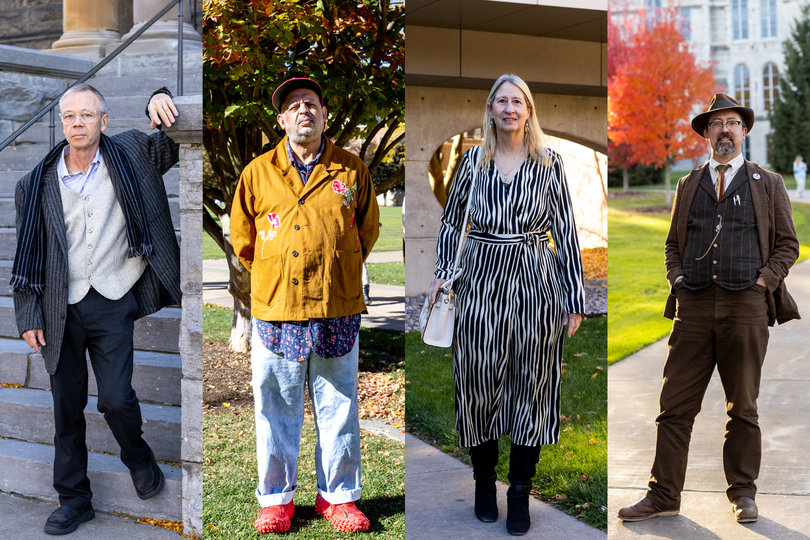
Advertising professor Carrie Riby waves to her students outside of the Newhouse School of Public Communications. Riby oftentimes looks to her students for current fashion trends to build her outfits. Tara Deluca | Photo Editor
Riby’s closet has acted as a time capsule; many of her pieces are older than her kids, who are in their 30s. Riby’s expansive selection of attire is why she’s rarely seen at a clothing store. But if she ever needs pieces of an ensemble, she can be found at a boutique or receiving freebies from her daughter, who works at Michael Kors. Riby remembered the time her daughter told her about a Zac Posen sample sale in the city, where Riby scored an orange Posen dress in the mid-2000s, around the same time she was hired to teach at the Newhouse School of Public Communications.
Other SU professors, like Zeke Leonard, also have closets that stretch back decades — his large tie collection dates back to the 1920s.
If Leonard, who teaches environmental and interior design, were a professor from the early- or mid-20th century, he’d blend right in. But in 2026, Leonard’s style is discernible. Leonard associates his fashion with authors like J.R.R. Tolkien, C.S. Lewis and, for movie fans, Indiana Jones and Professor Horace Slughorn from “Harry Potter.”
No matter the class, Leonard shows up to Smith Hall and the Nancy Cantor Warehouse wearing a tweed suit with many pockets (but, if it’s warm out, wool or linen), a gold watch chain, a fedora and most importantly, one of his over 100 ties. If SU’s campus is blanketed in snow, Leonard will probably wear a 1950s tie patterned with snowflakes; in the fall, he’ll sport a tie with a pheasant. But what sets his work apart is his overall monochromatic ensembles.
“I’m terrified of color,” Leonard said. “So I wear brown almost exclusively.”
Among other quirks, Leonard refuses to wear any clothing item with words in his outfits, something he’s done for over 10 years, he said.
“I don’t want to advertise for somebody else’s brand unless they’re paying me.”
While Leonard can show off bits of his personality through his outfits, he always maintains professionalism. With SU students paying thousands in tuition, Leonard reciprocates that professional relationship with his students not just through his teaching, but through his “uniform” as well, he said.

Environmental and interior design professor Zeke Leonard wears his brown suit jacket accompanied with a brown tie. Leonard’s closet spans decades, going back to the 1920s. Tara Deluca | Photo Editor
Among the School of Design students, Leonard’s earned the nickname Mr. Brown, but he’s not the only School of Design professor with a distinct style. His colleague, professor Dennis Earl, is known by students as Mr. Gray for his all-gray ensembles.
Although Riby looks to the latest fashion trends, Earl steers clear of them for his style. To him, it’s all about quality.
“What a lot of it is (is) what I think is beautiful, like color combinations, texture combinations. I like what’s going on in this as just an aesthetic thing,” Earl said. “You could say, well, that’s the definition of fashion. But I think of fashion as so much caught up in trends and the commercial industry of fashion, which I really have no interest in.”
Earl has always strayed away from trends throughout his life. That may have something to do with his personality as someone who is “against the grain.”
Earl focuses on quality fashion because of his skepticism, prioritizing materials and textures, and his personality. As someone who is more “restrained,” shades of gray reflect his quiet side; he rarely wears anything with “a lot of flash.”
“I’m a little bit claustrophobic, and I think of that as related to not liking rules or constraints too much,” Earl said. “I think of trends as a little bit of a claustrophobic thing for me, so I like to feel like I can do what I want.”

Environmental and interior design professor Dennis Earl sports a dark gray striped scarf, suit jacket and a light gray vest. Earl’s all-gray ensemble has earned him the nickname Mr. Gray among School of Design students. Tara Deluca | Photo Editor
Though Riby looks at what’s trending on campus, she rarely purchases new articles of clothing. Last week, Riby wore a leather jacket layered with a leopard print dress she’s had for over 30 years, one of the many trends that’s reemerged with Gen Z fashion.
Riby and her daughter often swap clothes, since both share the same size and fashion sense. However, in the few instances Riby does go shopping, it’ll always be with her daughter, even if she lives 250 miles away. Shopping with her daughter is not only a bonding activity, it’s also when Riby receives the most honest fashion advice — usually the opposite of Riby’s husband.
“What do you think of this outfit? Does it make me look fat?” Riby asks.
“Yes, it does,” her daughter responds.
“I’m going. I’ll see you later,” her husband says.
Riby’s eclectic style is indicative of the creative side of advertising, while Earl’s more muted style is similar to a rainy day with a heavy overcast, something Earl enjoys.
College of Visual and Performing Arts photography professor Yasser Aggour reflects the polar opposite of Earl. His style is only something Aggour could put in his own words.
“Without sounding pretentious, although it always does sound pretentious, I think it’s a combination of different things,” Aggour said. “It’s quirky. It’s a little bit streetwear. It’s also kind of Americana heritage, but often seen through either European or Japanese lens.”

Photography professor Yasser Aggour dons his red, chunky Balenciaga sneakers, which he wears almost every day. Aggour described his fashion style as a mix of streetwear and Americana heritage. Tara Deluca | Photo Editor
As a self-proclaimed “maximalist,” Aggour usually checks off three categories with his outfits: pattern, color and texture. Sometimes, Aggour crosses the line, where his style becomes a “fashion epic,” he admits.
While his style has evolved throughout the years, Aggour’s over-the-top style has stayed consistent. But like Earl, Aggour doesn’t do trends. While Aggour’s gone through periods where his fashion style is a bit preppier or more punk, fashion taste is more complicated than trends or textiles to him.
“Taste is one of the least academically understood areas I think of as a human endeavor,” Aggour said. “Where does taste come from? What’s considered good taste and bad taste? Is it purely class-based?”
While Riby, Leonard and Earl use their attire as a way to be taken seriously in the classroom, Aggour primarily sees his everyday wear as a way to show his individuality.
“I don’t think I’m too worried about being taken seriously,” Aggour said. “I’m self-confident in that the information I’m providing doesn’t require the accouterments of authority.”
Aggour’s style is recognizable to students on campus. As a “shopaholic,” Aggour jokes that he has “one of the largest closets in the country.” Aggour travels a lot, which is why he purchases clothes from places like Paris, Malaysia and his hometown of New York City. Aggour buys items from brands like Belgian’s Dries Van Noten, Japan’s Comme des Garçons and Alessandro Michele’s Gucci era, but his bright, chunky Balenciaga sneakers are what he often gets complimented on by his students.
On the other hand, Leonard typically purchases his clothes from thrift stores. While living in New York in the 1990s, he’d often visit thrift and antique shops, where catalogues go back decades. In fact, at the time, Leonard could find three-piece gabardine suits from the 1920s. Today, Leonard still ventures to thrift stores — sometimes with Earl in Japan. However, his choices have gotten more selective as his mid-century fashion taste has waned in stores. Instead, he now finds hidden goods on eBay.
WHAT YOU SHOULD READ NEXT
Runway pieces dissect anatomy at PhiDE, FADS’ fundraising fashion show
Syracuse University’s Phi Delta Epsilon chapter collaborated with SU’s Fashion and Design Society for its second-annual Anatomy Fashion Show, which raises money for Upstate Golisano Children’s Hospital through the Children’s Miracle Network.
While Aggour and Leonard feature vastly different styles and spending habits, both feel their ensembles don’t tell the full truth of their personality. Upon first glance, one may think Aggour’s pattern-meshing and vibrant attire signifies a person who skateboards or enjoys hip-hop and raves. But Aggour doesn’t see himself as that, rather, someone who is “book-ish” and eccentric with “a weird sense of humor.”
Similarly, Leonard said his love for old pieces of clothing is a testament to his passions in history and sustainability. But his everyday wear to campus doesn’t show his tattoos, his love for punk music or that he plays in a rock band. For Leonard, it’s “fun” to display parts of his identity through fashion.
“Fashion is how we communicate who we think we are to the world,” Leonard said. “Even if you say, ‘Oh, I didn’t put any thought into what I wore today,’ you’re still communicating who you are to the world.”