UConn’s 27 straight 2nd-half points push Syracuse to brink in OT victory
Get the latest Syracuse news delivered right to your inbox. Subscribe to our sports newsletter here.
EAST HARTFORD, Conn. — After Syracuse’s narrow victory over UConn Saturday, Fran Brown took all the blame.
The Orange, on paper, shouldn’t be in a shootout with a non-Power Four team, regardless of its caliber. But a lot went wrong against the Huskies, and, as a result, Brown dealt with an avalanche Saturday.
The main thing was the Orange’s defensive breakdown — allowing 27 unanswered points despite leading by 20 at one point in the second half. Brown didn’t want to throw Vince Kehres, SU’s first-year defensive coordinator, under the bus, even if Kehres was the one calling plays and setting Syracuse’s scheme.
“Coach V.K, I’ll never try to take credit from him, he did good,” Brown said. “Everything bad is me, good is him.”
Syracuse’s defense was rolling in the first half, but it completely shut off for most of the second, despite the win. The Orange allowed 302 total yards and four touchdowns in the back 30 minutes, plus overtime, despite UConn only having the ball for just over nine minutes. The breakdown helped the Huskies tie the game early in the fourth quarter and take the lead in overtime, when SU finally pulled out the win for good.
“It shifted as a football game,” Brown said postgame of the defensive breakdown’s effect. “They had the momentum honestly all the way up until the two-point conversion when it comes to the second half.”
Syracuse’s defense hadn’t been its main issue entering the game. In losses to Cal and Pitt, most scrutiny fell on the offense, including Steve Angeli’s woes, red zone struggles and continued penalties.
Against Cal and Pitt, the defense allowed 41 combined points.
Saturday’s game started similarly, as Syracuse jumped out to a 27-7 lead late in the second quarter and 34-14 midway through the third. SU made the stops it needed and got pressure on UConn quarterback Kalieb Osbourne.
Brown said making Osbourne’s day hard was part of his and Kehres’ gameplan to “figure out what he can do” and go from there.
It was exactly what the Orange needed after falling to 1-2 — handling the easiest remaining team on their schedule. Give them a boost entering two tough matchups against Virginia and Louisville.
Then, everything broke.
Cyncir Bowers jumped through a hole and scampered in for a 10-yard score late in the third. 34-20. Then, Osbourne hit a wide-open Xavier Watson in the flat for a seven-yard touchdown. 34-27.
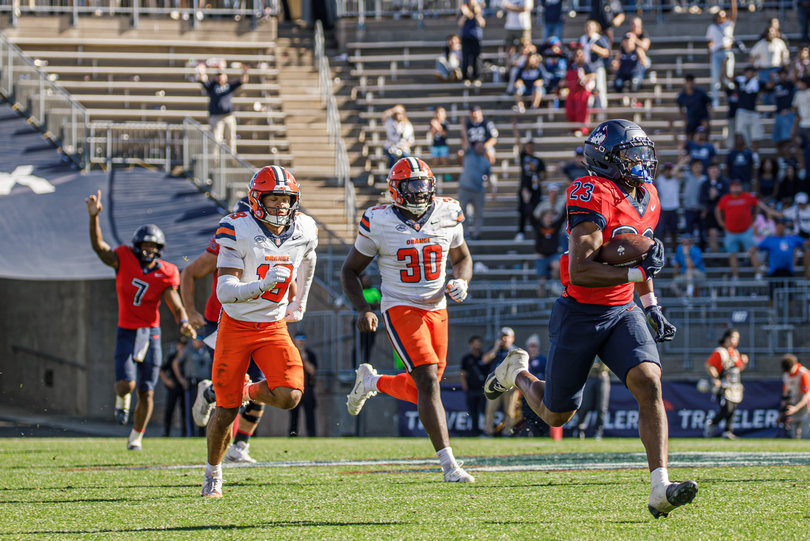
Bowers tied the game via a 71-yard touchdown run. He didn’t even need to do much; a massive hole parted on the right side, and he wasn’t touched the rest of the way. In overtime, UConn scored first before Amari Odom’s clutch fourth-down touchdown pass and subsequent two-point conversion run to steal the win.
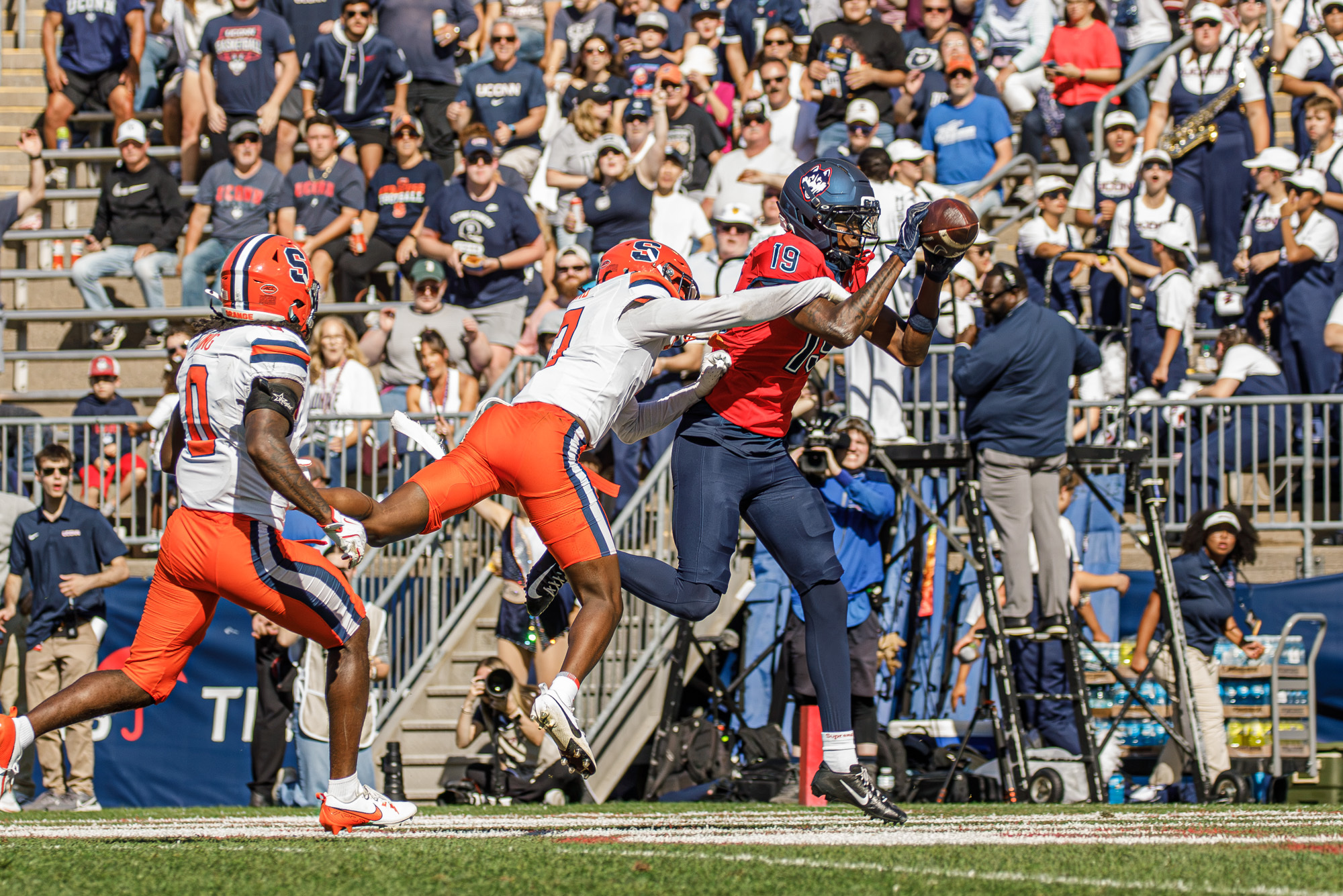
UConn wide receiver Javon Brown hauls in a pass during Syracuse’s 42-41 overtime win over the Huskies Saturday. Plays like these helped UConn come back from a 34-14 deficit, but ultimately, SU prevailed. Avery Magee | Development Editor
When asked postgame about what went wrong, Brown quickly pointed to the Orange’s rush defense, as shown by Bowers’ two scores. UConn had 14 first-half rushing yards. It added 167 in the second.
In the passing game, Huskies receivers often had room for days. Brown criticized his defensive backs — the position he previously coached at Georgia and still has plenty of influence over at SU — saying no one looked sharp. He added that it was less about receivers getting separation and more about contested catches that consistently went UConn’s way.
“All the DBs seemed like they had a little bit of rust on them out there,” Brown said.
Brown made one major defensive change — moving Chris Peal from corner to safety. Peal has been SU’s No. 1 corner after entering the season as a projected first-round pick in some mock drafts.
He also looked rusty in his new position, Brown felt, adding that he needs Peal playing deeper in the future.
Brown remains optimistic, though. Optimistic about Peal, optimistic about the unit as a whole. He doesn’t see it being this bad in the future.
“I feel that’s the worst they’re probably gonna play,” Brown said of his defensive backs. “That’s not usually who they are.”
Of course, Syracuse’s offense didn’t help much in the second half. Odom went from an 88% completion rate to 62% in the frame and didn’t throw another touchdown for the last 23 minutes of regulation. He also tossed two interceptions and had another drive end on downs.
That surely didn’t help SU’s defense as momentum continued shifting in UConn’s favor throughout the fourth quarter. But it doesn’t excuse the results either.
Opponents like UConn, which entered 2-2 with losses to Maryland and Miami (Ohio), should be games where Syracuse can get right and even experiment with players like freshman receiver Calvin Russell or Odom.
Initially, it looked like that would happen. Then, the Orange completely lost it.
And as miscues continue piling up, the “bad” as Brown put it, he’ll continue shouldering the load. At this point, his back must be close to breaking.