Pedro Gulli understands failure well — it’s what pushed him to Syracuse

Get the latest Syracuse news delivered right to your inbox.
Subscribe to our newsletter here.
Pedro Gulli has always focused on the past.
But the McGill forward wasn’t thinking about the goals he’d scored, the minutes he’d played, the hardships he’d endured or even his greatest accomplishments. At some point on this October 2025 day, Gulli learned to stop caring. To stop hiding. To shut off.
Minutes before the Redbirds were set to face Concordia, Gulli got a call from his mother that changed everything. He learned his father, Guillermo Gulli, was in the hospital after suffering a stroke. In that moment, nothing else mattered.
Gulli still took the pitch as if it were any other game. He didn’t tell anyone of the tragic news he’d received. In the 66th minute, he was subbed off after deliberately drawing a yellow card, yet he’d already contributed two goals and two assists.
“That’s the thing with Pedro; soccer was his safe space,” said Josten Ferri, one of Gulli’s childhood friends. “He just went into that game and used that as fuel.”
Gulli didn’t stay for the rest of the match, nor even go to the locker room. Instead, he booked it to the hospital, where his mother and sister stood beside his bedridden father in tears. As the doctor updated Gulli on Guillermo’s condition, his phone rang. It showed an unknown United States number, but he promptly declined.
Then it rang again. This time, he answered.
“This is Matty Evans from Syracuse University. I saw your past game, and I’d be very interested in bringing you in next year,” Gulli recalled hearing on the other end.
Fast forward one year, the call from Evans, Syracuse men’s soccer’s assistant coach, went a long way. Gulli’s at SU, where — with one regular-season match left — he’s tied for the team lead with four goals. But Evans’ call was a rare bright spot during a dark time for Gulli.
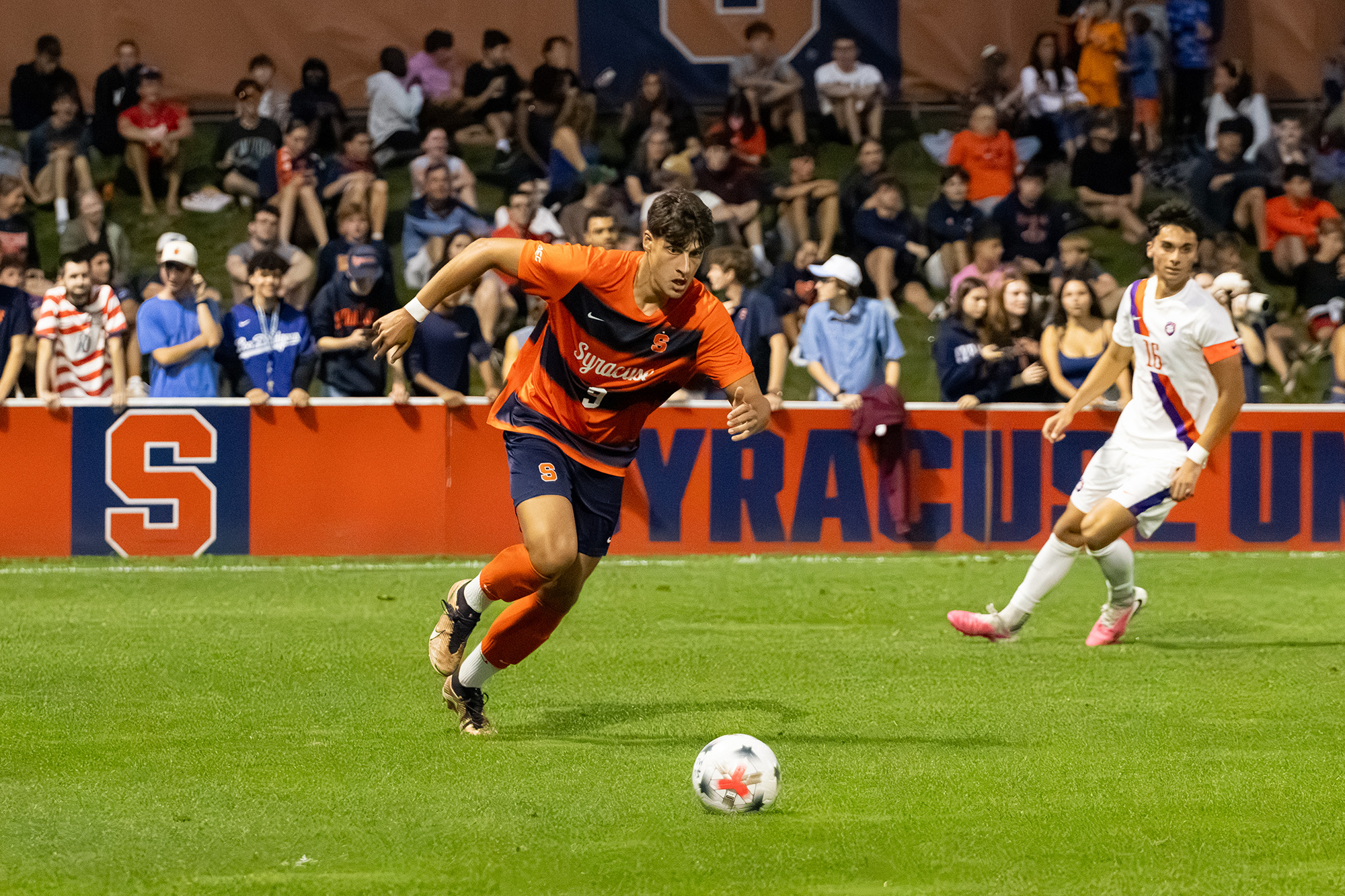
Pedro Gulli dribbles upfield during Syracuse’s loss to Clemson on Sept. 4. Gulli spent two seasons at McGill in Montreal before joining the Orange this offseason. Madison Cox | Staff Photographer
The graduate student fell in and out of depression. At times, his peers questioned and feared for his mental state. Shortly after his father’s stroke, Gulli’s mother suffered one, too. He said he looked left and right and felt like no one was there.
In Ferri’s words, Gulli smiled for the camera. He seemed to have it all — an engineering degree, a high IQ, a brawny physique, a Division I soccer career.
But there’s a door. And behind it, Gulli wasn’t smiling.
“He worked his whole life. His parents came from nothing. Poor family. His dad’s working check to check, and he’s helping support his parents, too,” Ferri said. “I think people should realize that not all people are actually happy sometimes.”
When Gulli got the call about his father, he used soccer to escape a world he dreaded entering. But before it became his escape, he was a 6-foot-2, 260-pound teenager who hated it so much he quit for three years.
After the 2022 season with McGill and being cut by CF Montréal a few weeks later, Gulli severed all ties with old teammates and coaches. At age 19, he did everything he could to forget the sport that shaped his childhood.
At first, he succeeded. He started his own business, a math tutoring company, that Ferri said made “crazy money.” He had a girlfriend and thrived while studying civil engineering.
But remember that door; behind it, Gulli was depressed. Deep down, he missed soccer. So, when the opportunity arose to restart his career, Gulli couldn’t pass it up.
Lakeshore SC was located near Gulli’s hometown of Beaconsfield, Quebec, and Gulli, who admitted he was heavy at the time, viewed soccer as a way to lose weight. He joined the squad in summer 2025. And it quickly became so much more.
Ferri joked that Gulli woke up one day to find himself as the best player in Canada. He scored 22 goals in 19 games with Lakeshore, leading McGill’s coaches who once doubted him to beg for his allegiance.
Gulli agreed to rejoin the Redbirds for the 2025 season, and he made it his mission to prove he never should’ve been doubted in the first place.
“He got cut even when he was performing. Coaches overlooked him. They would sh-t on him,” Ferri said. “I’m so happy for him because of how far he came, and he can rub it in their face.”
Returning to McGill was less about Gulli’s future and more about making his past self proud. For most of his life, something had gone wrong.
I know what it's like to fail. I know what it's like to be on the other end of the stick where people think you're not good enough.Pedro Gulli, Syracuse striker
His family moved from Argentina to Canada when he was a few months old due to the 2002 Argentine economic crisis, one of the worst meltdowns in the country’s history. His parents lost all their money, and his house was robbed. After seeing a newspaper ad promoting cheap flights to Canada, the family moved so Gulli and his two sisters could have “the best possible chance at life.” But that meant leaving cousins, grandparents and other relatives behind.
Three years after he began playing soccer at age 10, Gulli got more life-changing news. Guillermo called Gulli and told him that, when he returned home from soccer tryouts, they should go to Tim Hortons, the Canadian coffee chain. Gulli’s father had something unbelievable to tell his 13-year-old son.
When they arrived, Guillermo explained that he’d just gotten off the phone with a coach from an Austrian club who wanted to sign Gulli. He initially assumed it was an opportunity one, maybe two years in the future, but instead, he’d leave in five days. He’d live with his father’s coworker and wasn’t sure how long he’d stay. But it was something new. A chance to grow.
So, he did it.
In Austria, Gulli spent three hours on public transit to get to training and school. He had to learn German and couldn’t stay unless he passed the proficiency test. He hated it then, and even after two years, people still viewed him as the “Canadian boy.”
And then, when it was time to cut two players, Gulli was one of them.
“Sometimes the things you love, they can hurt. And at the time, I really loved soccer,” Gulli said. “I think that was one of the biggest blows I’ve ever had, hearing the coach saying, ‘Pedro, we wish we could have you here, but you gotta go back to Canada. You gotta restart.’”
When he returned to Canada, things didn’t improve much. Gulli said people saw him as the kid who didn’t make it. The kid who failed. He struggled to make friends and was constantly bullied.
“I realized that I wasn’t really respected. No one really believed in me,” Gulli said. “That led to a few more years of soccer, awful soccer. I really wasn’t enjoying myself.”
His depressive state began. Gulli blocked off contact with friends and some family. He spoke with his father, who’d faced a similar fate being overlooked as a rugby player back in Argentina. But any noise consumed Gulli.
One of Gulli’s good friends, Karim Mehdi, hosts Canada’s leading semi-professional soccer podcast called ON S’EN FOOT. Mehdi naturally praised Gulli often, his burly frame and agile feet. He was a D-I athlete, a rare breed in Montreal.
But the doubt only increased. Because he was under a spotlight, he was also under a microscope. Every achievement was expected, yet every failure was another chance to tell Gulli he wasn’t good enough. The jabs kept coming.
“I know what it’s like to fail,” Gulli said. “I know what it’s like to be on the other end of the stick where people think you’re not good enough.”
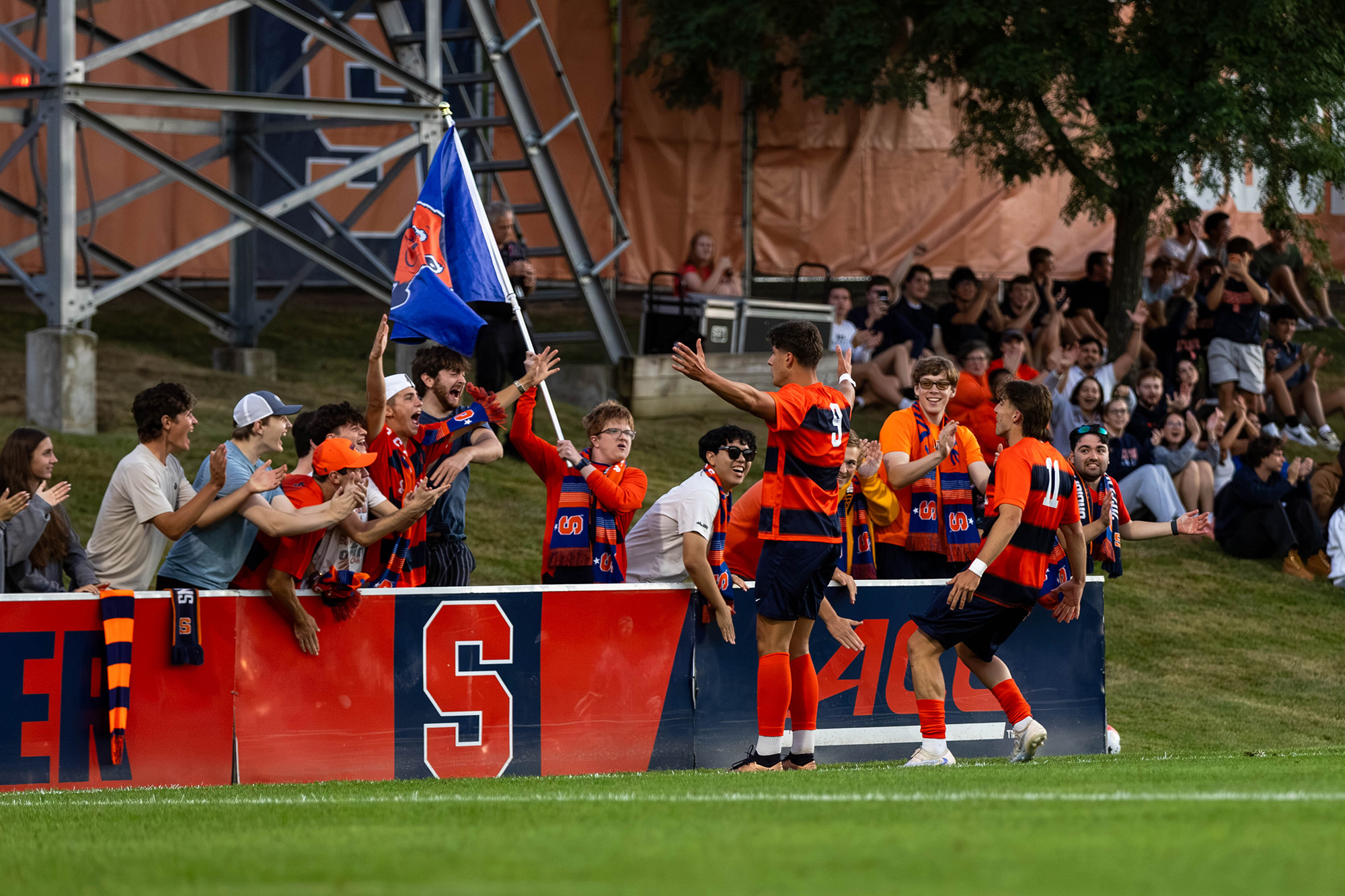
Pedro Gulli celebrates with a group of Syracuse fans after scoring in the Orange’s win over Loyola on Aug. 28. Gulli has become one of SU’s most reliable offensive players despite playing sparingly. Tara Deluca | Photo Editor
After a solid freshman season at McGill, CF Montréal offered Gulli a trial. He practiced with the team, but he was eventually cut. Then, he quit.
“Those words hurt me a lot,” Gulli said.
He focused on his education, yet struggled to take soccer lightly. He played with friends for fun, but by the time he left the field, he was often crying.
“You could still see that mentally, he wasn’t tapped in,” Mehdi said. “Any adversity, he would go like, ‘Oh, screw this, I don’t wanna play anymore, I’m going home.’”
After Lakeshore, Gulli returned to McGill. He broke out against Concordia, and at a time filled with darkness, Evans’ call was a bright light. But Gulli’s life didn’t get easier.
While his dad recovered in the hospital, he rotated with his mother and sister to keep him company. He pulled all-nighters in the McGill library and at the hospital beside Guillermo.
Evans also said that for Gulli to come to Syracuse, he had to be a graduate student. To reach that status, he took 27 credits, nine classes, in one semester.
“We would be studying together in the library almost every day for midterms and finals,” said Norman Bhuller, one of Gulli’s classmates. “Then, at one point, he’s like, ‘OK, now I’ve gotta go to practice, and then after practice I have to go train and then repeat all of that the next day.’”
Now, at Syracuse, Gulli sometimes returns to focusing on the past despite his best efforts.
Gulli’s appeared in all 15 of Syracuse’s matches, yet he’s started just two, and his 510 minutes rank 15th on the team. He’s thrived in limited time, but the numbers remind him of what he’s been through.
“He scored big goals,” SU head coach Ian McIntyre said of Gulli. “(But) he’s unfortunate not to be playing more, and he’s unfortunate to not have started more games.”
Most people don’t know Gulli’s whole story. He hesitated to tell his Syracuse teammates about his past because it stirred up emotions. Everything he’s been through still causes him to tear up.
Gulli’s finally ready to look forward. The past is the past for a reason. But it’s also the reason he’s here.
“The only way to succeed is to fail,” Gulli said.