

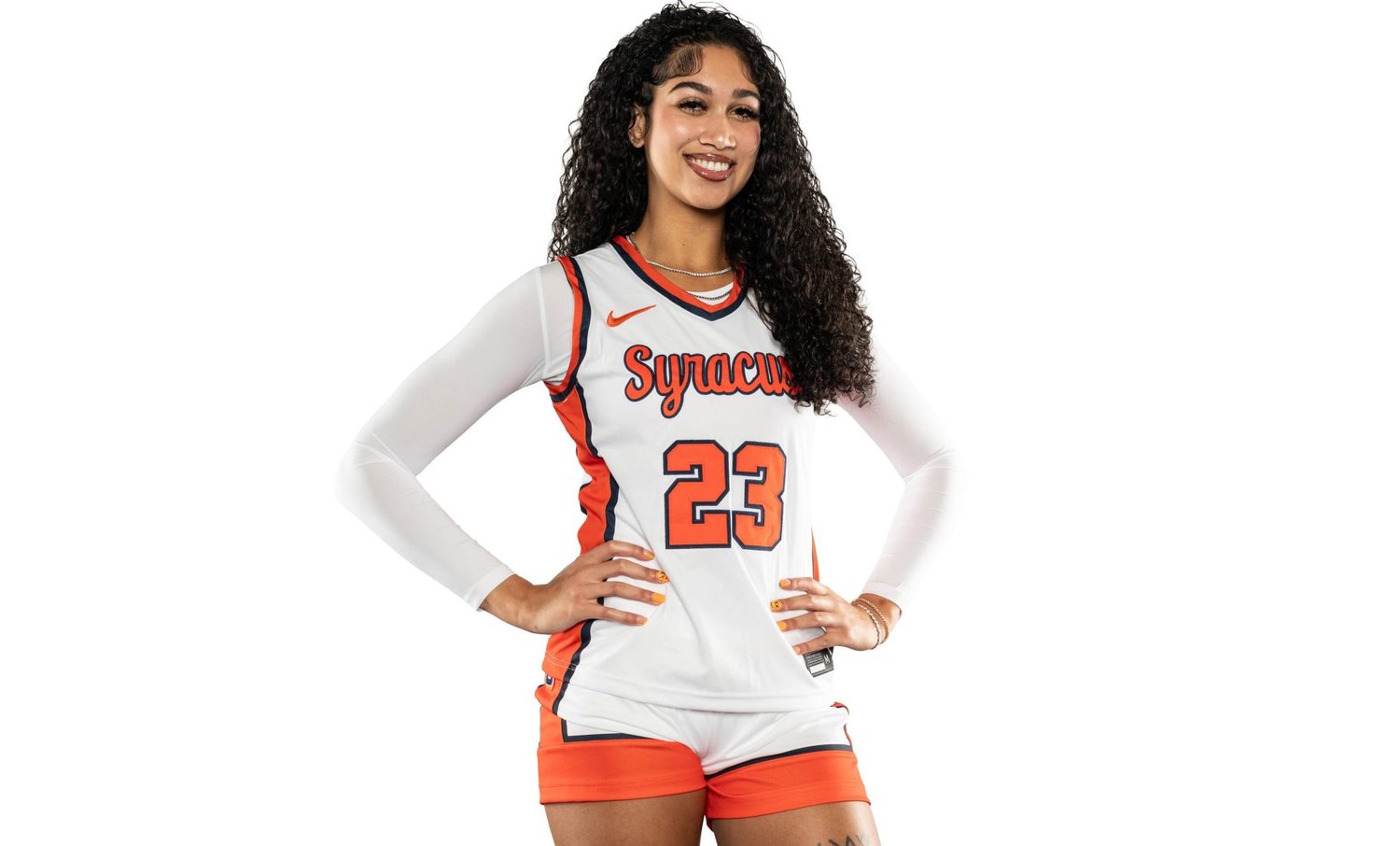
W
hen Sarah Rambus first met Jim Boeheim, she didn’t know who he was.
Rambus walked out of a training room and saw her head coach, Felisha Legette-Jack, watching a Syracuse men’s basketball practice with Boeheim. SU’s senior forward had never met the legendary coach but wasn’t afraid to introduce herself.
Boeheim, who coached SU men’s basketball from 1976-2023 and won the program’s only national title in 2003, was impressed by Rambus’ confidence and respect.
“That young lady understands the culture here,” Boeheim told Legette-Jack.
Rambus felt honored by Boeheim’s comments. For Legette-Jack, it’s part of the culture she’s building at SU.
“Those are things that we really think are imperative for this program,” Legette-Jack said. “It’s too important. It means way too much.”
Confidence. It’s something Rambus had when interacting with Boeheim but lacked at Oregon. Throughout three years with the Ducks, Rambus played center instead of power forward and felt she wasn’t unlocking her potential. So, she transferred to Syracuse, where she can maximize her skill set alongside reigning Atlantic Coast Conference Rookie of the Year Uche Izoje.
“We’re gonna put the ball in her hands,” SU general manager Mykala Walker said of Rambus. “We’re gonna let her loose. We’re gonna put her in positions where she can showcase what she’s really good at.”
A key reason Rambus chose Oregon was head coach Kelly Graves’ track record of players reaching the WNBA. Sabrina Ionescu. Satou Sabally. Nyara Sabally. The list goes on.
As a freshman, Rambus started just once and averaged 3.5 points per game on an 11-21 squad. She sat behind starting forward Grace VanSlooten and was inspired by how VanSlooten constantly had the ball in her hands and never stood still.
Rambus’ field-goal percentage jumped from 41.1% in Year 1 to 48.9% in Year 2, yet she still only started once. She started 17 times her junior year, averaging career highs in points (6.3), rebounds (2.4), assists (0.8) and field-goal percentage (53.7%).
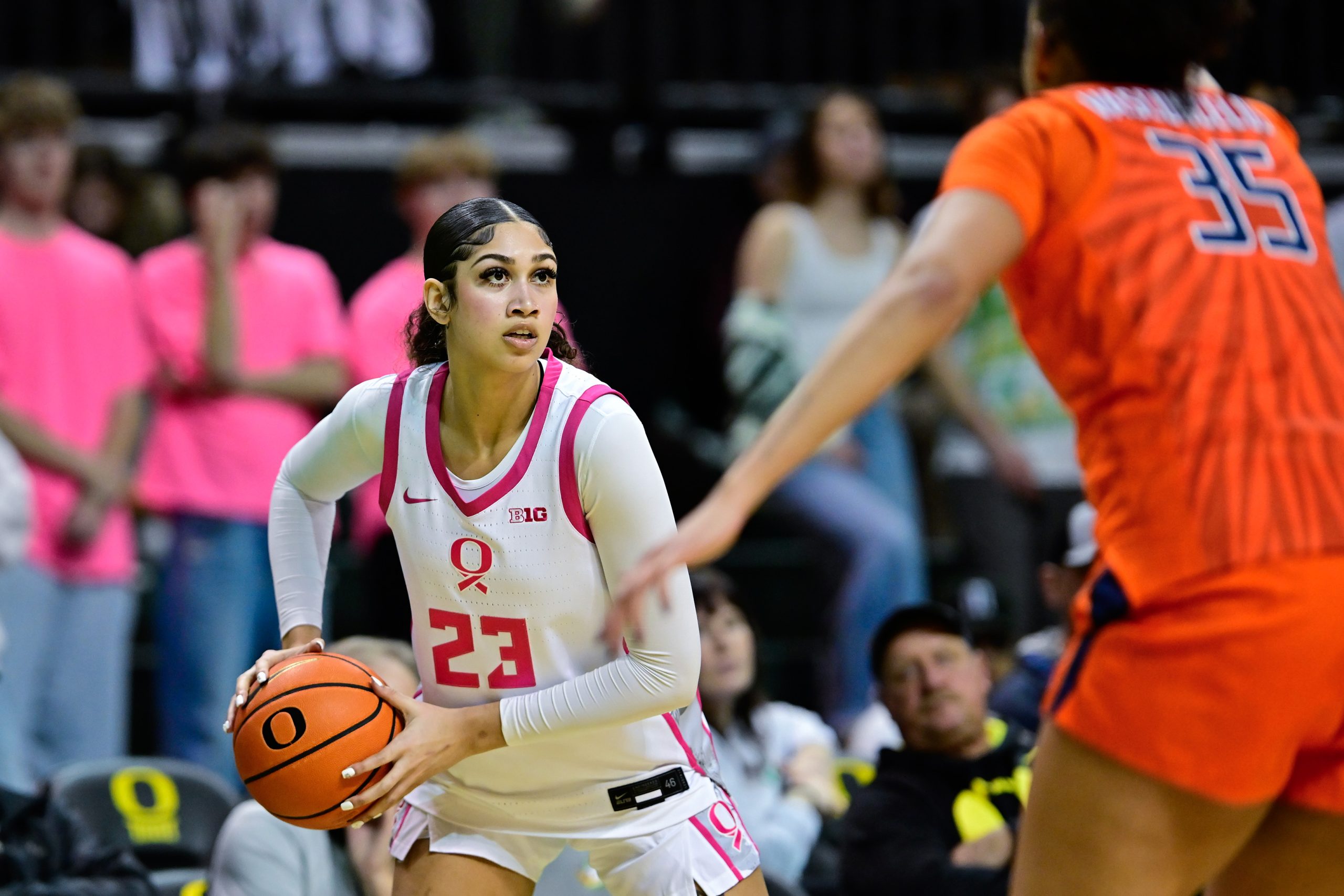
Former Oregon forward Sarah Rambus looks to pass in a game against Illinois. After three seasons with the Ducks, Rambus transferred to Syracuse this offseason to maximize her potential. Courtesy of Oregon Athletics
But halfway through her junior year, Rambus lost her starting spot. Confusion blanketed her mind. She thought she’d proven herself.
Vic Rambus, her father, was also perplexed about why his daughter, who he said consistently put Oregon on her back, wasn’t starting consistently.
“There were games where Oregon was playing lousy, and it put Sarah in, and Sarah would bring it back from an eight-point deficit, a six-point deficit or hit nine to 12 shots in a row and pull it out of the deficit,” Vic said. “And the coach will take her out and go back to the 3s and 4s shooting the ball.”
Even when Rambus started, she played center, despite being a natural forward. Vic said Oregon made her a 5 because she was quick and agile.
But that was nonsense. Forcing a stretch 3 or 4 to play the 5 was “physical and mental abuse,” Vic said. He said Oregon didn’t teach her skills to defend “true centers” effectively, tell her what she needed to improve or “put her in a position for her to be as good as she could’ve been.”
Toward the end of her junior season, Rambus grew increasingly disconnected with Graves and Oregon’s coaching staff. They weren’t receptive to each other after she lost her starting spot. In an exit meeting for the season, Graves told Rambus he “beat himself up” because he didn’t know why he couldn’t unlock her full potential.
Graves told Rambus she always had a spot on Oregon’s roster, but even if she returned as a senior, a starting role or opening at the 4 weren’t guaranteed. Rambus and her father were confused, given Rambus’ junior-year improvements, but the coaching staff told her team decisions run like a business.
“She felt like, ‘Man, I gave you guys three years of my life. I’ve been lawyering for this team. I’ve been putting in the work. I’m developing and getting better every year, every semester, every season. My statistics show it,’” Vic said.
Rambus also felt she wasn’t learning anything new from Graves late in her junior season. Simply put, she wasn’t getting Graves’ coaching anymore.
While she gained valuable experience from four March Madness games, she said she was ready for a change.
“I got complacent at Oregon,” Rambus said. “I needed a change of scenery. I needed to grow. I needed to be the player I know I can be.”
Rambus didn’t want to leave Oregon. But she knew she had to in order to fulfill her WNBA aspirations.
“She couldn’t understand why her opportunity was shrinking when her eligibility was shrinking as well,” Vic said. “She wanted to go someplace where she could make a difference, where she wanted the chance to do what she’s capable of doing.”
On April 13, Rambus committed to SU with one year of eligibility. She cited Legette-Jack and Syracuse assistant coach Natasha Adair’s attitude and experience as main reasons for joining.
Though Rambus has only been at Syracuse since June, she feels she’s already learned more than she would’ve at Oregon and has the chance to reach the pros. She specifically pointed to learning to guard post players and expanding her footwork. For Rambus, Syracuse’s coaching staff’s meticulous attention to detail stands out.
“I got complacent at Oregon. I needed a change of scenery. I needed to grow. I needed to be the player I know I can be.Sarah Rambus, Syracuse forward
“I feel like, at Oregon, we were too laid back. We had no discipline at all,” Rambus said. “At Syracuse it’s none of that. It’s discipline. Hands behind our back while (Legette-Jack is) talking. She’s very old school in how she runs things.”
SU’s general manager thinks Legette-Jack is the right coach for Rambus to feel comfortable. Walker said Graves didn’t emphasize rebounding and playing in transition, but Legette-Jack does, especially as a star rebounder at SU from 1984-88.
In practices, Legette-Jack has stressed tracking balls off the rim and glass and playing quickly. When Rambus arrived at Syracuse, she wasn’t used to running up and down the court. Now, Walker said, Rambus can do so faster than some SU guards.
“She fits here,” Walker said.
Along with improving her rebounding, Walker hopes Rambus can avoid fouls this season. Rambus committed a career-high 2.3 per game at Oregon last season and had eight games with four.
Legette-Jack and SU’s staff have routinely emphasized playing defense and getting to a spot with your feet rather than playing with hands. For Rambus especially, Walker said it’s important she keeps her hands where referees can see them.
“Just training to always have our hands up on the ball, off the ball too,” Rambus said. “You’ll be surprised if you try to hold your arms up for 30 seconds; it starts burning.”
Syracuse lost Dominique Darius, Laila Phelia, Sophie Burrows and other key players after last season. In rebuilding SU’s roster, Walker prioritized bringing in players who could add another element to Izoje’s game and keep teams from double-teaming her.
Walker said that, last year, teams came off SU’s other bigs and didn’t worry about them because of Izoje. But with Rambus, Syracuse has two inside forces who constantly challenge each other in practice, Walker said.
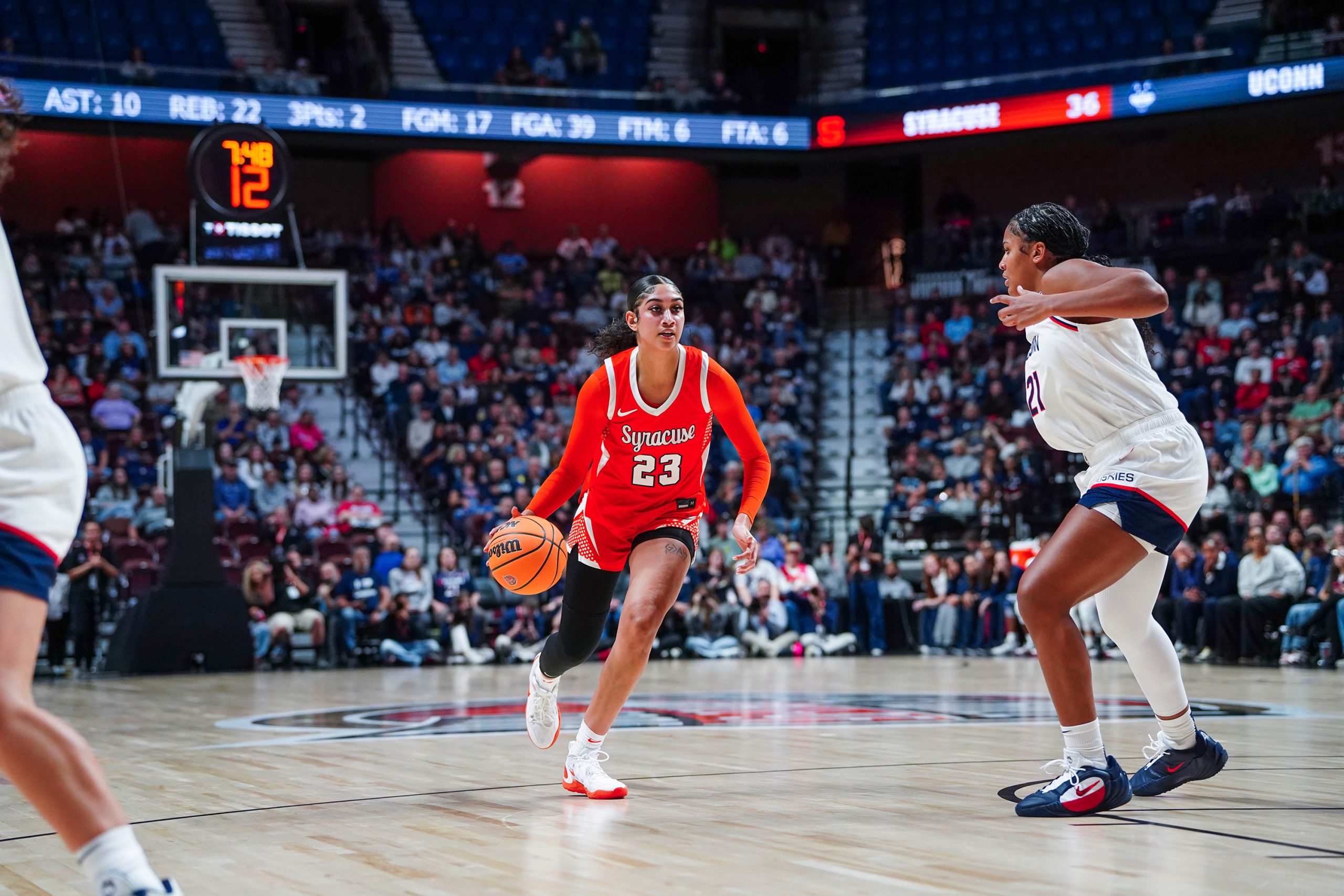
Sarah Rambus drives into the paint in Syracuse’s exhibition against UConn on Oct. 12. The Oregon transfer looks to form a potent frontcourt duo with Uche Izoje this season. Zoe Xixis | Asst. Photo Editor
“Their chemistry is getting so much better,” Walker said. “Uche having somebody to back her up gives her a little bit of ease inside. It’s not all on her shoulders; she gets to share the load, and we’ve gotten to see that a lot.”
Two thousand eight hundred and three miles. A different conference. Different coaches. A different frontcourt partner.
Sarah Rambus trusts Syracuse will get the most out of her. Something Oregon couldn’t do. And that’s why she took a gamble.
“You gotta go in order to grow,” Rambus said.
Photo courtesy of SU Athletics