Through Remembrance Week, alumni recall program’s ‘transformational’ impact
Have you had an experience with Syracuse University’s Title IX office? Share your story with The Daily Orange’s anonymous tip line.
Annette Campbell Anderson remembers exactly where she was when she heard about the Pan Am 103 bombing. She had just returned from her first semester at Syracuse University to spend winter break at her home in Baltimore when the news broke.
“I just remember standing in my parents’ living room in shock,” Anderson said.
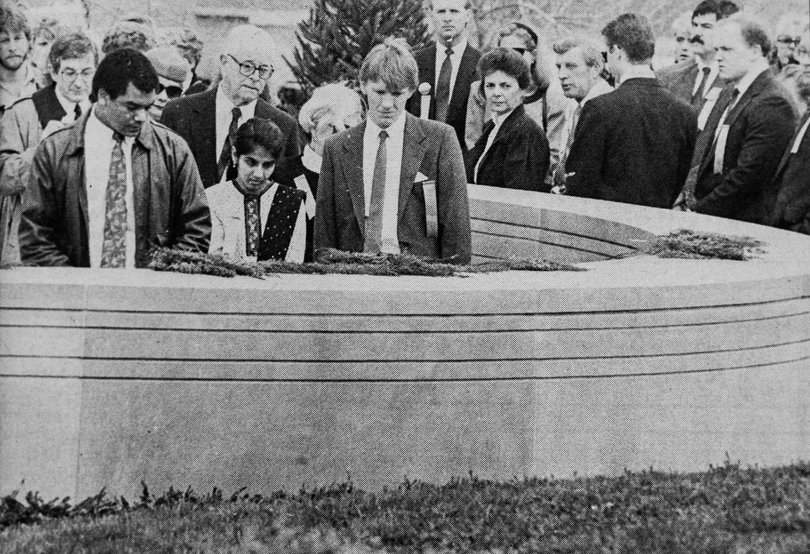
Once back on campus, Anderson, who graduated from SU in 1992, attended a remembrance event in the then-Carrier Dome, despite being a freshman and not personally knowing any of the 35 students who died. Still, she felt it was her “duty” to attend the memorial service for the students.
Anderson remembered then-Chancellor Melvin Eggers promising students that the university would never let the 35 Pan-Am passengers’ memories be erased.
A little over a year later, SU announced its first cohort of Remembrance Scholars to pay tribute to and remember the students who died. Anderson was included in that rank of scholars.
Thirty-six classes of scholars have risen through SU’s ranks since then, encompassing over 1,000 students. From the first cohort to the most recent, the scholars maintain that the experience has left an indelible mark on their lives or altered their paths entirely.
Jackie Arbogast was part of last year’s cohort, graduating in May 2026. Unlike Anderson, she doesn’t have a snapshot memory of Dec. 21, 1988. Instead, her mother does.
Arbogast’s mom was a senior at SU at the time and lost a close friend in the tragedy.
Arbogast said the experience helped shape her mother’s life and brought her family closer together. She applied to become a scholar during her junior year, keeping it a secret from her mom. When she was accepted, she called her mom from Spain, where she was spending a semester abroad.
“She just started sobbing,” Arbogast said. “I was so moved by that moment that the two of us both had because we were across the world from each other, and yet I felt the impact of how much that meant to her… I felt like I had never been closer with her, even though we were thousands of miles apart.”
Arbogast vividly remembers the details from her time as a scholar: visiting the university’s archives, the annual sitting-in ceremony and the laying of roses. She’s still in touch with the family of Seton Hall University student Beth Ann Johnson, the victim she spent her time as a scholar representing, due to program changes in the 2023-24 school year.
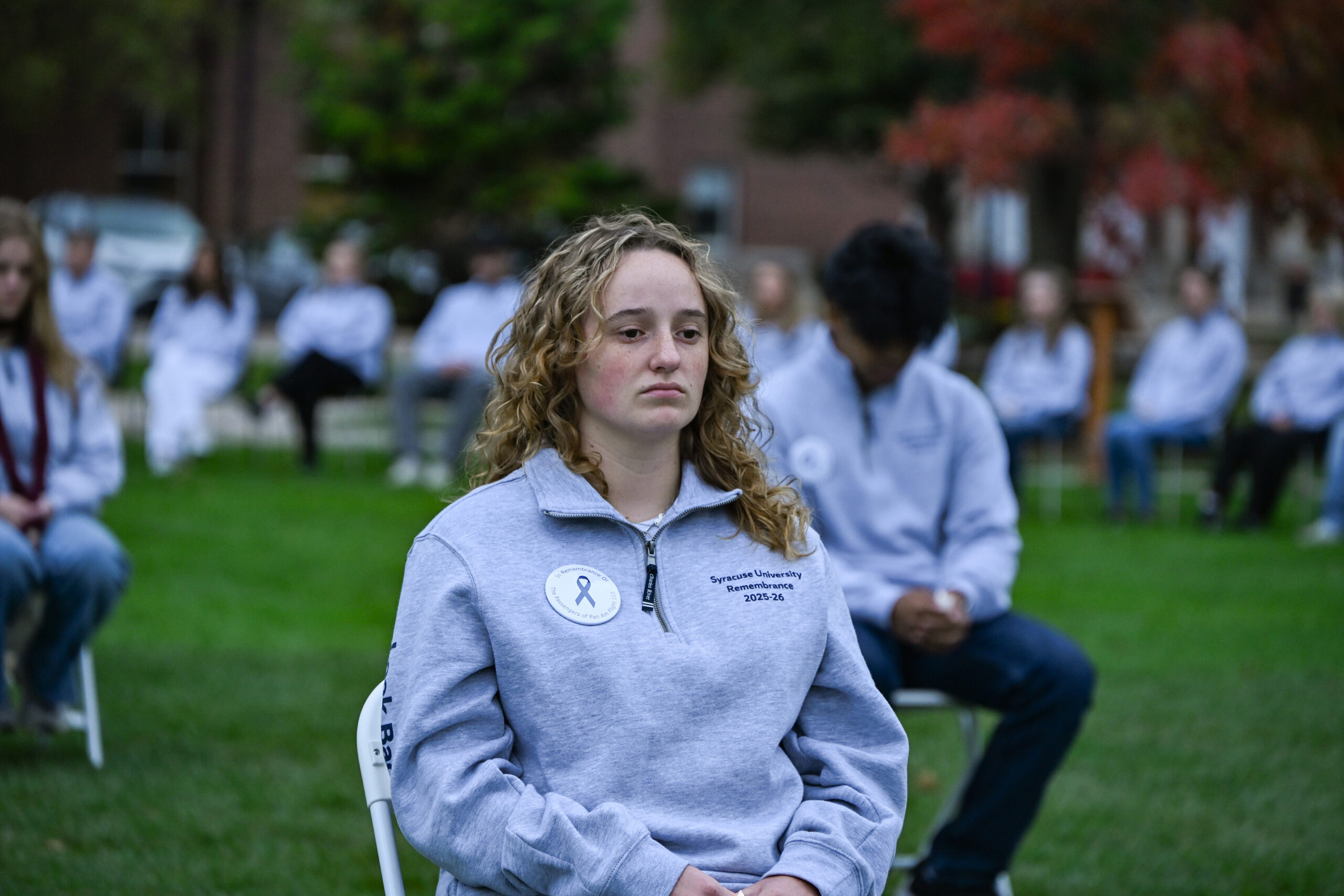
2025 Remembrance Scholar Jackie Arbogast sits alongside other students for the annual Sitting in Solidarity event. Arbogast said she applied to be a scholar because of her mom. Lola Jeanne Carpio | Staff Photographer
During Remembrance Week, Arbogast said she felt like she’d lost someone she knew personally.
For other alumni from the first cohort of Remembrance Scholars, their memories as scholars aren’t as clear as Arbogast’s, but the lessons remain unmistakably evident in their everyday lives.
Julie Friend was a sophomore at SU in 1988 when the Pan Am 103 bombing happened. Like Anderson, she became part of the inaugural cohort of Remembrance Scholars and felt a compulsion to represent the 35 students who were killed and live out what they could not.
“The theme of my application was, ‘We can’t let these kinds of tragedies prevent us from doing the things that are right and the things that we dream will make our lives better,’” Friend said.
Anderson applied to become a scholar at the recommendation of a professor, Robert McClure from the Maxwell School of Citizenship and Public Affairs. She said McClure’s endorsement gave her a self-confidence that “launched” her.
“I felt that I wanted to represent the memories of those 35, but also that I had done something good in the world,” Anderson said. “That what I was trying to pour into the university also got poured back into me, and that was a tremendous, tremendous feeling. I can never really explain how transformational that moment was for me.”
Friend echoed a similar sentiment, explaining that the responsibilities associated with being a scholar were motivational to their careers.
“I think we all just felt like we had a level of responsibility not only to move our careers and education forward for ourselves, but maybe also in the name of all these other people too,” Friend said.
WHAT YOU SHOULD READ NEXT
SU alum’s ‘Fuselage’ play commemorates friends, humanizes Pan Am 103 grief
Because of a last-minute decision, Annie Lareau wasn’t on Pan Am 103. But her best friends were. Almost 40 years later, Lareau has written her experiences with grief into her play “Fuselage,” which will debut at Syracuse Stage in April.
Years later, Anderson and Friend can clearly trace the impact of becoming Remembrance Scholars on their lives.
Friend is now the director in the Office of Global Safety and Security at Northwestern University. She describes her job as “risk management,” working to mitigate risks posed to students studying abroad. Throughout her career, she’s dealt with situations that make her look back and reflect upon her time as a scholar.
Friend recalled the 2004 Madrid train bombing and the 2005 London transit bombing, where many university students were studying at the time.
“Those are the moments where it made me reflect on not only my experience as a Remembrance Scholar, but it made me look at the Pan Am crash in a new light,” Friend said, explaining that it made her work become more personal.
At the time, Friend said, Pan Am 103 was an inconceivable tragedy and there was no “handbook” for what university administration should do next. After dealing with similar situations, she said her work has shifted to developing institutional and overall best practices to deal with security analysis and incident response.
Even now, Friend regularly attends intra-university conferences for her job. She said she always introduces herself as a Remembrance Scholar when she runs into SU staff.
“I definitely think it’s become a part of my identity,” Friend said.
Like Friend, Anderson is surrounded by university students in her current role as an assistant professor in the School of Education at Johns Hopkins University. She said SU gave her the confidence to get to where she is today, an experience she tries to recreate for her students and emphasize for her children, one of whom is a sophomore at SU.
“My journey really does start because I had people at Syracuse who believed in me, and being a Remembrance Scholar meant everything to that journey,” Anderson said.
Arbogast is just starting her post-graduation journey, but said she knows her time as a scholar will be something she carries with her throughout her life. She said Remembrance Week taught her lessons especially important in today’s world, when it’s common to emotionally block out a “tragedy overload.”
“It made me more hopeful for community and humanity because I felt more connected with the people that I met for one week than I had felt in a lot of my other relationships,” she said.
Remembrance Week is a reminder that sometimes, it’s important to sit with tragedy and grief and carry the good things out of it, Arbogast said.
“When you’re left with nothing but the rubble and the people around you who have also suffered this tragedy… it really brings people to their core, which is to take care of each other,” she said.