Vivid sculptures prove ceramists’ versatility at Clayscapes Pottery Market

Get the latest Syracuse news delivered right to your inbox.
Subscribe to our newsletter here.
The sun illuminates the bustling greenhouse on Buckley Road. Clay mugs painted with flowers and lace sit beside large serving bowls and sculptural vessels. At one booth, cream-colored pottery is covered in spiraling green leaves. At another, skulls stare out from candleholders, jars and platters are covered in shades of black, burgundy and bone. These clay sculptures are some of the many creations found at the Clayscapes Pottery Market.
“It’s gotten busier and busier every year,” Emily Seymour, chief financial officer of Clayscapes Pottery, said. “There’s a lot of return customers, which I think proves that there’s a great love for this art form once people see it and get to talk about it.”
On Saturday and Sunday, Clayscapes Pottery hosted its annual market for the ninth year at a greenhouse in Chuck Hafner’s Farmers Market and Garden Center, bringing together over 40 potters and ceramic artists from across the Northeast. The market, hosted by Clayscapes Pottery, featured vendors selling works ranging from functional cups and bowls to sculptures and pieces made for the garden.
“The Clayscapes Pottery Market is a show for strictly ceramic arts,” Seymour said. “It’s a great way to fund that community.”
Seymour said the strict focus on ceramics is what makes the event important. The goal, she said, is to foster the local ceramics community while helping visitors understand how much work goes into producing a ceramic object.
Clayscapes itself has deep roots in Syracuse. Seymour’s father Don Seymour founded Clayscapes Pottery in 2003 after years as a production potter. A year later, he added a community studio, and in 2010, Don added a gallery to his business space. The company operates as a ceramics supplier and offers classes and workshops for artists and the ceramic community in Syracuse.
That community drew vendor Nina Spano in.
WHAT YOU SHOULD READ NEXT
RetroGameCon draws gamers, cosplayers from around the world to Syracuse
The 13th annual RetroGameCon ran from Friday to Sunday, drawing 10,000 attendees from around the world to the Oncenter Convention Center.
For Spano, spaces like Clayscapes make art education available beyond universities. She believes Syracuse benefits from having people who make things with their hands and know how to think creatively.
“The more creative people there are in Syracuse, the better humans and stronger our region will be,” Spano said.
A retired high school art teacher and Syracuse University alum, Spano returned to the city to make art after leaving the classroom. Though Spano had some experience working with clay during her teaching years, it wasn’t until she found Clayscapes where she learned the full scope of ceramics, and she later started Nina Spino Handmade Ceramics.
“There’s all ages of people, all levels of ability working there,” Spano said. “You go to the studio every day, there with your friends and other creative people, and you’re learning from each other.”
Spano’s booth at the market reflected that personal approach. Her grandmother and great-aunts made lace by hand, which inspired some of the carved patterns in her ceramics. Spano loves to garden, which she captures through the plant motifs of her mugs, jars and vases.
A few booths away, Marcus Acevedo’s skull sculptures contrast with Spano’s floral creations, sitting beneath lids of ceramic jars. Blue-horned skull sculptures line one shelf, while larger pieces set the scene of goth and medieval art on another. Above Acevedo’s booth is a banner reading “Fire and Brimstone Pottery,” the name of his business.
Acevedo said his work isn’t limited to Halloween. The gothic imagery is part of the aesthetic he uses throughout the year, drawing partly on his interest in horror and the idea of “memento mori,” a reminder of mortality and the importance of living while one can, he said.
Despite their dramatic appearance, many of Acevedo’s pieces are meant for ordinary use. It’s “functional ware,” and something that people use regularly, he said.
Seymour said versatility is one of ceramics’ defining qualities.
Unlike artwork that remains on a wall, ceramics can become part of a person’s daily life, whether as a mug used each morning or a purely sculptural piece, Seymour said. A painting may eventually fade into a room’s background, Acevedo said, but a favorite mug can become part of someone’s routine. Customers sometimes return to tell him that a mug he made is now the one they use every day.
“It’s a piece of art that they can live with and use and get function and beauty out of,” Acevedo said.
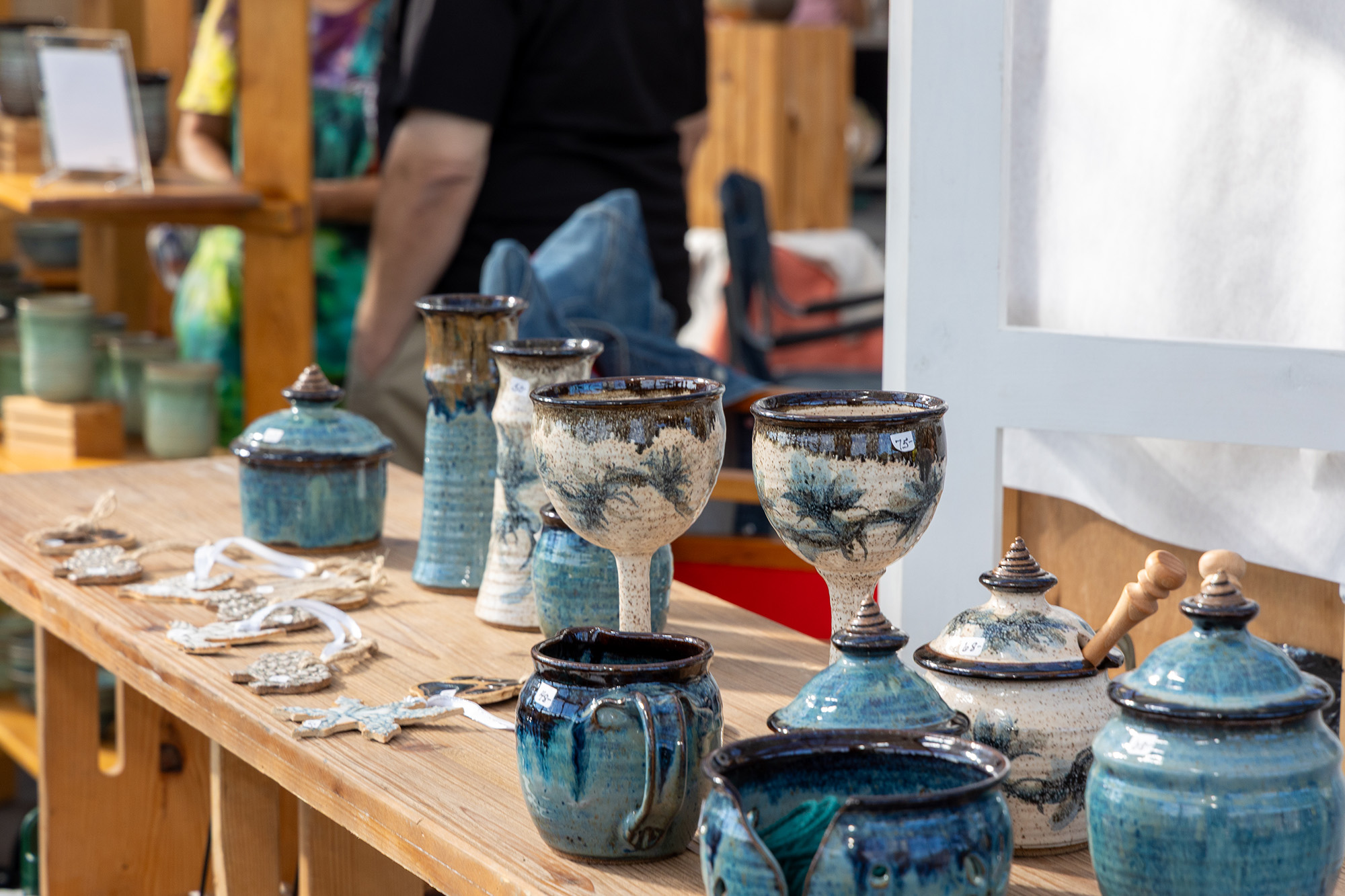
A sea of white and blue cups and bowls sit on a display table at the Clayscapes Pottery Market. This year’s market took place at the Chuck Hafner’s Farmers Market and Garden Center. Eli Schwartz | Asst. Photo Editor
For Acevedo, who travels regularly to states like Michigan to sell his work, the Clayscapes Pottery Market is also a chance to exhibit his pieces close to home as a Syracuse local.
But as Syracuse’s ceramics community gathers around Seymour, Spano and Acevedo said the future of formal ceramics education is less certain. Across the country, institutions like SU, West Virginia University and Hood College have either cut their ceramics programs or made them concentrations of B.F.A. programs.
For Seymour, the shift risks diminishing an art form whose history stretches back thousands of years.
“We think it’s really unfortunate because not only is it a great art form, but it can be used in everyday life,” Seymour said. “Pottery is ancient, and it’s so important for the development of civilization.”
Spano, who earned a master’s degree in art education from SU in 1992 and spent her career teaching art, said the reduction in ceramic programs extends beyond preparing students to become professional artists. Spano considers a fine arts education a way of teaching people to think creatively, solve problems and make decisions. People don’t always acknowledge the value of those skills, she said.
Acevedo has a B.F.A. and M.F.A. from Alfred University that included ceramics within a broader art curriculum. He said a standalone ceramics major isn’t necessarily the only — or even the most practical — path for aspiring artists.
Ceramics is an expensive art, from studio fees and material costs, Seymour said. The Clayscapes market allows artists to showcase their art and help fund their future projects.
“It’s a great way for the public too to see the art form, to see how many different ways it can be done and take a piece home,” Seymour said.