Ensembles weigh American Dream through music at We Hold These Truths show

Get the latest Syracuse news delivered right to your inbox.
Subscribe to our newsletter here.
Adrianna Ramirez-Owens visited Hendricks Chapel to watch her daughter sing at Sunday’s We Hold These Truths concert. But Ramirez-Owens was also reminded of her family’s past.
“This concert was really amazing to shed light on that unique journey of everybody that is in the audience,” Syracuse resident Ramirez-Owens said. “As a female Latina in the United States, it was really powerful to see how many voices we had singing these amazing songs today.”
The show, which celebrated the United States’ 250th anniversary, reflected the importance of the American dream in Ramirez-Owens’ family. She said her father emigrated from Honduras to the U.S. in pursuit of a better life for him and his family.
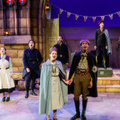
Six ensembles performed at the show, including Ramirez-Owens’ daughter with the Liverpool High School Advanced Treble Chorus, Nottingham Ham Fam Voices Treble Choir, Spirit of Syracuse Chorus, Ensemble Sonora and members of SU’s Oratorio Society and Vox Salina. The concert spoke to the complexities of the American Dream and covered themes of female empowerment, American identity and folk traditions.
Directed by Wendy Moy, the chair of music education and associate professor in the College of Visual and Performing Arts and the School of Education, the concert featured multiple musical styles such as choral music, contemporary works, acapella performances and traditional folk songs. When Moy organized the show, she wanted to bring together different age groups and collaborate with community partners, like Syracuse City Schools.
“I wanted to reach out to people that I collaborated with and wanted this program to be based on relationships,” Moy said.
Rhiannon Riley, a baritone singer with the Spirit of Syracuse Chorus, said she appreciated how the songs she sang didn’t only commemorate the U.S., but also dove deeper into the nation’s history.
“Exercising your civic duty to make as much change as you can, even in a system that feels unchanging, is really important,” Riley said. “I think this concert had a good balance honoring the fact that we are here and also acknowledging the fact that things have happened, voices have been silenced and ways that we can help combat that.”
The Spirit of Syracuse Chorus used its concert set from the SingUnited International Competition in Columbus, Ohio, where they recently took 13th place. The group specializes in a cappella barbershop harmony, in which instead of the highest voice, the main melody is sung by the lead group singers, an inner voice that’s surrounded by both high and low harmonies. This dynamic sound complements their performative facial expressions and synchronized movements.
During the show, attendees were encouraged to place sticky notes on posters around Hendricks titled “My Dream For America,” where they could write down their hopes for the country’s future.
“I didn’t want it to just be us, the singers, singing to the audience,” Moy said. “I wanted all of us to be a part of the conversation.”
Two faculty members at SU’s Setnor School of Music, Loren Loiacono and Natalie Draper, used a commissioning grant from the New York State Council on the Arts to premiere their new works at Sunday’s concert. Loiacono introduced her piece “Campaign Song (Or, Why We Oppose Votes for Men),” while Draper debuted her song “American Dream.”
WHAT YOU SHOULD READ NEXT
Military musicians perform patriotic classics at Hendricks’ America 250
The Syracuse University Brass Ensemble and the 10th Mountain Division Band performed Friday at Hendricks Chapel for the America 250 Concert.
The concert also included sing-along pieces like “The Star-Spangled Banner” and “America The Beautiful,” where audience members were encouraged to stand and sing these classic tunes. For the final piece, “Homeland” by Gustav Holst and arranged by Z. Randall Stroope, all of the ensembles sang together, covering the entire stage and lining Hendricks’ walls.
“I hope this is the start of a conversation where we, as a community here at Syracuse, and the rest of the United States and the world (can ask), ‘Who do we want to be? How do we hold those truths of life, liberty and the pursuit of power?’” Moy said.