‘All about the music:’ DIY student venues amplify Syracuse’s hardcore scene
Get the latest Syracuse news delivered right to your inbox.
Subscribe to our newsletter here.
At night, the neighborhoods surrounding Syracuse University come alive. No matter the weather, SU and SUNY ESF students alike aren’t tucked away into beds. Groups of students from around campus make their way to fraternity houses and bars, but a select few find themselves walking to a basement on Lancaster Avenue.
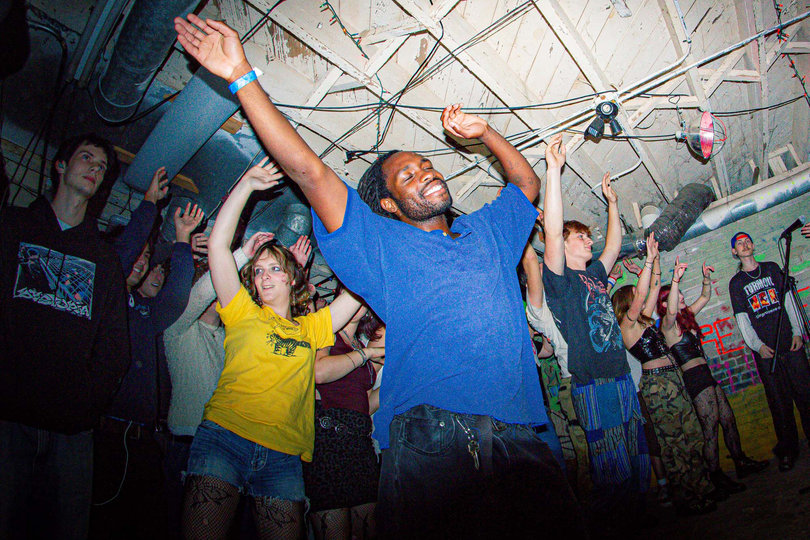
Once inside, the flocks are greeted with colorful string lights, people dressed in goth or other alternative styles and musicians tuning their instruments. Buckle up — it’s another Saturday night at The Coven.
“DIY venues are close quarters, a cool environment, and it’s all about the music, not like other party venues,” Aiden Lindblom, a freshman who attended the show, said.
The Coven isn’t the only house venue near SU. Other DIY venues, like Basement 560, are becoming more popular in the Westcott-University Neighborhood. Now, more than ever, these venues are hosting goth, punk and hardcore bands and fans.
SU has always had a dynamic music scene. Student musicians have never been in short supply — the only question has been where they can play. DIY House music venues have been popular around the world since the 1970s, and SU as well as ESF have a history of a thriving DIY scene. A few years ago, venues like Mudpit and Crater ruled the SU scene, but over the last three years, they slowly fell off as hosts graduated or, in the case of Dazed, litigation shut them down.
Now, new-gen DIY venues are gaining traction in the area, and most of them are leaning into hardcore, goth and punk music.
The Coven is a gothic-focused venue that throws shows every few weeks. Run by an ESF doctoral student, the venue is located in a basement on Lancaster Avenue and encourages an alternative/goth dress code. At Saturday’s show, multiple bands played music ranging from softer goth to screamo. Students swayed to the slower tracks, then amped it up during the last band, Desire Lines, creating a mosh pit — running into each other and bouncing off of the walls.
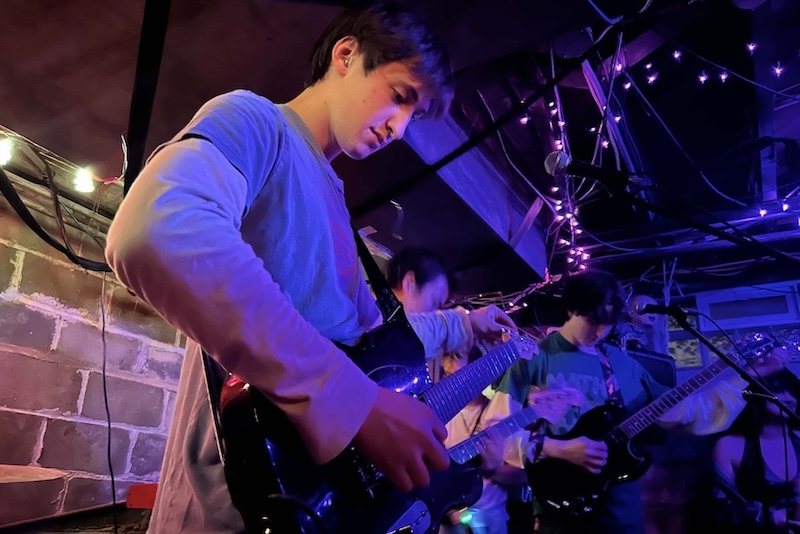
A guitarist from the band Desire Lines performs a set at The Coven. Venues like the space have spurred the hardcore music scene in the Syracuse University area. Caroline Erskine | Asst. Copy Editor
Basement 560 is part of the 560 Art Collective, a house in the University Neighborhood that ESF students have resided in for over 20 years, said Mac Puckett, an ESF graduate who’s been running the venue for about a year. Puckett revived the basement shows after they stopped following the COVID-19 pandemic. Hosting two to three times a month, the venue leans toward metal and punk music, though Puckett also books noise, drum and bass and shoegaze acts. Almost all proceeds go to the performers, and some shows have raised money for groups such as Food Not Bombs.
Puckett said the basement aims to capture moments like one he remembers from last year, when the vocalist for the band Char stood on a chair beneath a beam of light during a show. His head was craned back, mic raised to his mouth as he screamed the lyrics.
“It felt religious. It felt extraordinary. It felt like this was an essence to being human,” Puckett said.
Another aspiring house venue, The Jugg, teamed up with Nights at Cage, a mostly DJ-driven venue on Walnut Avenue, on Oct. 23 for a hardcore show. Attendee Logan Michaels, a Syracuse local, estimated about 100 people packed into Cage’s fenced-in space.
These genres are defined in very distinct ways. Goth stems from the punk movement of the late 1970s and took shape in England with a more melodramatic style.
Hardcore also grew out of punk, but it took root in the United States. Anthony Shumway, a 19-year-old guitarist and vocalist who grew up in Syracuse, said hardcore sits closer to punk, while metal developed as its own genre. Puckett said Syracuse’s hardcore music scene stretches back to the late 1980s or early 1990s with local bands such as Earth Crisis, a Syracuse-based band.
Audrey Farris, an SU sophomore and first-time attendee of The Coven, said the people drawn to harder music help explain why so many new venues lean that way.
“I think that people that are into harder music tend to be a little bit more rebellious, so they’re not as scared about getting in trouble for throwing,” Farris said.
Despite the different genres, the communities are known for being inclusive, welcoming and especially LGBTQ-friendly. The alternative dress code helps fans who want to wear elaborate looks feel welcome without fear of ridicule, according to multiple attendees.
Lyric Hutzelmann, an SU sophomore who performed at The Coven as part of her band, Sleeper Pick, said the dress code sets the venue apart from others.
“This feels like something that’s more organized and put together, and you can really show it off, show that side of your personality off,” Hutzelmann said. “You don’t have to feel weird and out of place with it.”
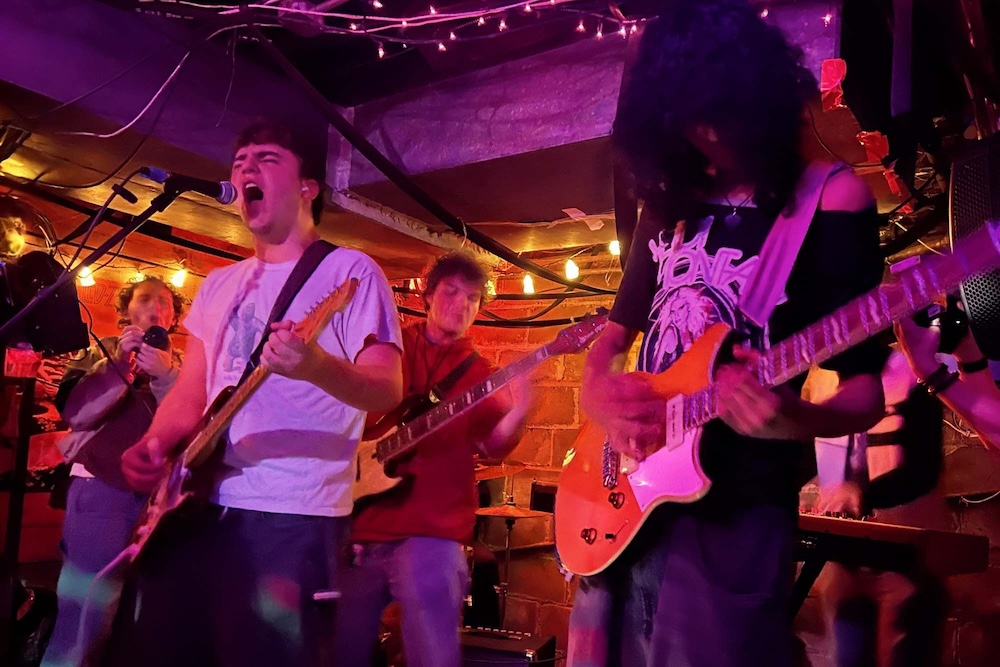
Under neon lights, a band performs at The Coven. The spot is a gothic-focused venue run by an ESF doctoral student. Caroline Erskine | Asst. Copy Editor
Hutzelmann said SU’s campus felt “cookie cutter” after arriving as a freshman, and The Coven offers a place where alternative dressers don’t stand out. Farris said she doesn’t dress alternatively every day, and that’s part of the appeal. At Saturday’s show, there were attendees in everything from an edgy top and eyeliner to full corpse paint and a black lacy dress, all dancing to the music and talking to the people around them.
“I don’t wear this eyeliner and stuff all the time,” Farris said. “But this is who I am, and it’s great to be able to have a space like this to express it.”
At Basement 560, Puckett said the venue runs with an anti-fascist, pro-queer, pro-feminist model, and often donates to related causes.
Puckett said that mission extends to booking. A spring show last semester raised money for the New York Immigration Coalition, and Puckett looks for bands whose music carries messages of resistance and hope. Puckett said the venue makes no profit, and Basement 560 attendees tend to care about the music and look out for one another.
“I want to create a space for artists to share what they’ve got to say,” Puckett said.
Local musicians said they seek out basement venues for the connection. Michaels and Ari Oviedo, the founding members of the band Peace for the Kids, grew up in Syracuse and take part in the music scene both in the city and around SU’s campus. The band plays punk-influenced reggae rock, and Michaels said house shows shape their sound. Earlier this year, the band played a living room show at Wormland, a house venue in Westcott. There, a crowd sang along to their original songs for the first time, which Michaels said was a “really special moment.”
Times like those are why Syracuse’s hardcore scene feels like a big family, Shumway said. Hardcore has always been about being with friends, caring about other people and being passionate about the same topics.
WHAT YOU SHOULD READ NEXT
Syracuse’s student DJs experiment at campus parties, bar dance floors
Syracuse University is saturated with student DJs; Greek houses, local bars and house parties make it easy for aspiring DJs to get their start.
Some students share the vision of building up the scene themselves. Hutzelmann plays bass in two bands, hopes to start a mosh pit by the end of the semester and urges more people to open DIY venues.
“I think things are coming back. I just don’t know that they’ll come back to the magnitude that they were before,” Hutzelmann said. “But I don’t know. The people need to gather.”