SU Drama’s ‘Henry V’ recontextualizes Shakespeare through WWI perspective

Get the latest Syracuse news delivered right to your inbox.
Subscribe to our newsletter here.
Before the lights turn off in the Syracuse Stage/Drama Theater Complex’s Storch Theatre, the “Henry V” audience sees World War I soldiers setting up their production of William Shakespeare’s “The Life of Henry the Fifth.” The soldiers could be seen moving through the stage, creating a new scenery from military supplies before placing a crown made of bullet casings on a young soldier’s head, transforming him into the prince and soon-to-be King Henry V.
“I love the idea of people utilizing theater specifically as the vocabulary of coping, of escaping and of confronting what they’re dealing with on a daily basis,” John Tufts, the director of “Henry V,” said.
Tufts reimagined Shakespeare’s 14th century play through the perspective of World War I soldiers who recreate Shakespeare’s account of the Hundred Years’ War while simultaneously experiencing the more modern war surrounding them. The Syracuse University Department of Drama’s show debuted Friday and will run through Saturday.
Originally written in the late 16th century, the original “The Life of Henry the Fifth” follows England’s King Henry V as he leads his army into France during the Hundred Years’ War.
However, “Henry V” follows 12 World War I soldiers performing Shakespeare’s “The Life of Henry the Fifth” while in the midst of World War I. They chose to cope with the effects of war, from injuries and mental strain, through theater as a means of escape. The soldiers have seen the atrocities that come from war, except for one soldier who is chosen to play Henry V.
“Henry lived his whole life with status. He was a prince and then he was a king, and this soldier has always been a soldier,” SU senior Gerald Bellamy, who played Henry V, said. “In this moment, he’ll be a king, but when this play is over, he’s a soldier again. This is probably the closest to a king he will be in his life.”
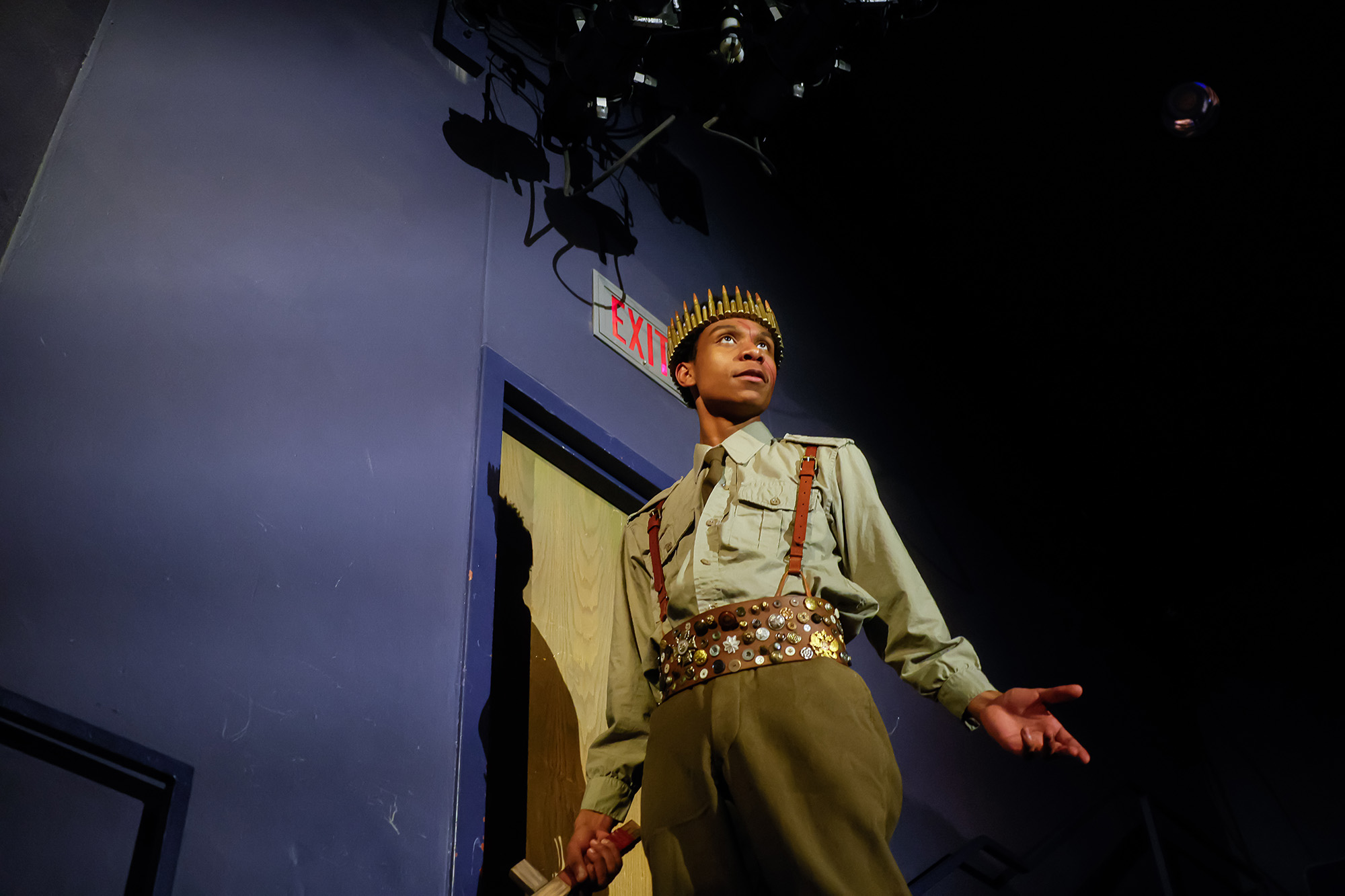
Gerald Belamy basks in the spotlight in a scene of “Henry V.” Belamy stars as the main character, King Henry V, in the Syracuse University Department of Drama’s “Henry V.” Zabdyl Koffa | Staff Photographer
Tufts first developed “Henry V” within a play concept two years ago, after watching Peter Jackson’s documentary “They Shall Not Grow Old,” which featured restored footage of World War I soldiers. Tufts also used a real photograph from World War I, which depicted an open-air performance by the Bohemians concert party for the British and Allied troops in front of a ruined building in Trouville, France, on Aug. 16, 1918.
Using the footage and photograph as inspiration for the play’s makeshift scenery, Tufts began to imagine a production where the performers would use materials that could be found in a military camp rather than relying entirely on traditional theatrical equipment, with the help of School of Design assistant professor and scenic director of “Henry V,” Zeke Leonard.
“We were trying to make a statement about it being a temporary theater that has been improvised,” Leonard said.
The music throughout “Henry V” follows the same approach. Metal tools, cans and buckets became instruments during the show, allowing the cast of “The Life of Henry the Fifth” to recreate sounds authentic to the 14th-century battlefield. Additional sound effects of bombs and plane engines reminded audience members like SU freshman Liliah Brundage that the “The Life of Henry the Fifth” cast members are living through a war of their own.
For Brundage, she thought the play was going to be a straight production of “The Life of Henry V” and was surprised to see the World War I aspect. She realized what was happening after the use of bomb sounds and the cast turning their scenery back into medical supplies, using the stretchers as banners to help an injured soldier.
For the students, the play’s World War I setting also offered a new way to approach Shakespeare’s themes. This was especially evident through the connection between Henry and the Boy, played by SU sophomore Raymond Jarboe, Bellamy said.
The Boy serves as a narrator and an innocent figure who guides the audience through Tufts’ production. He’s an original character in “The Life of Henry the Fifth,” also represents a young wounded World War I soldier who has already experienced the realities of war in “Henry V.” The Boy’s relationship with Henry creates a contrast between the characters they portray and the soldiers they are outside of “The Life of Henry the Fifth.”
“You have this king who’s been in war before and is now leading this war effort, and then in the real-life World War I situation, this child has been in war for quite possibly years at this point, and this young man hasn’t,” Jarboe said.
Beyond balancing the two layers of the production, the actors also faced the challenge of playing multiple characters within Shakespeare’s story, such as SU senior Grace Paskey, who plays three roles: a bishop named Ely, the French King and Erpingham.
“For Ely, I tried to really focus on a quiet demeanor, clutching the hands together and holding onto the cross,” Paskey said. “For Erpingham, he’s an older character, so I tried to do a deeper voice. I also decided on having a limp for my character because he had been in a lot of wars in the past.”
While some actors portrayed characters using small changes in posture, movement and voice to transition between roles, others had to go through dialect lessons.
WHAT YOU SHOULD READ NEXT
Performances in NYC homage musical ‘Hell’s Kitchen’ strike unexpected chord
The national tour of Broadway musical “Hell’s Kitchen” stopped by Syracuse’s Landmark Theatre this week, and performances are lined up through Sunday.
For SU senior Emily Gorin, who played Exeter, Mistress Quickly and Alice, one of the more demanding aspects of the production was learning to speak French for one of her characters. Having never studied the language before, Gorin worked to develop a convincing French accent while memorizing dialogue she couldn’t originally understand. By the end of the show, Gorin wanted to sound fluent in French.
The cast also worked to make the production more accessible for audiences who might find Shakespeare intimidating, Paskey said. Some of the cast even attended training in London to practice performing Shakespeare. The rehearsal process focused on understanding the language themselves, so they could make the audience understand it during performances.
Through the play’s World War I setting and student performances, “Henry V” gave Shakespeare’s “The Life of Henry the Fifth” a new perspective, showing that even though Shakespeare was alive almost 400 years ago, he brings up talking points that feel modern, allowing his work to be reinterpreted and adapted across different periods.
“It really makes you think about what it means to recontextualize Shakespeare for modern audiences and the kind of visual style and planning that goes into that,” Bellamy said.