SU Ph.D. candidate’s club Cinecuse conveys Palestinian dialogue through film
Have you had an experience with Syracuse University’s Title IX office? Share your story with The Daily Orange’s anonymous tip line.
When Syracuse University Ph.D. candidate Hyejun Kim interviewed Palestinian filmmaker Kamal Aljafari at the 64th New York Film Festival, she pitched the idea of paying him to screen one of his films to SU students. What she didn’t expect was for him to offer to screen all of his films for free.
Kim became a fan of Aljafari after viewing his work at South Korea’s DMZ International Documentary Film Festival this September. While working on her dissertation about lost South Korean cinema, she found films from Palestinian directors who are trying to restore lost visuals stolen during the siege of Beirut in 1982.
“In the absence of (a) Palestinian archive, they’re making cinema,” Kim said. “They’re using cinema in order to make an archive.”
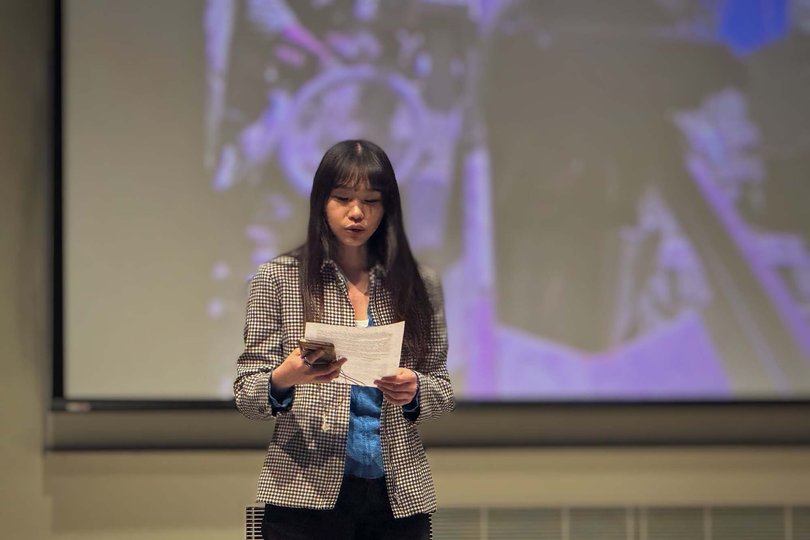
Cinecuse, an SU cinema club created by Kim, ended its three-part film screening series “Archives Against Erasure” on Tuesday in Kittredge Auditorium. The final screening, titled “Reclaiming the Archive: Cinematic Sabotage,” featured two of Aljafari’s short films, “Paradiso, XXXI, 108”and “UNDR,” and his feature-length documentary “A Fidai Film.”
The screening revolved around the experimental practice of “cinematic sabotage,” coined by Aljafari, that reclaims archival footage of Palestine from the Israeli archive. Earlier screenings in the series featured films explaining the connections and solidarity between Palestine and Japan.
Kim said she wanted to create Cinecuse and the screening series because of a lack of independent film culture on campus and around the Syracuse area.
“I wanted to introduce film. Foreign films, international films and experimental films that people wouldn’t normally get exposed to,” Kim said.
Serene Masri, another SU English Ph.D. student, was invited by Kim to co-moderate the panels for the first two “Archives Against Erasure” screenings. As a Palestinian-American, Masri said Aljafari’s films can reveal how current events aren’t singular, but intertwined with the history of other groups and past incidents.
“Addressing Palestinian liberation doesn’t just address Palestinian liberation,” Masri said. “It also addresses the liberation of so many other peoples who are also existing under settler-colonial governments as well.”
Attendee Emma Frank said while she was still processing the screened films, they shouldn’t be seen as out of people’s comfort zones.
“The big takeaway is the idea that films like this are important because they let us be in conversation with one another in a way that is difficult to do when you’re approaching learning and activism in a way that’s not community-oriented,” Frank said.
Mainstream and entertaining films can be helpful at times, Kim said, but she doesn’t believe they have the power to change how a person thinks. She said she hoped to provide a space where a group can view international struggles in a way that can affect their lives.
Kim said there’s currently overwhelming silence around Israel and Palestine across SU’s campus due to previous disciplinary action students have faced. Her status as an international student, she said, made speaking out a “risky business.”
She received support for the “Archives Against Erasure” series from several SU departments. Kim said this backing revealed a group of allies who had her back and weren’t afraid to speak out for their beliefs. When she first planned the event, Kim said she didn’t know what to expect, and considered hosting the screenings as a part of a “secret” series.
“It was gonna be like ‘Dead Cinephile Society,’” Kim said. “But having this much support really showed me that there (is a) community of people in Syracuse who are advocating for justice in Palestine and condemning genocide.”
Kim aimed to recover lost memories with the screening. In doing so, she found an unseen community of people who were willing to speak and help out others, she said.
Masri highlighted the importance of Palestinians telling their own stories due to past violence against Palestinian journalists and writers. She said she hoped those who attended the screenings would take away a desire to learn more about Palestinians and their history.
“I’m somebody who doesn’t necessarily believe that one book, one film or one image of something is going to completely give somebody a new perspective,” Masri said. “But I think the hope is always that it creates this desire to learn more and to learn from the people themselves as well.”
Kim said the screening taught her what it meant to curate films for a larger audience. She said she wants to continue the club’s nature of being politically engaged and giving her audience the freedom to make their own judgments in a safe community space.
“To have a screening is not just about watching a film. It’s about creating a space for people to gather together,” Kim said. “I think right now for me, the important question (is) what sort of community space do I want to create, and what film is conducive for that. I think that’s the question that I will be grappling with in the future.”
The popular narrative in the United States is that Palestinian solidarity is a controversial topic, Masri said. But she believed that bringing screenings to college campuses can help challenge that notion and shine a light on the voices that have been hidden and erased for decades.
“My identity kind of just becomes a controversial topic, and so I don’t see holding a film screening as something that I am willing to cut myself off from,” Masri said. “If people have a problem with us holding a film screening on films that highlight and center Palestine, then I think that says more about them than it does us.”