Syracuse ice hockey’s special teams yield varied results amid 4-game skid
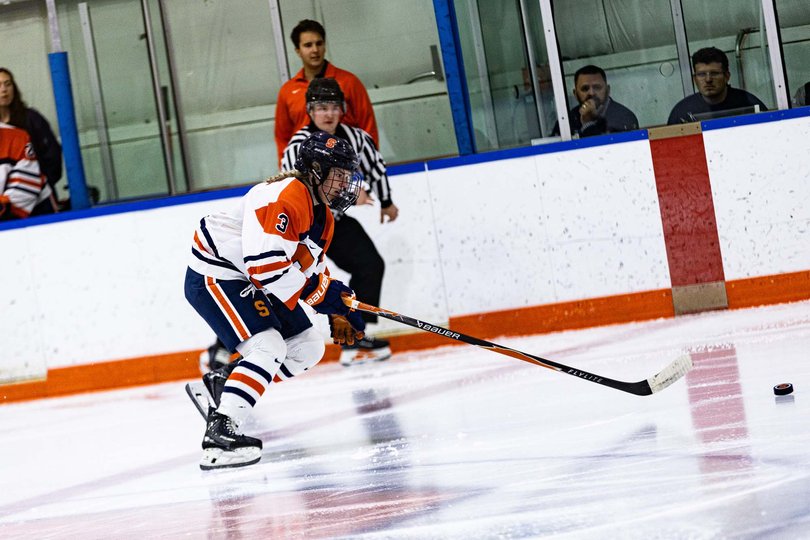
Get the latest Syracuse news delivered right to your inbox.
Subscribe to our newsletter here.
Syracuse was in an unideal position.
It conceded a goal midway through the first period against Lindenwood on Nov. 6, and after Nina Geric was sent to the box for a body check, it had to keep Lindenwood’s 1-0 lead in check.
What better way to do that than scoring a shorthanded goal?
Seconds into the power play, Jackson Kinsler intercepted the puck near the blue line, streaked through the neutral zone and glided toward the corner of the offensive zone. Emma Gnade trailed, and Kinsler found her wide-open between the hashes. A quick slapshot, and the game was tied 1-1.
Last season, Syracuse’s special teams were nothing to write home about. Its power play converted on 12.4% of its opportunities, ranking second-to-last in Atlantic Hockey America. SU’s kill was successful 74.6% of the time, dead last in the conference.
But Syracuse’s new head coach has a penchant for improving special teams. In Brian Idalski’s first season at St. Cloud State University, both sides of its special teams saw marked improvements.
So far this season, Syracuse (8-7-0, 6-4-0 AHA) has done the same. The penalty kill has been excellent, allowing four goals in 41 tries, the eighth-best mark in the country and second-best in the AHA. But its attack has lagged behind. Syracuse has converted just eight goals in 52 chances, including a dismal 1-for-6 mark against RPI last week.
The penalty kill unit’s seen resounding results all season, but that doesn’t mean it can’t improve.
In SU’s season-opening win over Stonehill, it drew a staggering seven penalties but conceded five. The Orange were perfect on the kill, limiting Stonehill to 1.4 shots per advantage, but Idalski said there was still plenty to improve upon postgame.
“I thought we took way too many penalties,” he said. “I think we’re starting to understand what some of the structure looks like and what we’re asking them to do execution-wise, so it’s just a matter of reps.”
Killing all five penalties against Stonehill was a start, but it was far from the sustained results SU wanted. Yet through 24 penalty kills in the next seven games, SU conceded just three power play goals as it rolled to a 5-2-0 record.
In the seven games since, SU has improved its kill even more. The Orange have stayed disciplined, committing just 15 penalties. In the rare instance a whistle is called against the Orange, they’ve conceded just one power-play goal across the stretch.
The reality is we’re still figuring out some of the roster and personnel and skill sets and how do they best fit with each other. That’s something we want to continue to grow, but it’s been pretty good so far.Brian Idalski, Syracuse head coach
After SU killed two penalties against RPI on Saturday, associate head coach Brendon Knight, who stepped in for Idalski while he was away on international coaching duties, was pleased.
“The last couple of weeks, we’ve been a little more aggressive on the forecheck and the initial end zone,” Knight said. “We’re just in the right spots right now. Our sticks are in the lanes. We’re getting in front of pucks.”
But just like Idalski, Knight saw room for improvement.
“We get hemmed in a little bit,” he said. “When we get our hands on the puck, we have to make sure we can send it 200 feet down the ice. I think right now we’re struggling in that aspect a little bit.”
While SU’s kill has improved steadily throughout the season, its power play hasn’t been as successful.
After Syracuse went 0-for-3 with an advantage against Colgate on Tuesday night, its overall mark fell to 8-for-52. While it’s still the third-best mark in AHA, SU’s converted just once in 12 opportunities across its past three games.
As a result, Syracuse has lost four straight. It’s the Orange’s longest losing streak since an eight-game rut two seasons ago. But Idalski isn’t concerned.
“We want to play good games like this,” Idalski said after Tuesday’s loss to Colgate. “This was fun hockey. This is what it means to compete at a high level. I wish our whole schedule was top-10 teams; I think that’s more fun to play.”
Last season, Peyton Armstrong and Nea Tervonen led SU with three power-play goals apiece. This season, neither has one. Yet Stella Costabile and Jessica Cheung have stepped up with two power-play goals each.
SU’s special teams would certainly benefit from Tervonen and Armstrong regaining last year’s form, but there are more fixes to focus on.
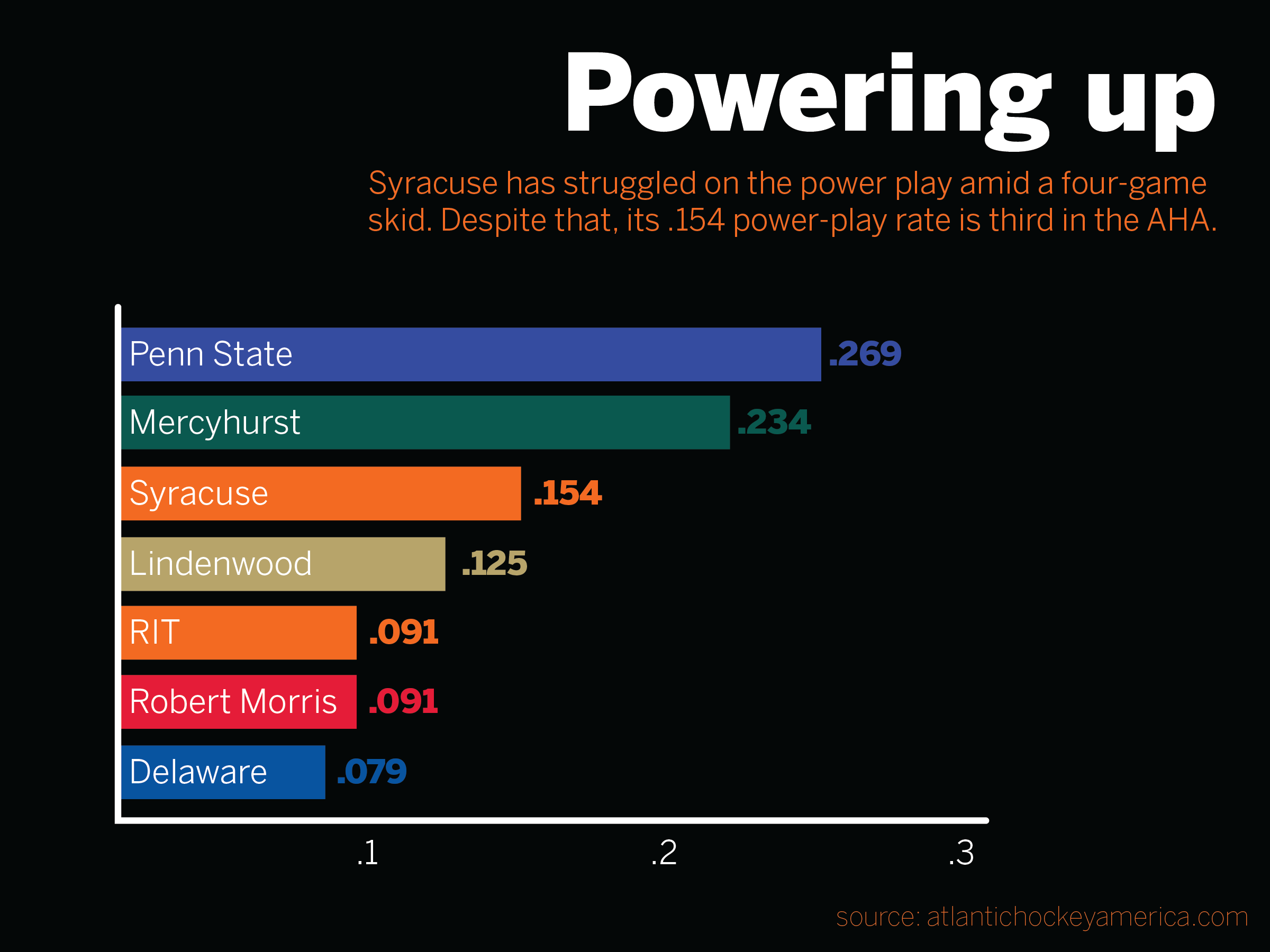
Zoey Grimes | Design Editor
When asked what Syracuse could do to improve special teams efficiency, there were a few things on Idalski’s list.
“I think some of that’s just quickness of puck movement and decision-making,” he said after SU went 0-for-3 against Colgate. “I thought we were a little slow with some of our reads and puck movement. We’ve got to zip the puck around two, three passes, tape-to-tape quickly, and get pucks to do the same.”
Just like Knight’s view of the kill, Idalski is focused on faster puck movement in advantage scenarios. The shortage of puck movement was prevalent against Colgate, when SU registered just one shot on goal across three power plays.
SU’s weakness doesn’t come from its ability to draw penalties, as the Orange average 3.47 power plays per game. The deficiency is due to execution.
The shorthanded connection between Kinsler and Gnade against Lindenwood is a prime example of what SU’s coaches want to see on both sides of special teams: quick reads and even quicker playmaking with a clear result to show for it. But after a 4-0 loss to Penn State, Idalski acknowledged that results take time. Over a month later, his sentiment remains true.
“The reality is we’re still figuring out some of the roster and personnel and skill sets and how do they best fit with each other,” he said. “That’s something we want to continue to grow, but it’s been pretty good so far. Super happy with its development.”