‘Hamnet’ tenderly grapples acceptance, change in naturalistic adaptation
Get the latest Syracuse news delivered right to your inbox.
Subscribe to our newsletter here.
“To be or not to be; that is the question.”
In Chloé Zhao’s “Hamnet,” Will Shakespeare (Paul Mescal) recites this famous “Hamlet” line as he peers over the River Thames, contemplating between life and death. Throughout the film, Will teeters between hanging onto tragedy or stepping into an unknown world free from suffering.
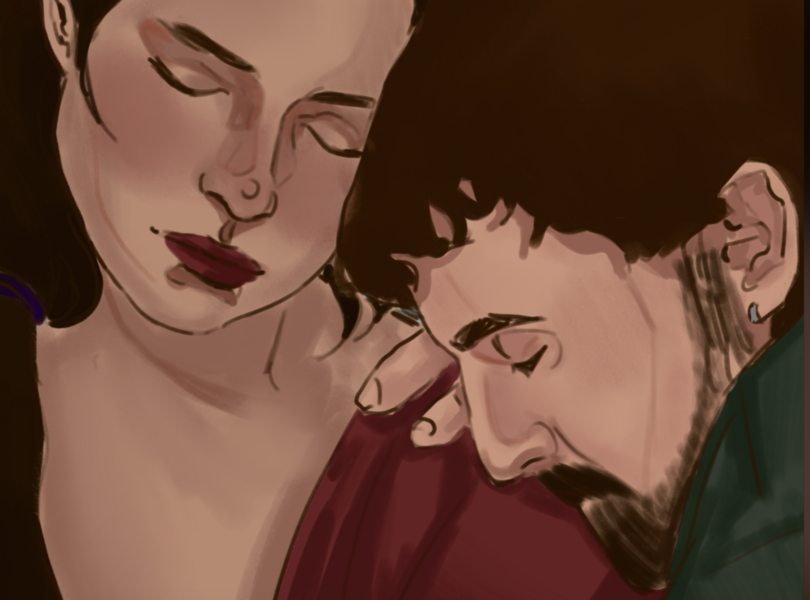
“Hamnet,” limited-released on Nov. 26th and will be released in theaters nation-wide on Dec. 12, follows Will and his wife, Agnes (Jessie Buckley), as they fall in love, build a family and deal with the death of their only son — Hamnet. Adapted from Maggie O’Farrell’s 2020 novel of the same name, Zhao’s fifth feature is her best to date. It harnesses the same narrative and visual beats that have defined her auteur style: a naturalistic, sentimental spectacle that grapples resilience, acceptance and change.
The historical, romance drama is a classically trained actor’s dream: a fictional retelling of Shakespeare’s life. It features a star-studded cast, with the sublime performances from Mescal, Emily Watson (Will’s mother) and Joe Alwyn (Bartholomew; Agnes’ brother). But, it’s defined by Buckley’s crown-stealing performance as Agnes that will undoubtedly land her a Best Actress nomination come January.
The story follows Agnes as she meets Will, a village tutor who works to repay his father’s debts. Will is entranced by Agnes and repeatedly tries to court her attention but only succeeds when she asks him to do what he learns he can do best — tell a story.
The film opens with Agnes, a forest witch who lays among the trees and calls to her pet hawk. Cinematographer Łukasz Żal, who previously used camera stillness to instill fear and unease in “The Zone of Interest,” inverts this same tactic. The camera work creates a calm tranquility, which meshes well with Zhao’s documentarian-like realism.
Zhao’s direction takes center stage. The camera patiently shifts as naturalistic lighting accents Will and Agnes’ faces. The greens of the forest pop; Zhao lets landscape nurture the bud between the couple.
The troubled youth that Will and Agnes share becomes core to their romantic relationship. Agnes, who can see people’s futures, is an outcast in her family and belittled for her rebellious attitude. Similarly, Will is berated by John for pursuing the literature and the arts, instead of inheriting the family’s glove business. It isn’t until Will attacks and threatens his father that he’s free from family burden.
Soon, Agnes is pregnant and gives birth to their first child, Susanna (Bodhi Rae Breathnach). To find purpose and a way to support his family, Will travels to London and leaves them behind to become a playwright. He works toward becoming the greatest writer of his era, but Agnes is again alone to birth and raise their twin children: Judith (Olivia Lynes) and Hamnet (Jacobi Jupe).
Will’s familial absence is the first major signifier of loss in the film; he must sacrifice his presence in Agnes and his children’s lives to ensure their comfort.
When Agnes gives birth to twins, Buckley shows incredible fear, anxiety and love. Her delivery is absolutely mesmerizing, tugging the softest parts of my heart and leaving my eyes glued to the screen.
Again, Zhao is patient with the camera, but here she swaps an established calm for tension, as her vivid pace raises the stakes more than any action film. Zhao gives life to Agnes’ central fear that one of her children will die, focusing Agnes’ uncertainty on Judith who is nearly stillborn. Though we know Hamnet’s destiny, I was still distraught for Judith’s life.
Will and Agnes face medieval norms that designate men to schooling and women to house skills and witchcraft. But Hamnet, when Judith is near death with the bubonic plague, embraces witchcraft to save his sister. He encounters death itself and tells it to take him, not his sister, because he’s Agnes’ son and is strong.
Will is late to Hamnet’s death and must leave the next morning. In London, he creates “Hamlet,” and goes months without talking to Agnes. He leaves Agnes alone again to encounter the rage, depression and acceptance that her Hamnet is gone – her vision given life. Precognition is Zhao’s strongest narrative tool, a force that gives and takes definition from Agnes’ life.
It isn’t until Agnes and Bartholomew venture to the Globe Theatre in London that they find Will again, playing the ghost of King Hamlet.
Like the day Will wooed her, Agnes is confused by the form of Will’s stories. But, as the late King Hamlet speaks to Prince Hamlet (Noah Jupe), and Prince Hamlet speaks to the audience in the play, Agnes understands that her loss isn’t singular; that this play isn’t about them, but something more.
The redundant use of Max Richter’s “On the Nature of Daylight” boggles the tension in this scene, turning my tears into near laughter. A score that has been worn to death by major Hollywood films, I felt a missed chance to arrange an original piece.
Yet, this instance of musical banality doesn’t ruin the film. “Hamnet” has earned its place as one of the greatest films of the decade.