‘Wicked: For Good’ honors historical 1939 origins despite unnecessary additions
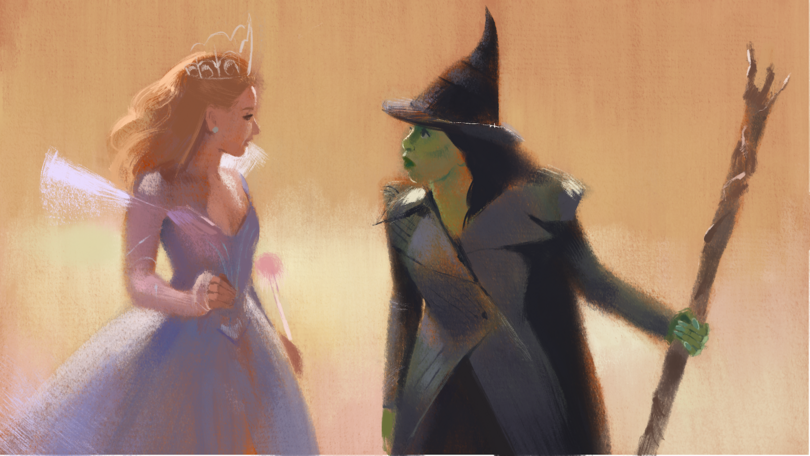
“Wicked: For Good” added two extra songs not included in the original musical. Both feel unnecessary and take up time that could’ve been spent on important plot points, our columnist writes. Julia Rodenberger | Contributing Illustrator
Get the latest Syracuse news delivered right to your inbox.
Subscribe to our newsletter here.
Last fall’s “Wicked” took the popular culture world by storm with its viral press tour clips, collaborations and booming success at the box office. So, it’s no wonder fans like myself dedicated an entire weekend to the release of its sequel, “Wicked: For Good.”
I’ve been a fan of Wicked since middle school, having seen the Broadway show live and a YouTube bootleg countless times (sorry, not sorry). Jon M. Chu’s rendition of the story, adapted for the big screen, is far from perfect. But, despite its faults and the flaws of its source material, the two films are an impressive feat that have more redeeming qualities than damaging ones.
The first film brought the story of Elphaba and Glinda — which has run on Broadway since 2003 — front and center in the media landscape. The film shows the first act of the stage musical, ending with Elphaba’s (Cynthia Erivo) iconic catharsis song “Defying Gravity,” in which the young girl steps into her mystical powers while condemning the Wizard of Oz (Jeff Goldblum).
“Wicked: For Good,” released on Nov. 21, continues the story some time after the first film’s events. Elphaba is now a fugitive hiding from the corrupt Ozian government led by the Wizard and aided by Madame Morrible (Michelle Yeoh). Meanwhile, Glinda (Ariana Grande) is boosted into celebrity by Morrible, with the responsibility of lifting Ozian spirits in the face of Elphaba’s supposed wrongdoings.
In contrast to the musical, which leaves this time jump unaddressed, viewers get to see some of the events between acts. Elphaba flies around Oz on her broomstick and frees imprisoned animals (who do manual labor laying yellow bricks). While Elphaba’s motives for these acts are to combat the corrupt Wizard, Morrible uses her position as press secretary to portray the girl as a terrorist.
Morrible and the rest of Oz’s leadership refer to Elphaba as “The Wicked Witch of the West,” distributing pamphlets that exaggerate her as a caricature of evil. Her attempts to free the animals are seen as traitorous, despite her good intentions.
The second act of the musical is when the characters in Act 1 develop into the familiar faces in the 1939 “The Wizard of Oz.” While the film does the stage show justice, the source material is far from perfect and leaves many ambiguities.
An undeniable theme in Wicked’s storyline is its allegorical ties to historical fascist regimes. The Wizard uses propaganda to scapegoat Oz’s animals, making it seem as though the group is responsible for a historical drought that afflicted Oz. We see this progression throughout the first movie, as the goat Dr. Dillamond loses his teaching ability and is ousted from Shiz University.
The film expands on these themes, doubling down on the source material. From its opening scene that depicts a SS-like police force overseeing coerced labor, to the travel ban placed on animals and Munchkins, it’s clear Chu wanted to hammer home the Wizard’s brutality beyond what was included in the stage show.
Despite these injustices in Oz, Glinda is branded “The Good Witch” and given a platform to distract the Ozians from Elphaba’s supposed terror. In the Emerald City, we see this contrast unfold visually as the two women are portrayed opposite each other. Pink banners celebrating Glinda’s benevolence hang directly across from green ones villainizing her close friend.
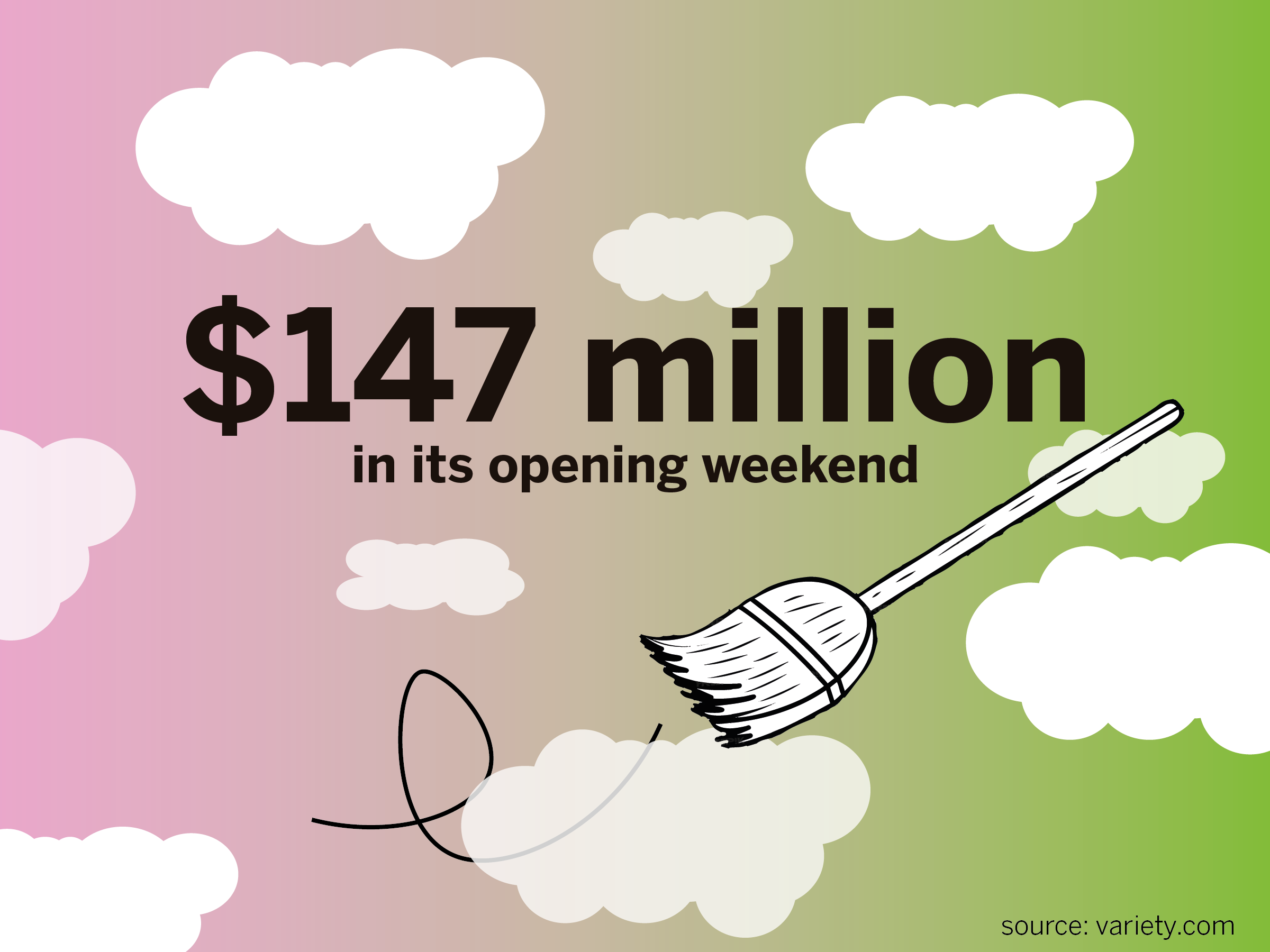
Ilyan Sarech | Design Editor
To fuel the celebration and “ballyhoo,” Glinda announces her engagement to the newly appointed Captain of the Gale Force, Fiyero, played by People’s 2025 Sexiest Man Alive Jonathan Bailey.
In the complex “Thank Goodness / I Couldn’t Be Happier,” Glinda delivers a powerful reflection on the paths she’s taken to get where she is now.
“There are bridges you cross you didn’t know you crossed until you’ve crossed,” she sings in the song’s climax, acknowledging her complacency in the system that targets Elphaba and the animals.
Like the stage musical, this is one of the most important moments in Glinda’s character. Midsong, she publicly accepts that to achieve her dreams she had to betray the person closest to her.
While it’s easy to glamorize Glinda’s character for her quirky charm and pristine aesthetic, this song forces the audience to accept her direct role in the injustices happening throughout Oz. She can’t help but indulge in the fame and fortune of working alongside the Wizard, no matter who he harms with his targeted rhetoric.
One of two newly added songs, “No Place Like Home,” is a patriotic ballad Elphaba sings while trying to convince the animals to defend Oz. While the song’s sentiment is empowering and draws parallels to our current political climate, it’s unnecessary, taking up vital screentime that could be used to explain lingering plot holes like the confusing timeline that leads us to the events in “The Wizard of Oz.”
One of the film’s biggest redeeming points comes from Erivo’s performance as Elphaba. A powerhouse vocalist and experienced actress, Erivo delivers on Elphaba’s transition into wickedness after losing those close to her in “No Good Deed.” The fire-lit backdrop of the Tigelaar Castle as Erivo belts makes for the film’s most breathtaking scene. I would pay money to watch it in theaters again for the first time.
The song added for Glinda’s character is called “The Girl in the Bubble” and it’s a surprisingly bland tune. While it adds some depth to Glinda, drawing connections to her childhood ambitions, it lacks lyrical prowess, unlike the rest of the musical’s tunes.
We’ve already watched Glinda’s internal conflict unfold in earlier scenes, so this song feels like a weak underscore of a plot we’ve already seen. I can tell why the song was cut from the original stage production, as it kills the momentum between “March of the Witch Hunters” and “For Good.”
In the soundtrack’s final song and the story’s climax, Glinda and Elphaba reconvene before Elphaba’s approaching demise. They share a heartfelt ballad, familiar to theater kids as the second act’s defining tune.
“Because I knew you, I have been changed for good,” they sing before Elphaba “melts.”
In a change from the musical’s script, there’s a defining moment the pair experience before Dorothy famously throws her lethal bucket of water on the witch. Elphaba and Glinda share a pause, split between a castle door. After the powerful duet just moments before, this moment serves as the ultimate tearjerker before the film’s epic conclusion.
Coming out of recent movie musical catastrophes like “Dear Evan Hansen” and “Mean Girls,” it’s clear the cast and crew took special care of “Wicked.” From its iconic press tours to viral TikTok trends and dances, “Wicked: For Good” swept through the pop culture landscape, much like the twister that carried Dorothy to the land of Oz.