Student Government Association’s 4-tier RSO funding structure explained
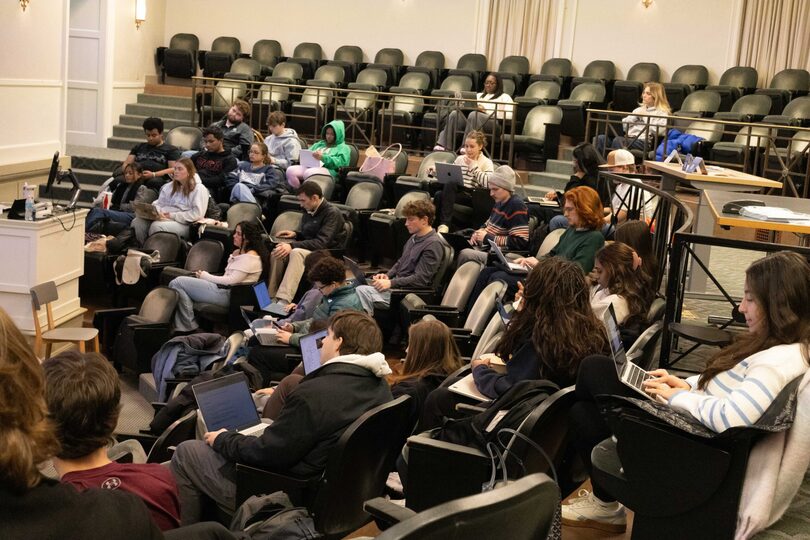
SU is home to 384 registered student organizations, most of which rely on funding from the Student Government Association. The finance board uses a tier-based system to inform its recommendations for RSO funding. Aaron Hammer | Staff Photographer
Get the latest Syracuse news delivered right to your inbox.
Subscribe to our newsletter here.
During the 2024-2025 academic year, several of Syracuse University’s Registered Student Organizations faced unexpected funding cuts after overspending in past Student Government Association sessions.
While SGA ran out of RSO funding within the first two months of last semester, it’s still awarding funding to organizations this fall, approving $3,729.31 of its special allocations budget on Nov. 17, Comptroller Alexis Leach said during an SGA meeting.
“The finance board tries to fund as many programs and as many organizations as they can,” Executive Director of Student Engagement Anne Lombard said. “They just considered their requests for the spring semester, and there was probably almost twice the amount requested that there was to allocate. So it’s really hard.”
SGA’s finance board, led by Leach, is responsible for reviewing budget requests and distributing funding. The funding comes from the student activity fee, a semesterly cost for SU and SUNY ESF undergraduates. The fee increases concurrently with SU’s tuition, as outlined in SGA’s constitution.
As RSOs prepare for the spring 2026 semester, The Daily Orange has broken down how SGA distributes its funding to the 384 RSOs on campus.
Budget requests
There are two main ways RSOs can apply for funding. The first is through advanced allocations, RSO budget requests submitted the semester prior to when funding is needed. Generally, RSOs need to submit requests in October for the upcoming spring semester and in March for the next fall semester.
RSOs can also receive funding through special programming. Special programming requests are for events planned during the current semester.
The fall 2025 special programming fund for all RSOs is $125,000, Leach said.
The finance board makes recommendations on whether to approve or deny budget requests, which are voted on and reviewed at SGA’s Monday assembly meetings. The board uses SGA’s financial code, guidelines for expenditure of student activity fees, to help inform its recommendations.
Finance Board Secretary Tim Phelps said the fiscal code is something many students misunderstand, with many thinking that the codes are “arbitrary” or not real.
“In reality, we do have fiscal codes that we use to back up our decisions,” Phelps said. “And those are available to (anyone) to look at and reference.”
Several budget requests get denied, partially approved or approved with contingencies.
Partial approvals mean part of the funding request has been denied and needs revisions to be approved. Contingent approvals mean the funding has been approved; however, the RSO still needs to submit appropriate documentation.
“There isn’t enough money for all of the programs,” Lombard said. “So even when they’re excellent requests, and they’ve done everything they need to do, and they’ve gotten it in on time, there is still an element of discretion amongst the finance board.”
Finance Board Member David Alpert said RSOs often have funding requests denied because they fill out budget request forms incorrectly. He said common mistakes include listing the wrong space for an event or missing proof of total costs. In some cases, RSOs can resubmit a denied request.
“If you request Poland Springs water, we can’t fund that because it has to be Coke products,” Alpert said. “That’s not a deniable (mistake) though. We’ll just say that you have to resubmit since it was the (lack of) Coke products.”
Timeline
The finance board follows a two-week rule for its special programming, where an event cannot be held less than two weeks after an RSO’s date of approval, as stated in the fiscal code.
The rule is enforced by SU’s Office of Student Engagement, which also manages student activities funding.
Phelps said if an RSO submits a special programming request on a Friday, the approval date is typically “the Tuesday after the process happens.” The event would then have to be held at least two weeks after it’s approved.
RSOs can’t streamline the funding process beyond following the rules and making sure funding requests are error-free. They’re approved based on the accuracy of budget requests and in accordance with the fiscal code.
RSO tiers
The finance board uses a tier system to inform its recommendations for RSO funding. These tiers determine the amount of funding an organization can receive based on its “programming capital.”
According to section 1.10-2 of chapter 4 of the SGA constitution, organizations can increase their programming capital by hosting more events and working with other, more experienced, organizations.
Programming capital, as defined in SGA’s constitution, is built by hosting successful events.
The “success” of RSO events is measured by turnout and ticket sales compared to expected attendance and student feedback.
Tier 1 RSOs have little to no programming capital and can only receive up to $12,500 in event funding. Tier 2 includes RSOs with successful programs, though they can’t receive more than $25,000.
Tier 3s can receive up to $40,000 and Tier 4s are eligible for funding that exceeds $40,000. Tier 4 RSOs include senior organizations like University Union and CitrusTV, Lombard said.
“A higher tier basically means that the groups have a record of doing strong and consistent programming,” Lombard said. “So to move up to another tier, it means that they’ve achieved the goals at the current tier and that they are evaluated by the finance board to move up to the next tier, which means that they can request more money per event.”
RSOs must meet specific requirements to move up a tier and can only do so one tier at a time. First, they must meet a time-on-campus minimum. To move from Tier 1 to Tier 2, RSOs must have four semesters of programming history, supply requests and publication requests, according to the constitution.
It takes five semesters to move from Tier 2 to Tier 3 and six semesters to move from Tier 3 to Tier 4. New RSOs are automatically placed in Tier 1.
RSOs also need a letter from their faculty advisor, a list of marketing strategies, the RSO’s justification for moving up a tier and a list of the organization’s “collaborative experiences.” RSOs also need to provide examples of five events they’ve hosted at their current tier.
Tier applications are approved by a majority vote from the Finance Board and do not take effect until the following semester.
“They do their best to be fair, but at a certain point they do run out of money,” Lombard said. “It’s ugly and they hate it, but it’s hard because there are so many good ideas that come forward.”