Syracuse finally answers PG question by avoiding ‘real point guard’
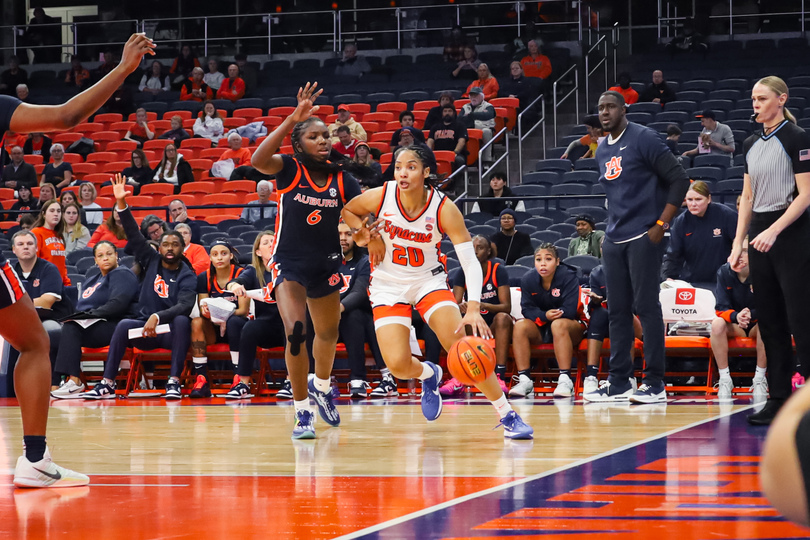
Despite not starting consistently at USC or UCLA, Dominique Darius has fit right into her new role as Syracuse's de facto point guard. Leo Gensler | Staff Photographer
Support The Daily Orange this holiday season! The money raised between now and the end of the year will go directly toward aiding our students. Donate today.
A little over a week before Syracuse’s season opener, assistant coach Khyreed Carter sat in his office, fielding questions about freshman point guard Camdyn Nelson over a call. After praising Nelson’s work ethic and decision-making, he was asked a parting question — one on the minds of many entering the season.
“How do you anticipate filling the point guard position this year?”
Last season, Dominique Camp scored just 4.3 points per game across 22 starts as SU’s primary floor general, a far cry from the production her predecessor — Dyaisha Fair — poured in. Fair averaged 21 points per contest in her two seasons with the Orange, ending her five-year career as the NCAA’s third-highest all-time scorer.
With Camp graduating after the season, the position would be wide open. Still, Carter, SU’s backcourt coach, was noncommittal on how the Orange would address it.
“Very much so point guard by committee,” Carter responded. “We went out and brought some talented freshmen, and we also got some kids in the portal that we think can play point guard for us as well.”
So far, Carter has stuck to his word, regularly rotating SU’s point guards through its first nine games. Syracuse started Nelson at the point in its first three games, and she regularly split time with Angelica Velez early on. But recently, Nelson’s role has decreased, not appearing in either of SU’s last two games. Instead, the Orange have turned to USC transfer Dominique Darius.
It’s difficult to consider Darius a traditional point guard. Camp, for example, held a 30.5% assist percentage last season, while past Syracuse point guards like Alexis Peterson and Tiana Mangakahia owned seasons with assist percentages over 40%.
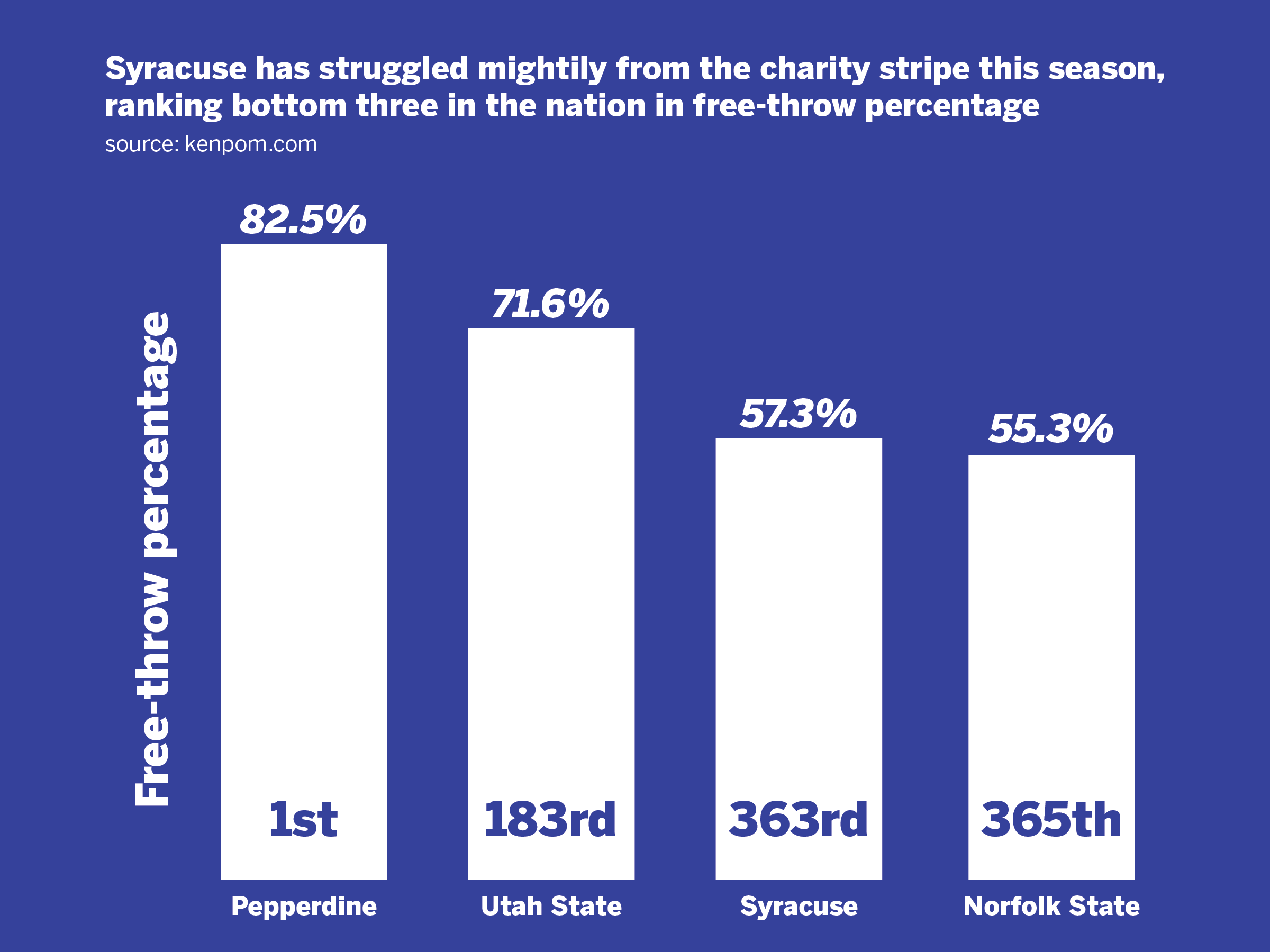
Ilyan Zarech | Design Editor
Darius, on the other hand, only has a 21.6% assist percentage this season, and it’s her first campaign with an assist percentage north of 20%. She’s more of a combo guard than a facilitating floor general, looking to create looks for herself more than others.
And yet, it’s hard to say the experiment isn’t working. Syracuse has won eight of its first nine games and five of six since Darius took over. Despite starting sparingly at the Division I level, Darius has seamlessly fit in with the Orange. She’s averaging 12.9 points and 2.1 steals per game, also becoming SU’s “defensive captain,” fellow point guard Olivia Schmitt said.
“When you sit for four years, you learn different skillsets,” Legette-Jack said, discussing Darius’ leadership. “Her pivot was to help other people perform well. And now as she’s playing, she’d never lost that trait.”
While the Orange averaged 78 points per game with Nelson at the point — compared to 69 with Darius — that discrepancy can be explained by the fact Darius has faced four Power Five teams as SU’s point guard, compared to Nelson’s zero.
Moving away from the traditional, table-setting point guard was a risky decision. But thanks to the team’s offensive versatility, it’s worked like a charm so far.
Even with Darius ostensibly filling the point guard role, she isn’t always the one initiating Syracuse’s half-court offense. Sometimes, the rebounder plays the outlet pass, as Uche Izoje did to Sophie Burrows in the first quarter of SU’s win over SMU Sunday. Sometimes, Laila Phelia brings the ball up the court, like when she took over the offense in Syracuse’s 66-60 overtime win over Auburn on Dec. 3.
“(Laila) struggled a little bit, but then that fire came,” Legette-Jack said after SU’s win over the Tigers. “She went face first into that fire: ‘Give me the ball, get everybody out of the way.’”
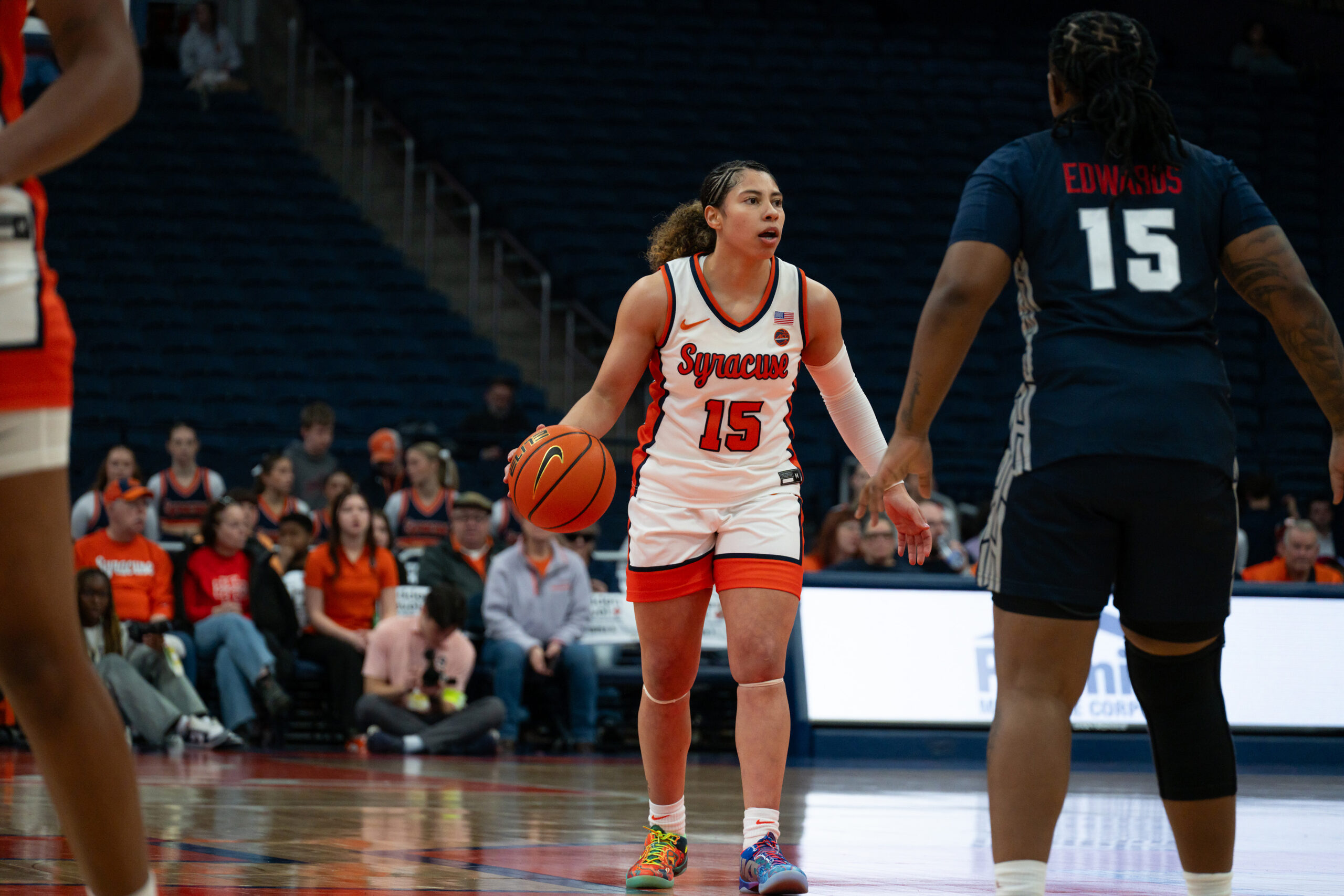
Angelica Velez dribbles up the court in Syracuse’s 78-62 win over Howard on Nov. 30. Velez collected a career-high nine assists against the Bison. Zoe Xixis | Staff Photographer
That’s not to say the Orange have completely abandoned using a pass-first point guard. Velez has appeared in every game off the bench, and her 37.1% assist percentage is much more akin to what one would expect from a facilitating point guard. Since her return from injury, Schmitt’s playing time increased, playing substantial minutes late against Auburn and SMU.
But the Orange also aren’t nailed down to the rigid offensive structure built around a facilitator. Before the season, Carter said he wanted an offense where everyone had permission to lead. He didn’t want Syracuse’s players to feel a need to wait for the point guard to receive the ball after a rebound or outlet pass. He desired a free-flowing offense with a variety of potential ball handlers. Right now, his vision is coming to fruition.
“Let’s all be able to push the pace,” Carter said, describing Syracuse’s offense. “Let’s all be able to run the plays from any spot.”
In between his response about SU’s point guard committee, Carter first posited the idea that the Orange might not need a true point guard. Carter pointed to Fair’s success as evidence, emphasizing she wasn’t necessarily a “real point guard” when she was Syracuse’s floor general.
She could play off the ball just as effectively as she could on it. In her final season with SU, Fair had a 19.8% assist percentage — a lower mark than Darius’ aforementioned 21.6%.
Before this season, it’s easy to see how that idea would invite skepticism. After all, Fair isn’t walking into the JMA Wireless Dome anytime soon.
But nine games in, the concept doesn’t seem nearly as far-fetched. And if everything keeps going right, the Orange might finally fill the void Fair left almost two years ago.