Should J.J. Starling be more aggressive offensively?
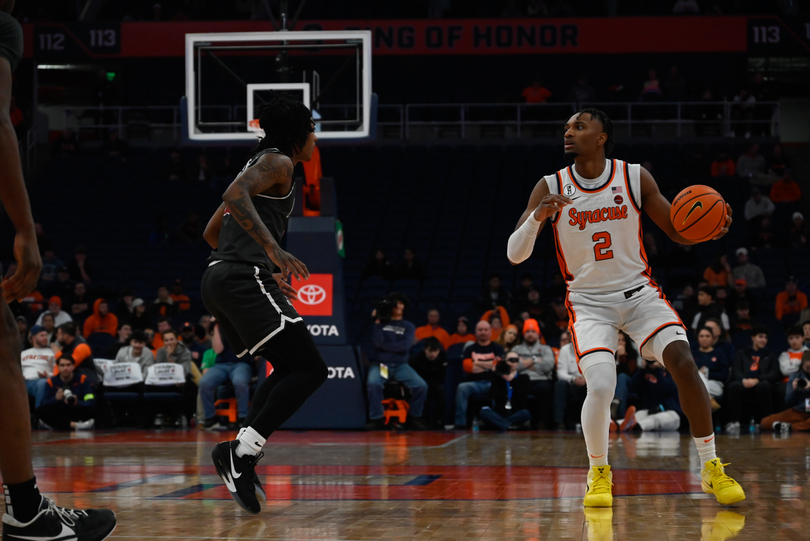
J.J. Starling’s shot attempts per game have diminished from 16.0 last season to 9.5 thus far into the 2025-26 season. Christian Calabrese | Staff Photographer
Support The Daily Orange this holiday season! The money raised between now and the end of the year will go directly toward aiding our students. Donate today.
J.J. Starling’s shot attempts per game have diminished from 16.0 last season to 9.5 thus far into the 2025-26 season. But when Starling was injured to begin the season, head coach Adrian Autry said he was missing an “All-Conference” player.
The statement is technically true, as the senior guard earned Preseason All-Atlantic Coast Conference Second Team honors. While the former McDonald’s All-American was named to the ACC All-Freshman Team after playing one season for Notre Dame, he didn’t earn All-Conference honors across his two prior years with the Orange. This was supposed to be the one where he elevated to that level.
Instead, Starling hasn’t been an offensive focal point. He’s averaging the fifth-most points per game among SU players, while his %Shots — a KenPom metric that measures a percentage of a team’s shots taken while a player is on the court — has dropped from 31.8% (which ranked 42nd nationally) to 24.2%. After leading Syracuse and second-place Donnie Freeman in that metric by over 5% last season, Starling’s clip ranks fourth on the team this year.
“I just want to help my team win. I just want to win,” Starling said when discussing his usage dip.
The statement would be one thing if the Orange had a couple of losses and were dominating teams they should be. That’s not the case, however, as Syracuse (6-4, ACC) is barely above .500 through 10 games after losing to Hofstra at home Saturday.
So it begs the question: Should Starling be more aggressive?
The case for yes
Don’t take it from me, take it from Autry after the Orange were upset Saturday.
“He just needs to keep being aggressive,” the head coach said. “He’s a guy that can get going. We need him to be aggressive.”
Besides Freeman, who’s missed the last six games with a lower-body injury, Syracuse doesn’t have an alpha scorer. While Starling prioritizes wins, SU’s best path for victory may require him to be more aggressive.
“But obviously, with the player I am and what I’m capable of, there’s got to be moments I pick up myself to where I got to be aggressive,” Starling said. “Not even just scoring, but making the right read and stuff like that. So I got to do a better job with that.”
The player Starling is capable of being is a top-10 scorer in the ACC, like he was last year. Due to Freeman’s season-ending injury and poor roster construction, SU’s offensive identity surrounded getting the ball to Starling and having him make a play.
It’s hard to pinpoint an offensive identity this year. Typically, Autry likes playing a version of “drive and kick” where the ball handler either attacks the rim or looks to set up a teammate for a 3-pointer if the defense collapses. Through 10 games, Syracuse has the 107th-best KenPom offensive efficiency.
In simple terms, what the Orange are doing offensively isn’t working that well. Putting the ball in the hands of arguably their best pure scorer could help them improve.
This team was in part built around Starling. He needs to be a face-of-the-program-like player for SU to succeed.
The case for no
While it’s indisputable Starling is a talented offensive player, he’s also a flawed one. Even when he led Syracuse in scoring last year, EvanMiya’s offensive BPR (OBPR) metric — which reflects a player’s offensive value when they’re on the court — ranked Starling as its fourth-best player behind Eddie Lampkin Jr., Jyáre Davis and Jaquan Carlos.
That’s because Starling was an inefficient scorer. He shot 40.7% from the field, 26.8% from 3-point range and 68.5% from the free throw line, culminating in a 48.7% true shooting percentage (TS%). Starling’s TS% was the second-worst on the Orange last year, only ahead of Kyle Cuffe Jr.’s 48.5% mark.
This year, Starling TS% has dipped to 46.8%. Despite shooting a career-best 33.0% from beyond the arc and improving his field goal percentage to 42.1%, Starling’s free throw percentage abysmally sits at 40.0%.
“I don’t think so,” Starling said when asked whether taking more shots would help Syracuse win. “There’s going to be some nights when I’m off, I might take five shots. Might be some nights where I’m clicking and I might take 12, it just can’t go off of that.”
For a player whose forté is getting downhill and finishing near the rim, Starling needs to figure out his free-throw shooting. If he doesn’t, opponents should just foul him every time. And if that happens, he might be unplayable.
Another argument against Starling is that his OBPR ranks fifth on the Orange behind Freeman, Nate Kingz, Naithan George and William Kyle III. Even with Freeman out, it’d be hard to argue that increasing the fourth-best offensive player’s usage would all of a sudden help Syracuse’s offense click.
Assuming Freeman returns by the time conference play starts on Dec. 31, he should resume his role as SU’s No. 1 option. If Freeman is fully healthy, Starling could be taking even fewer shots.
So what does this mean?
Two things can be true at the same time: Starling is one of Syracuse’s most talented scorers, but he’s also one of its most inefficient scorers. Reducing an inefficient scorer’s shots hypothetically enables the team to take more efficient shots, but it also limits that player’s scoring output.
The Orange’s offense, with Starling essentially serving as Superman, ranked 106th, per KenPom’s offensive efficiency. This year, with Starling taking more of a backseat, they’ve placed 107th.
Syracuse has desperately lacked an alpha scorer in Freeman’s absence — Starling is more than capable of filling that role. But with how he scores, it might not be worth it to increase Starling’s volume.
It’s a nuanced question to answer. And a big one Autry should seek answers for as soon as possible, with his program’s back against the wall to snap its four-year March Madness drought.