Opinion: Maduro’s capture fits century-long pattern of American imperialism
Get the latest Syracuse news delivered right to your inbox.
Subscribe to our newsletter here.
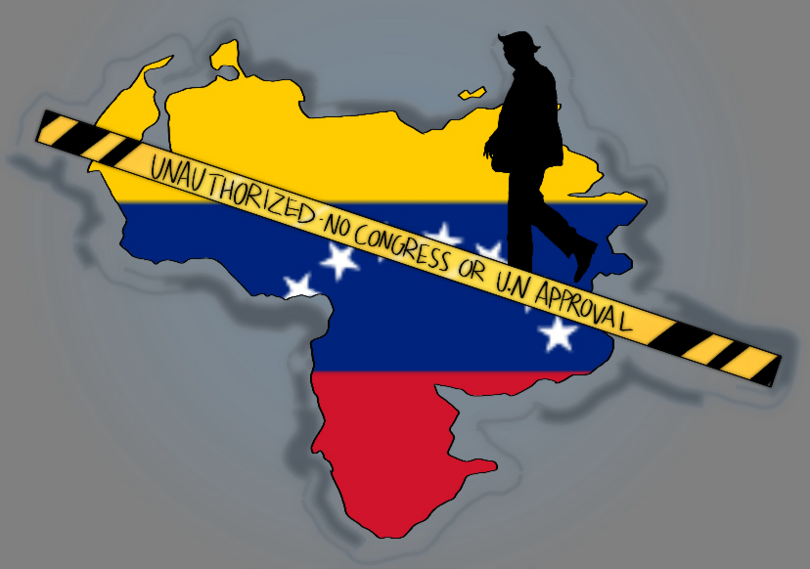
On Jan. 3, United States Special Forces conducted an extrajudicial operation in Caracas, capturing Venezuelan dictator Nicolas Maduro and his wife. What followed was a mixture of relief, celebration, criticism and condemnation.
Florida, home to the largest Venezuelan population in the U.S., saw protests and parties alike. While the joy and relief of many Venezuelans celebrating Maduro’s arrest is rooted in a legacy of suffering under the regime, it’s imperative the Latin American consciousness doesn’t succumb to a definitive ecstasy.
The extrajudicial force by which the U.S. captured Maduro doesn’t mean liberation for the people of Venezuela. Rather, it’s the continuation of more than a century of U.S. intervention in Latin America meant to exploit, coerce and control. It’s the reinforcement of an imperialist leash on the Western Hemisphere, tightly wound around the fist of a volatile U.S.
Since early September, Trump has latched onto a variety of explanations to justify the escalation of U.S. military force in Caribbean and South American waters. According to a PBS report, there have been 35 known strikes against what the administration has alleged to be “narcoterrorists” funneling fentanyl and other illegal narcotics into the US by boat. One hundred and fifteen people have been killed in this process.
Notably, Venezuela is completely absent from the global equation of fentanyl production and distribution. The Drug Enforcement Administration’s 2025 National Drug Threat Assessment instead names Mexico as the main producer of the drug, with China and India as primary suppliers for the chemicals used to produce it. The entry of cocaine into the U.S. has been another justification used for these illegal attacks. And yet, only 5% of Colombian cocaine is estimated to transit through Venezuela, with the large majority being sent to the Caribbean or Europe.
Malcolm Nance, an intelligence and foreign policy analyst, explains this as an interwoven evolution of both the war on drugs and terror, and he’s right. On Jan. 20 of last year, Trump signed an executive order categorizing criminal organizations and drug cartels as foreign terrorist organizations. This move has both allowed the Trump administration enough domestic legal latitude to accelerate plans of brute military force in Venezuela and nurtured a public disinformation campaign used to justify it to supporters at home.
What we must understand is that American imperialist projects have long been enacted under the minimal cover offered by public perceptions toward terrorism and illegal narcotics. But ultimately, imperialism is conducted in the name of economic control and political compliance, in spite of human dignity, self-determination and overall stability.
It’s under the guise of the Monroe Doctrine, now having evolved into the Trump corollary, that Trump has continued to wage an economic, political and military war against the countries of the Western Hemisphere and beyond. In many ways, this administration follows a close parallel of neo-eurasianism.
This war-mongering, imperialist philosophy of far-right political philosopher, Alexander Dugin, is closely followed by Steve Bannon, Dugin’s closest ideological successor in North America and a vital cog in the MAGA machine. While the ideological basis for American and Russian imperialism clash in many ways, they both operate under an enthusiasm for total domination and expansive power, especially over the countries of the Global South.
Russia’s invasion of Ukraine, the Gazan and Sudanese genocides, the civil war in Yemen, the ravaging of the Democratic Republic of Congo, the destabilization of Iran and the fires in Argentina’s Patagonia are all recent examples of global imperialist powers devastating peoples and land, whether directly or behind the scenes. These crimes have occurred under the demands of control and compliance required to create their respective expansionist, imperialist projects and so the accumulation of their capital can explode from stolen minerals, lands, oil, and life.
The exhaustive legacy of U.S. imperialism in Latin America, specifically, has given us the historical basis so that we may recognize the patterns of behavior used to create the current conditions for further U.S. intervention in the region.
But ultimately, imperialism is conducted in the name of economic control and political compliance, in spite of human dignity, self-determination and overall stability.
Examples go as far back as October 1928, if not further, when Colombian banana farmers issued a list of demands to the U.S.-based United Fruit Company, now Chiquita Brands International, after having been deprived of proper living and work conditions, fair wages, insurance and adequate work weeks. When denied once more, workers decided to strike in November. The strike reached its climax on Dec. 6, when the UFC, backed by the U.S. government, threatened invasion from U.S. Marine Corps stationed off the shores of Ciénaga, Magdalena, if the Colombian government did not handle the situation to the U.S.’ liking.
The “Masacre de las bananeras” saw more than 1,000 workers and bystanders murdered by the Colombian military as it opened fire on a crowd during a protest.
Since then, the U.S. has conducted military operations in Puerto Rico (1950), Guatemala (1954), Cuba (1961), Brazil (1964), the Dominican Republic (1965), Bolivia (1971), Chile (1973), Nicaragua (1979), El Salvador (1981-82), Grenada (1983) and Panama (1989-90). Independence efforts from colonial rule have been quelled. Democratic leaders have been assassinated and replaced with brutal dictators. Economic sanctions have been leveraged as part of a system of control under the U.S. dollar. Natural resources have been strictly controlled to the economic benefit of the U.S.
These historical patterns of behavior lead us to where Venezuela might go next.
The safety and security of the people aren’t a priority to an administration that allowed for Maduro’s repressive Chavista regime to remain in power in exchange for access to some of the crudest oil fields in the world. The people of Venezuela aren’t truly free if the conditions of their autonomy require that their national exports be sequestered and sold off to ExxonMobil, Chevron, ConocoPhillips and co.
The question we must ask ourselves now is: How can the people of Venezuela command their self-determination? Where does that lie?
In short: without the U.S.
The U.S. has positioned itself to convince many Venezuelans that the U.S. is on their team. Yet, this administration continues its violent campaign of immigration warfare on U.S. soil, and by having removed TPS designations from Venezuela just last year, there is now an even wider avenue of opportunity for many immigrants to be sent back to a similar situation that had forced their escape.
In 1972, Alí Primera, a Venezuelan singer-songwriter, wrote “Techos de Cartón,” touching on the exploitation of oil by the U.S. and the cost of mass displacement and poverty that was imposed on his people. I don’t think he would be surprised to learn that the exploration of his present reality became a prophecy for what was to come.
Primera once said that he doesn’t sing to illustrate misery, rather, he sings because there exists the possibility to erase it. I find myself sharing in some of the relief and joy expressed by many of my Venezuelan compatriots today, not because I believe that this is the end, but because I am confident in the victory we will find in the future.
Que viva el pueblo latino, y que viva nuestra lucha contra el imperialismo.
Mateo Lopez-Castro is a senior sociology, television, radio and film major. He can be reached at malopezc@syr.edu.