Opinion: Apathy toward ICE’s abuse is immoral, poses threat to Americans
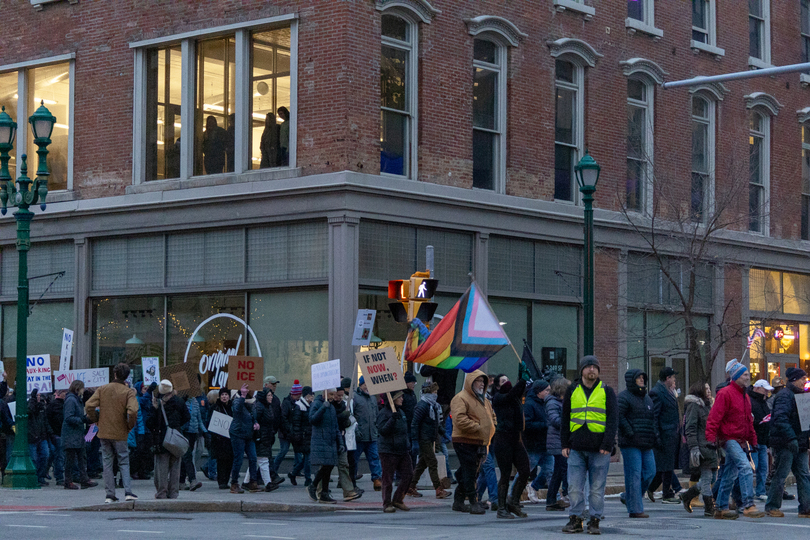
As ICE agents face little accountability for violent abuses, our columnist argues public apathy is immoral and dangerous. Silence in the face of unchecked federal power poses a threat to all Americans, she writes. Cassie Roshu | Senior Staff Photographer
Get the latest Syracuse news delivered right to your inbox.
Subscribe to our newsletter here.
On New Year’s Eve, American citizen Keith Porter Jr., a 43-year-old father of two girls, was shot and killed in front of his apartment door by an off-duty U.S. Immigration and Customs Enforcement agent in Los Angeles. Although the Los Angeles Police Department claimed to be investigating the accident, Porter’s family and the wider LA community have been met with silence. Few locally elected officials have spoken out, no arrest has been made and the state attorney general insinuated he doesn’t plan to take action.
On Jan. 7, Renee Good, a mother of three, was fatally shot by a federal immigration agent in Minnesota while calmly trying to turn away in her vehicle. Vice President JD Vance defended the agent, incorrectly claiming the Department of Homeland Security backed an entitlement to “absolute immunity.” DHS Secretary Kristi Noem accused Good of engaging in “domestic terrorism,” seemingly excusing her murder.
On Jan. 13, in Houston, ICE violently placed 10th grader Arnoldo Bazan, a U.S. citizen, in a chokehold. The agent also took his phone, which was later found sold to a used electronic vending machine near a detention facility. Houston police haven’t interviewed the agents, telling Bazan’s sister they can’t help.
On Jan. 14, ICE agents racially profiled a disabled woman, smashed her car window, cut her seatbelt and violently pulled her from her vehicle as she shouted that she was disabled in Minneapolis. As 2,000 federal agents flood the area in the “largest immigration operation ever,” school districts in Minnesota have had to cancel school for tens of thousands of students to ensure safety.
I hope that violence doesn’t epitomize what the new year has in store for us, but it’s hard not to when violent power breaches are synonymous with our current regime. BIPOC communities can’t afford to be apolitical when our identities are policed and politicized.
Noem unleashed ICE to target the “worst of the worst” — DHS officials even baselessly claim that 70% of people arrested by ICE have criminal convictions or charges; but, The Cato Institute shows that nearly 73% of detainees in ICE custody had no criminal conviction.
Public safety is nothing but a pretext to criminalize immigrants, make a profit out of their detention, militarize communities and desensitize the public to the atrocities our government is capable of inflicting if not in accordance with their agenda.
According to the American Immigration Council, the U.S. Supreme Court has left almost no way to sue federal officers for violating individuals’ constitutional rights. Local and state law enforcement can be sued under 42 U.S.C. Section 1983, but no similar statute exists for federal agents.
The Supremacy Clause largely protects federal officers from state prosecution, with some limitations. In Good’s murder case, the FBI’s control of the investigation has reportedly blocked state investigators from accessing key evidence. Qualified immunity protects officers from many civil lawsuits, and while federal prosecutors can pursue criminal cases for “deprivation of rights under colour of law,” they must prove willful intent, which is often subjective and requires a high legal bar to win.
In 1971, the Supreme Court ruled in “Bivens v. Six Unnamed Known Agents of the Federal Bureau of Narcotics” that individuals could sue federal drug agents for violating his Fourth Amendment rights through unlawful search and arrest. It’s been almost eviscerated since.
Even in fatal cases, such as the border patrol who fatally shot a teenager across the U.S.-Mexico border, the Supreme Court has made clear that lawsuits against federal officers are generally barred, except under the narrow circumstances of Bivens and two additional outdated cases. While efforts to codify Bivens haven’t progressed in Congress, they could gain more traction as people mobilize against federal law enforcement overreach.
It’s possible to sue for damages, as individuals retain the right to sue the federal government under the Federal Tort Claims Act for injuries caused by federal employees. While financial compensation cannot undo the harm caused by deaths or serious injuries at the hands of federal employees, it can at least promote accountability by symbolizing a functioning legal framework and deterring future rights abuses.
One thing remains clear: The system is working as designed. It protects the compliant and racially privileged, with the DHS embracing white, nationalist online content, including a recruitment message using a neo-Nazi anthem, “We’ll Have Our Home Again,” in an ICE ad. This post fits a broader pattern of the federal government’s blatantly racist social media presence, infantilizing their violent rampage while desensitizing the public to their bizarre tactics and widening the thresholds of our own moral litmus tests.
These blatant breaches of power and the impunity that has been blanketed onto unscreened agents pose a threat to all.Valeria Martinez-Guiterrez, Columnist
Trump said it was immigrants who were “poisoning this country,” yet the stench of foul play traces back to his own government’s hands.
Criminal impunity for federal agents is especially terrifying given the lack of verification in the hiring process, as investigative journalist and veteran Laura Jadeed tested. After a six-minute interview at a Texan job fair, to which Jadeed brought her resume but didn’t sign any paperwork and was just a Google search away from her articles opposing the Trump administration, Jadeed was emailed a tentative offer days later. Without a background check, she later discovered she’d been listed as being hired on the portal.
The combo of fast money — including a $50,000 on-the-spot hiring bonus during economic regression — weak screenings for ICE agents to meet a $75 billion budget surge, the criminal impunity DHS limboes within and exploits on social media is nothing short of a recipe for another Holocaust. Seventy-three thousand people are currently in detention centers. Rapid expansion has forced rushed infrastructure, ranging from small county jails to inhumane tent facilities holding up to 5,000 people. If citizens’ rights aren’t being respected, the reality behind bars is much worse.
In 2025, 32 people died in ICE custody, the highest number in more than 20 years, and four more died in the first 10 days of 2026. Rather than addressing serious public health and safety threats, the government spends billions on mass detention to pressure innocent people, as being undocumented is a civil offense, not a felony, to accept deportation without due process. Mass raids around the country have already resulted in preventable deaths, a consequence of an immigration enforcement system operating with a bigoted lack of oversight and accountability.
If citizens, children and peaceful towns are being terrorized by the government, we must question who the real threat to public safety is. Everyone has a role to play, skills to exploit and privilege to leverage. These blatant breaches of power and the impunity that has been blanketed onto unscreened agents pose a threat to all. The worst thing we could do is stand idly by.
It’s a moral imperative to get involved. Non-governmental organizations need graphic designers and artists of all mediums to freelance or volunteer. Immigration Alliances and groups like the Eastern Farmworkers Association need translators and even computer engineers can fill technological voids necessary for apps or websites.
If human rights permeate for some, they’ll never be absolute for all.
Valeria Martinez-Gutierrez is a senior majoring in geography, sociology and environment, sustainability and policy. Her column appears bi-weekly. She can be reached at vmarti10@syr.edu.