Opinion: Relieving student debt would strengthen economy, but Trump refuses
Get the latest Syracuse news delivered right to your inbox.
Subscribe to our newsletter here.
Late last year, the United States Department of Education announced that student loan borrowers in default will see their wages garnished to repay their student loans in early 2026. Over 1,000 were supposed to receive notice of wage garnishment the week of Jan. 7.
On Jan. 16, though, the Education Department announced that this process would be temporarily delayed. While this gives borrowers in default some breathing room, it ignores the root of the problem of student loan debt and doesn’t actually translate into aid forgiveness.
Delays like this one are just stopgaps. Without substantive forgiveness, borrowers remain trapped in debt and President Donald Trump administration’s approach continues to prioritize ideological opposition over economic reality.
This debate isn’t new, either. I first grappled with it in high school, just months after the Supreme Court struck down former President Biden’s student loan debt forgiveness program. I frequently encountered the neoconservative viewpoint that federal student loan debt forgiveness is unfair to college graduates who have paid off their debt and forces non-college graduates to pay for debt forgiveness.
This line of thinking is not only outdated but incorrect. Federal student loan debt is held by the government, and forgiving it doesn’t burden taxpayers in the way this argument suggests. Claiming that student loan forgiveness is unjust because some borrowers have already paid off their debt is like arguing that we shouldn’t take medicine when we get the flu because our ancestors had to combat it without treatment.
Despite this logic, the neoconservative position on student loan debt forgiveness has gained new traction in government policy following the start of President Trump’s second term. Project 2025, a Heritage Foundation political initiative, was co-authored by one of the strongest critics of student loan debt forgiveness and has been incorporated into much of the Trump administration’s agenda.
Project 2025 has been rightfully criticized for proposals that include abolishing federal Diversity, Equity, Inclusion and Accessibility practices and eliminating many of Biden’s policies on LGBTQ+ rights. Far less attention has been paid to the project’s provisions targeting federal student debt forgiveness, even as those policies have already begun to be implemented by the Department of Education.
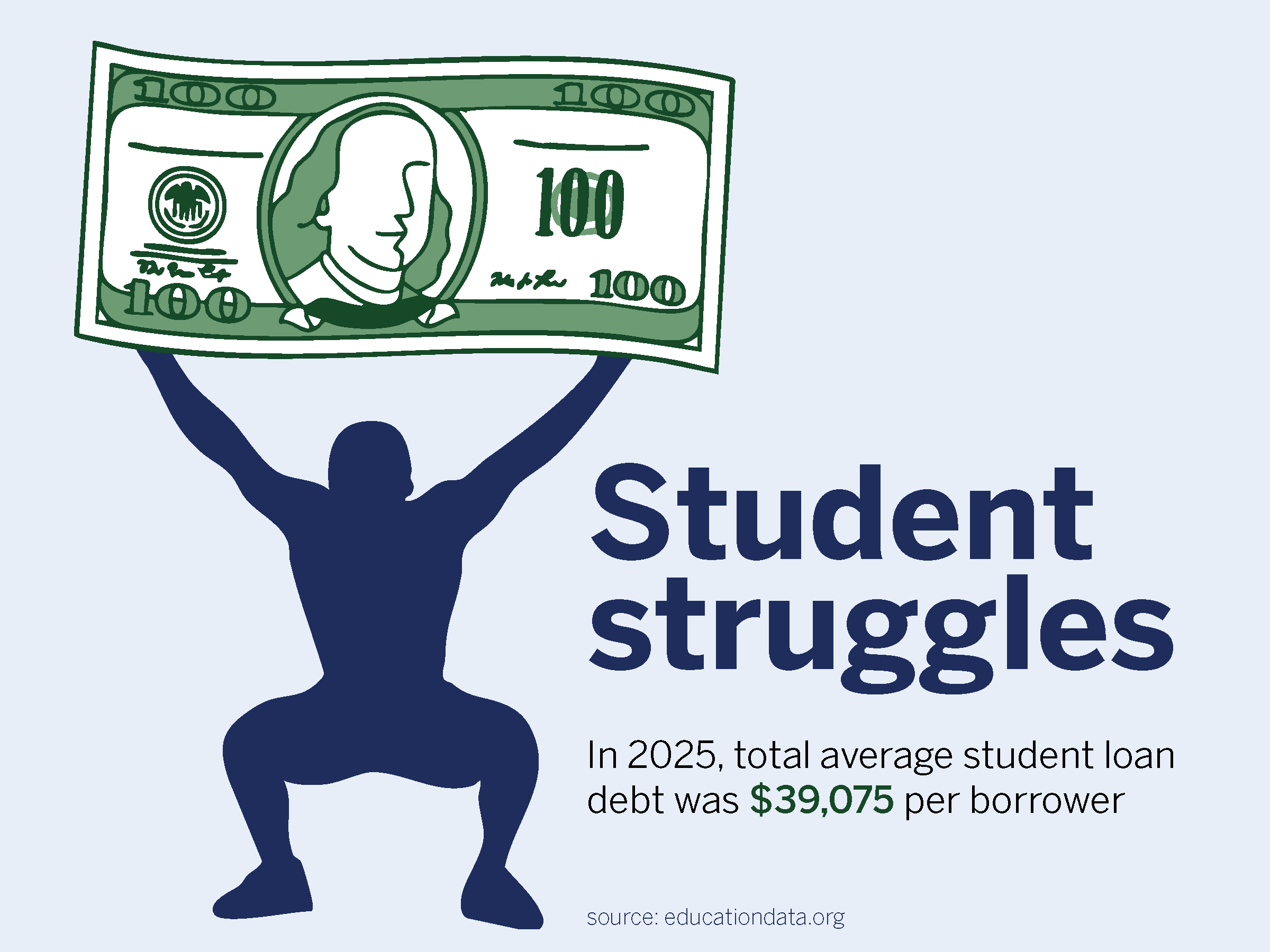
Federal student debt forgiveness is often misconstrued as overly expensive and unjust, ignoring basic economic reality. Over the past 40 years, the average cost of attendance at U.S. colleges and universities has doubled, driving total student loan debt to $1.8 trillion nationwide, while the salaries of recent graduates have risen by just 14%. This widening gap has resulted in a damaging debt crisis for younger Americans, limiting their ability to fully participate in the economy.
At Syracuse University, the median federal student loan debt is $26,000 for borrowers who completed their undergraduate degree. This debt has resulted in many SU graduates delaying buying a house, purchasing a car or starting a business. Federal student loan debt stunts economic activity among younger generations, especially at SU, one of the most expensive schools in the country, concentrating economic influence among older generations, such as baby boomers.
Federal student debt forgiveness can pragmatically exist, yet the Trump administration has chosen not to pursue it, continuing a historical pattern of undermining higher education.
The roots of the student debt crisis date back to the 1960s, when neoconservative politicians such as former California Governor Ronald Reagan were alarmed by the counterculture brought on by baby boomers. To fight back against campus activism, Governor Reagan slashed the University of California’s budget, forcing the school to increase its costs to make up for the lost funds. Following this, many states cut funding for their public universities, which directly impacted college affordability.
By 1978, American college students owed $224 million in student loans – a figure that exploded to $1.6 billion by 1988 and grew exponentially ever since, driven largely by continued cuts to higher education. At the same time, enrollment increased, placing greater demand on university funding.
Adelaide Guan | Design Editor
Private universities have also raised tuition in response to funding cuts and growing enrollment. Without government oversight, these increases have been much steeper, making private universities some of the most expensive in the nation.
College ranking systems also drive rising tuition. Highly ranked schools can use their ranking to justify higher costs and their popularity pressures many high school students to enroll despite the price. Many of these “top universities” offer limited aid, forcing students to take on significant debt and further fueling the crisis.
With the option to defer payment, many students take on more debt than they can manage, resulting in widespread defaults. Carrying significant student loans at a young age overburdens Americans and limits their ability to participate fully in the economy.
As numerous publications have highlighted the crushing reality of student loan debt and its impact on young Americans, the Trump administration continues to enact policies that make repayment significantly more difficult. Federal student debt forgiveness is an absolute necessity to ensure financial stability for millions of Americans and strengthen the economy. Forgiving student loan debt allows college graduates to gain economic mobility and expand opportunities for others through increased employment and greater spending.
Federal student debt is held primarily among low-income, first-generation, female and minority borrowers – groups that often lack the resources of the upper class to pay off student loans. For these groups, repaying student loans is a steep uphill battle, and forgiveness helps level the playing field with economically prosperous Americans.
As college students, we need to do more to fight for loan forgiveness. Student movements have been majorly influential in U.S. history, from anti-Vietnam to anti-apartheid protests, shaping foreign and domestic policy along the way.
Protesting the Trump administration’s handling of federal student debt is important, as many SU students could face crippling debt that burdens them for decades. Now more than ever, protests are receiving extensive media coverage, drawing national attention to the issues at stake.
Without forgiveness, the U.S. is choosing an economic future where younger Americans are financially insecure while wealth remains concentrated among older, upper-class Americans. This is a preventable future, but there needs to be greater public action in order to prevent it from becoming an ingrained part of America.
While student debt forgiveness increasingly seems unlikely, protesting or speaking out about experiences with the unaffordability of college and the burden of student loan debt draws greater attention to issues in higher education.
Public opinion can sway decisions made on any policy. Student debt forgiveness, even under an administration that opposes it directly, can still be swayed into enactment.
Sam Jacob is a freshman majoring in political science and international relations. He can be reached at stjacob@syr.edu.