After year on Marshall Street, MakerSpace remains a flourishing center
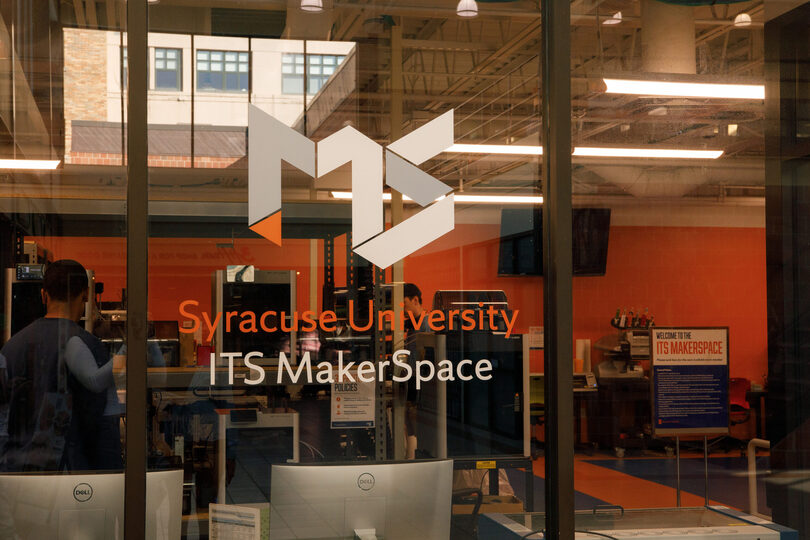
Following its relocation to Marshall Square Mall, ITS MakeSpace is free space for all SU students and faculty to use. ITS MakerSpace features 3D printers, embroidery machines and a music studio. Avery Magee | Photo Editor
Get the latest Syracuse news delivered right to your inbox.
Subscribe to our newsletter here.
A gym in Marshall Square Mall has transformed into the home of Syracuse University’s MakerSpace. On a busy day, students can be found tinkering with 3D printers, embroidering designs or jamming out in a cubicle music studio.
“People make stuff for projects, they make stuff for school, they make stuff for gifts, they make stuff just for kicks,” founder John Mangicaro said.
John officially opened the ITS MakerSpace in 2014, housed in Kimmel Hall. When SU announced plans to tear down the dorm at the end of 2024, MakerSpace was forced to relocate. January 2025 marks the one-year anniversary of its move into a new location in Marshall Square Mall. They’ve carried over the machines they’ve had for years, like embroidery machines, with some new additions, like a complete computer lab.
MakerSpace started because of John’s fascination with tinkering, building and eventually, 3D printing.
John has worked various jobs at SU for around 40 years. Fifteen years ago, he was working in information technology at SU, then housed in the Newhouse School of Public Communications. He first heard about 3D printers and was intrigued to buy one. Makerspaces and think tanks were just starting to pop up, and an IT director approached John with the idea to make SU’s own.
“He says, ‘Hey, listen, I think I could get some money, would you like to build a place that we can do this stuff?’” John said. “And I’m like, ‘yeah sure, I can finally get my dream job.’”
Now, MakerSpace has multiple printers, sticker machines, laser engravers and other appliances. The move to Marshall Square Mall meant a bigger, more central location. Freshman Sarah Klemmer visited MakerSpace last semester; since it’s in one of the busiest spots on campus, she’s more inclined to return, she said.
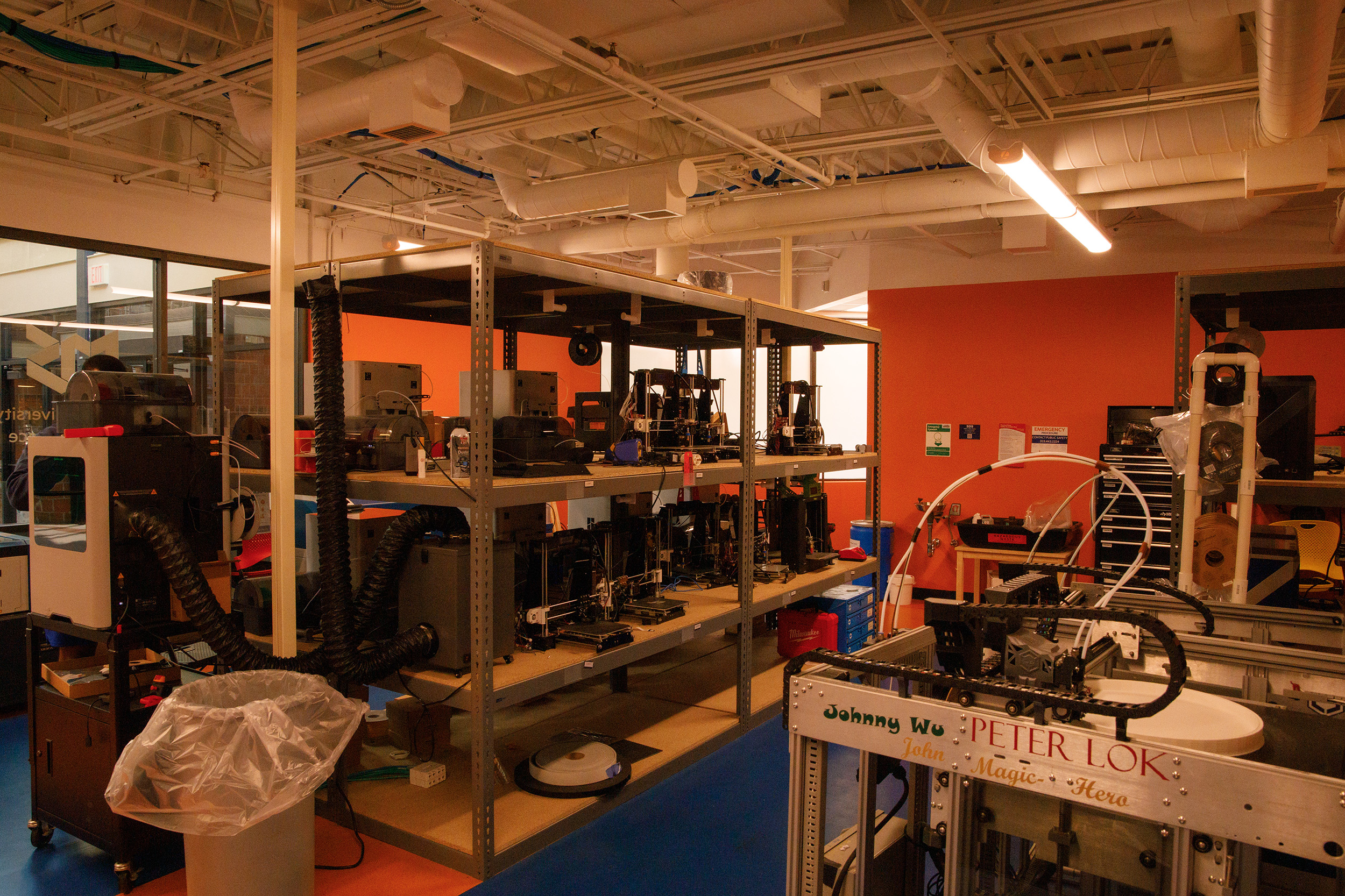
Not only does ITS MakerSpace offer services to create items, it’s also a place for the staff to learn more outside of their majors. For junior Jack Cofer, MakerSpace gives him the opportunity to gain experience in fields that interest him outside of his geography major. Avery Magee | Photo Editor
When designing the new space, Gianna Mangicaro, MakerSpace’s associate director for learning environments and media production, played a large role in the layout and organization. At the time of the move, MakerSpace was gaining more traction, with around 3,300 work orders. They ended 2025 with almost 5,000 projects, a testament to the new central location’s accessibility, Gianna, John’s daughter, said.
John said in the past, when he told friends who worked on campus about MakerSpace, they never visited because they didn’t know where it was. Now, they’re there all the time.
The move also allowed MakerSpace to have a fresh start organizationally. Gianna planned the layout of the machines strategically, with 3D printers grouped together and textile equipment all in one spot. Due to the increased activity, she also developed a queuing system to streamline work orders.
But, despite the location change, the values MakerSpace was built on stayed the same, said Gianna.
MakerSpace is built to be a place for collaboration — it’s somewhere students, faculty and staff can go to conceptualize their ideas, Gianna said. With the new space, that goal has gone further than just 3D printing.
Music has always been an important part of John’s life; he spent two years on tour playing the drums with a band. So, since he first started MakerSpace, he always wanted to incorporate a music studio. He asked for it for six years, and finally, just before leaving the Kimmel location, he received the money to do it.
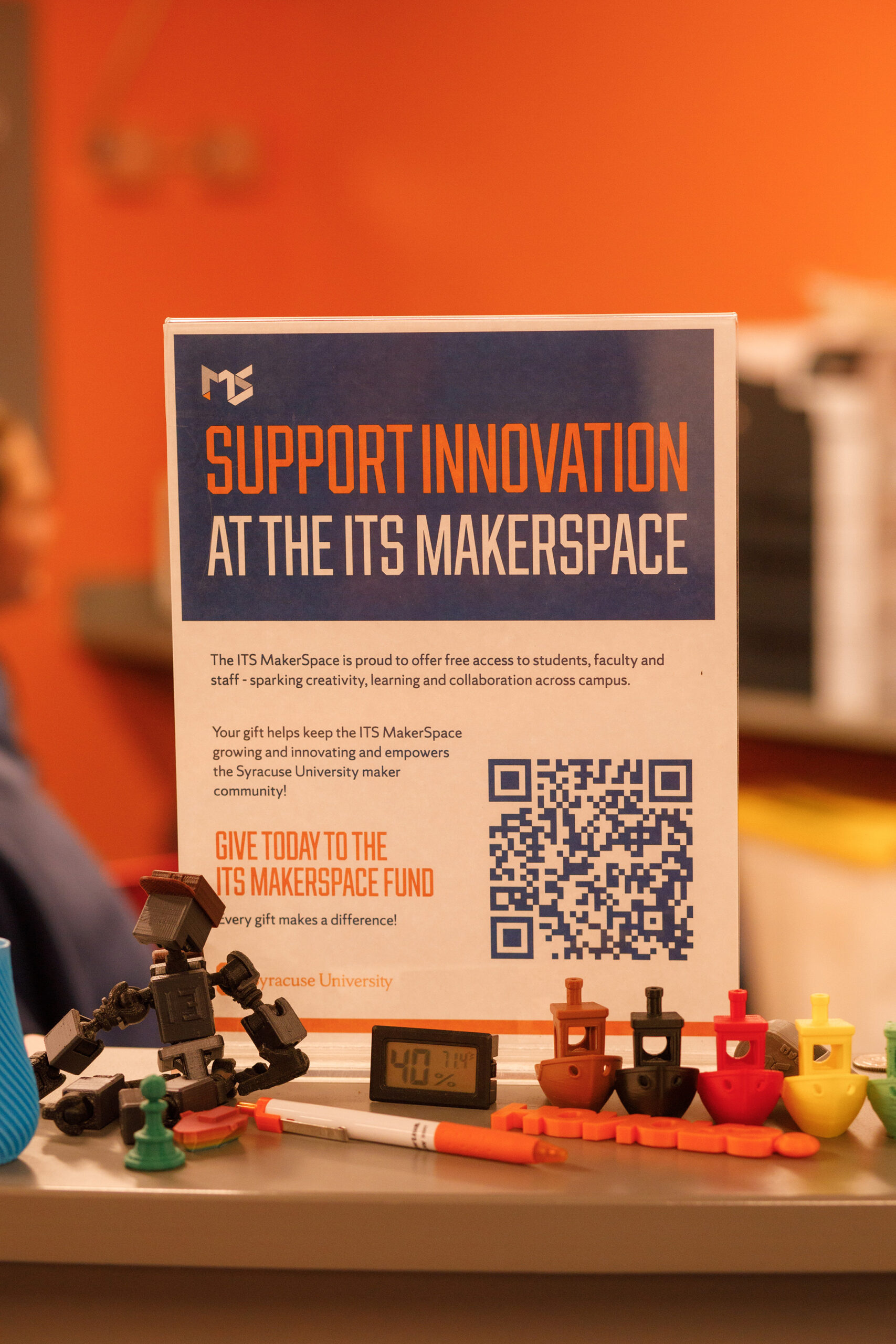
John Mangicaro opened ITS MakerSpace in 2014 to create a space for Syracuse University students and faculty to make their own creative endeavors. MakerSpace ended 2025 with 5,000 projects. Avery Magee | Photo Editor
In the new location, they built two cubicles on the far end that became music studios, equipped with guitars, a drum set, a keyboard and other instruments. People can come in to play together, but it’s hooked up to headphones, so there’s no live sound. Students can also record and mix with the advanced software the space offers.
John said this addition reflects what MakerSpace is for: a place where anyone can come together to create. Some students come in to play and ask John how to find other musicians. He said he hopes MakerSpace can begin to incorporate other ways for people of similar interests to find one another.
“There’s a lot of people that just want to sit and play, and if we can find a vehicle for these kids to network, you’ll see a lot more production,” John said.
Gianna said MakerSpace is a great way for students from all majors and schools to collaborate. When she was a student, MakerSpace was one of the only places she could meet people not in her specific program, she said.
The connection that happens between students happens organically, through working on projects together, which is always cool to see, Gianna said.
The student staff at MakerSpace is proof of the connection it fosters, John said. While John sometimes looks for students with some knowledge of software, his staff often know nothing about the machines before starting out — John “throws them in the fire,” he said.
Junior Jack Cofer has worked at MakerSpace since his freshman year, at both locations. As a geography major, MakerSpace gives him the opportunity to gain experience in fields that interest him outside of academics, he said.
“I came in knowing nothing, then over the course of now three years, I’ve learned the ins and outs of all of it,” Cofer said.
As a supervisor of the student-led team on site, Cofer spends a lot of time problem-solving with his peers, both those who come in to do a project or his coworkers. The team is constantly plugged in to new developments in the tech world, as well as hearing what students want to see, Gianna said.
John recalled when one of his students approached him, showing him a new high-resolution 3D printer. Within a month, they were able to purchase it for $50,000, when it typically goes for $200,000.
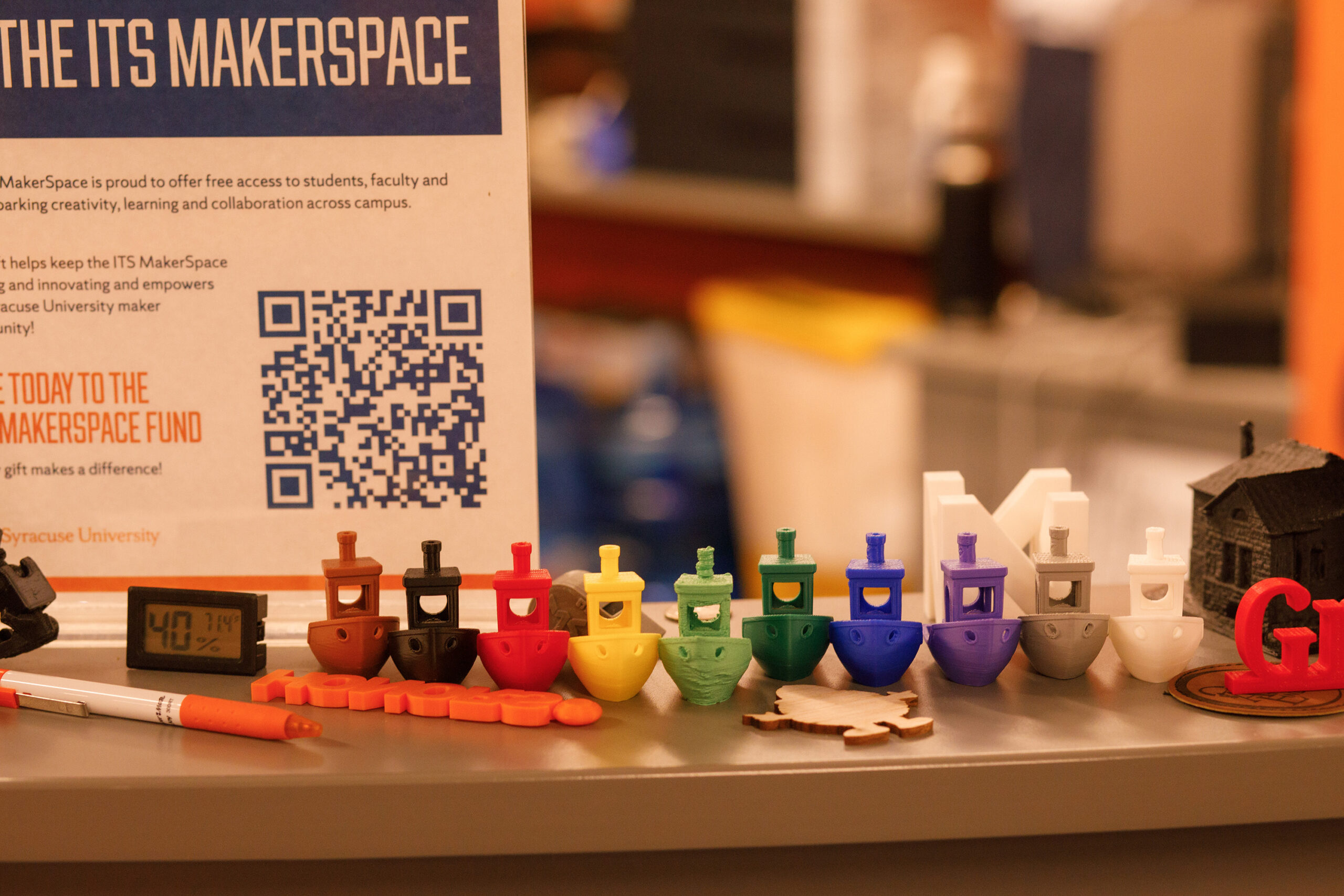
John Mangicaro always had a fascination with tinkering and building different objects. Upon discovering 3D printing, Mangicaro opened ITS MakerSpace in 2014 in its initial location at the now demolished Kimmel Hall. Avery Magee | Photo Editor
MakerSpace receives funds through the university and fundraising efforts like Giving Day. MakerSpace is free for students and staff to use, something that sets them apart, Cofer said. Mangicaro said that while students in fields like architecture and engineering may have their own studios, MakerSpace is for those who don’t.
To access the space, SU students just need to swipe their SUID, and equipment is free to use within usage limits.
“We’re here for people who don’t have that resource,” he said. “We accommodate everybody, we have more equipment than any other place on campus.”
While MakerSpace houses high-tech projects, it’s also a spot for people to have fun, Cofer said. Klemmer’s visit to MakerSpace meant 3D printing a Clash Royale crown for someone in her professional fraternity. Having a space where students can do tech-related activities but also make random gag gifts is a great asset, she said.
Moving forward, MakerSpace remains a hub for creativity and learning. With the constantly evolving tech world, John hopes they can smartly incorporate advancements like AI to make their processes more efficient. But at its core, MakerSpace is a center for development.
“We’re here to help students bring their ideas to life, to fail forward,” Gianna said. “To make mistakes and learn.”