SU seeks ‘new start’ with GSO rather than senate-passed mediation plan
Get the latest Syracuse news delivered right to your inbox.
Subscribe to our newsletter here.
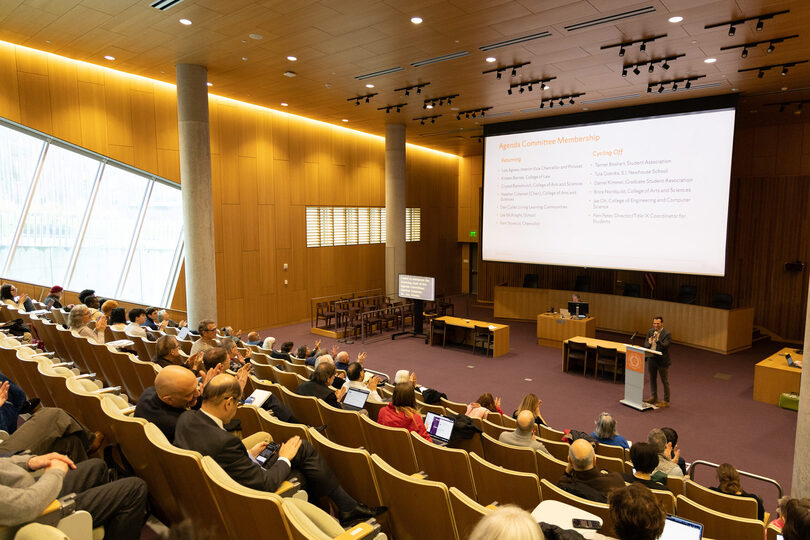
Syracuse University will not pursue mediation with current or former Graduate Student Organization officers, Vice Chancellor and Provost Lois Agnew said at January’s University Senate meeting. Instead, they will develop a new model for graduate student representation.
In December, the senate overwhelmingly passed a resolution to kickstart a “supervised process of mediation” between the Graduate School and GSO, which was deregistered by the university last summer.
Agnew said the university is seeking a “new start” in graduate student support and will begin a process to consult with students across different programs and schools this semester.
“We need some kind of representative graduate student organization, but the question is what does that look like in this landscape?” Agnew said. “How do we make sure that all graduate students are represented?”
In April, GSO declared itself an independent entity from the university, due to “increased oversight” from administrators. That summer, SU removed the body’s registered student organization status.
Today, GSO is no longer an RSO and lacks many past responsibilities, including distributing the student activity fee.
At the December meeting, Peter Vanable, the dean of SU’s Graduate School, told senators GSO leadership was “explicitly cautioned against pursuing independence.” He said the Graduate School had been “very thoughtful” in executing GSO responsibilities before the switch.
Agnew said she and Chancellor Kent Syverud identified three main issues with the resolution:
- Student officers and GSO are unhappy they are facing consequences for their actions, though those consequences were “clearly laid out” by administrators.
- There is now no way to elect graduate student representatives to the Senate that is aligned with the senate bylaws.
- The term “graduate students” ignores the “diversity and breadth” of student experiences and perspectives at SU, thus the need for a “new start.”
“These do not have to be mutually exclusive,” said Crystal Bartolovich, an English associate professor. “There can be the mediation that we voted for overwhelmingly, and this broader initiative, which I support.”
She added Ph.D. students are now represented by a collective bargaining unit, which she said must be considered in future models of graduate student representation — later echoed by Syverud.
Van Gulick described the administration’s response to the resolution as “a rebuke to the senate,” citing last month’s vote, which explicitly called for a mediation process.
Committee presentations
Senators PJ DiPietro and Coran Klaver gave a presentation on efforts from the Committee on Intersectional Equity for Race, Ethnicity, Sexuality, Gender Identity and Disability.
They said the committee is working on assessing the processes of salary appeals and bias incidents at SU, while contributing to the Office of People and Culture’s data collection initiatives.
Members of the committee also emphasized the need to support vulnerable students amid “federal policy shifts and external scrutiny.”
“Our committee noted changes like the removal of BIPOC references from the Intercultural Collective website in January 2025, and the need to support both students directly and the institutional framework serving them,” Klaver said.
Student athlete senator Ruben Rojas Betanzos and Department of Sport Management professor John Wolohan said college athletics are in a “period of flux,” unlike other areas of higher education.
Wolohan said under the House v. NCAA settlement, SU can directly contribute or share up to $20.5 million in revenue with athletes. The committee is also looking into how SU generates the funds for the multimillion-dollar revenue-sharing pool, and whether it is all sourced from the Athletics fund.
“The question the committee would like to ask the athletic department is, where is that money going?” Wolohan said. “How is it being distributed? Is it going to football (and) basketball? Is it going to the women’s and Olympic sports?”
Wolohan said the committee has been trying to meet with university leadership, including Syverud and athletics director John Wildhack, to better understand how revenue will be allocated and if certain sports could be left behind.
Rojas Betanzos said the committee is also examining how to better integrate student athletes into the broader student body, particularly as the ACC’s expansion to the West Coast has increased travel and time away from campus.
Agnew provided an update to the ongoing portfolio review process, which requires each dean to submit a report for their college. The deadline for deans to submit their reports was moved from Jan. 1 to Jan. 23.