SU’s Kendo Club studies Japanese sport tradition, forms close collective

Once a way for samurais to continue training after no longer needing to battle against warlords, Kendo is a Japanese martial arts sport that grew in popularity in the mid-19th century. Kendo Club honors this history, practicing with bamboo swords, armor and helmets. Calysta Lee | Staff Photographer
Get the latest Syracuse news delivered right to your inbox.
Subscribe to our newsletter here.
Armor clanks and shinais, a traditional Japanese bamboo sword, clash as members of Syracuse University’s Kendo Club put on their helmets. This close community is ready to spend the next two hours chasing a perfect strike.
“While we were competing with each other, there was this form of brotherhood among all of us,” said Christopher Zervos, SUNY ESF sophomore and Kendo Club social media manager. “We all share this one thing: the sword, the shinai and our love for this sport.”
Started in 2007, the Kendo Club gathers SU and ESF’s martial arts enthusiasts twice a week to practice the sport of kendo. The sport’s origins are rooted in Japan. Its popularity grew in the early 19th century when samurais were no longer fighting warlords but still wanted to train with each other, Zervos said. The sport blends physical activity with mental strategy and is open to both beginners and more advanced martial artists.
Before joining the Kendo Club, Zervos had experience with karate, which is another form of martial arts. Zervos holds a brown belt and said that while karate and kendo have similar aspects, they are very different overall. Kendo is offensive and aggressive; karate is more defensive, Zervos said.
SU sophomore and Kendo Club president Christian Han said kendo relieved his stress, especially during his hectic schedule as an ROTC student in his freshman year. Practicing the sport since 2020, Han said he appreciates the sport’s decompressing abilities.
“When school gets busy, it’s really nice to just show up there and just beat someone up with a stick. It doesn’t hurt or anything, but overall, it provided a lot of community enjoyment there,” Han said.
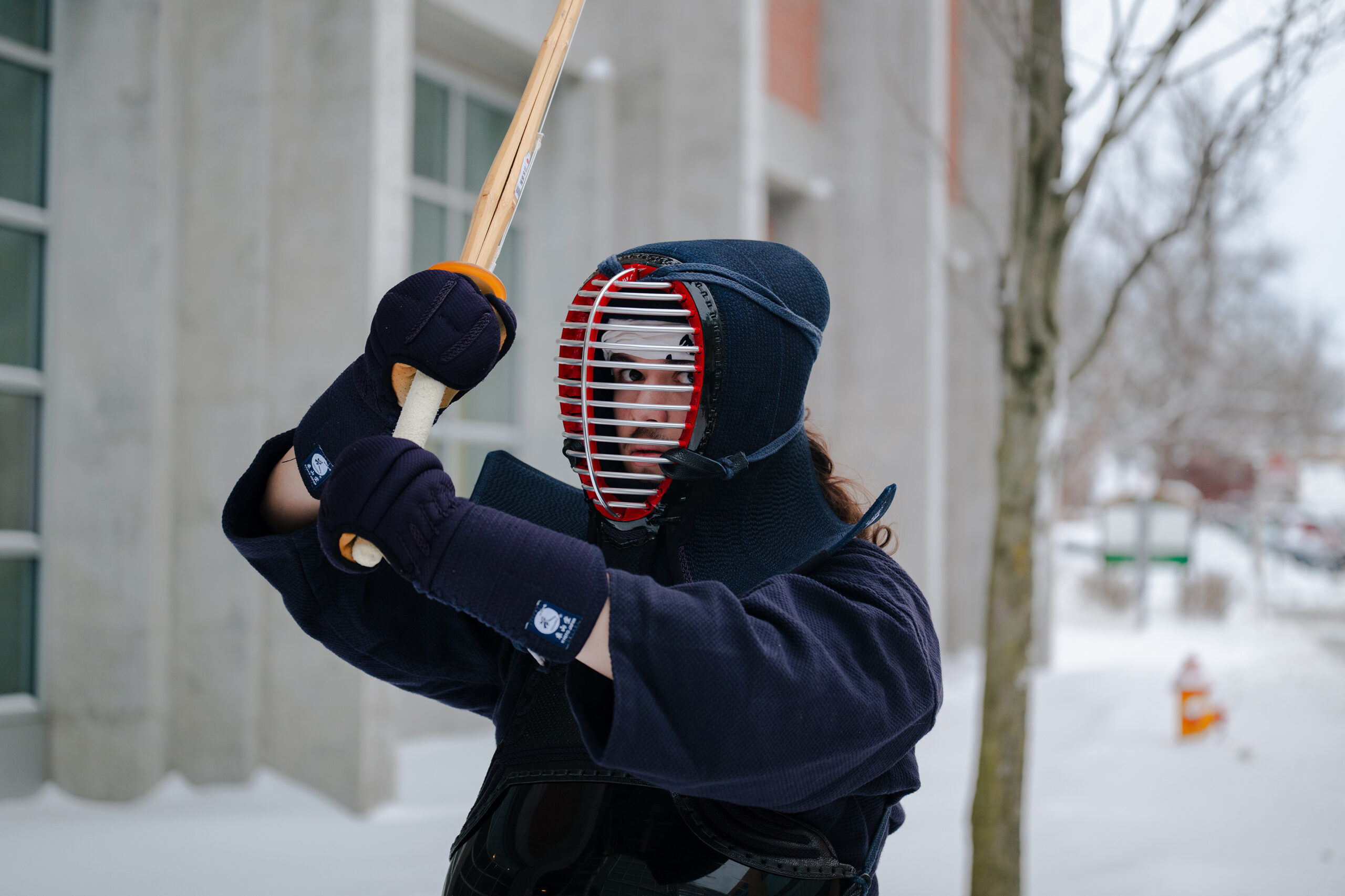
Kendo utilizes equipment like shinais — a bamboo sword — armor and helmets to practice the sport. Kendo is a more offensive sport, utilizing mental strategies to compete in matches. Calysta Lee | Staff Photographer
Because the club doesn’t have a sensei, Han said it was difficult for them to continue to grow their skill levels in the club. Han invited sensei Lewis Murphy to travel from New York City to attend two of the club’s practices during the fall semester.
Han has taken on the responsibility of the club’s head coach. Since Kendo Club doesn’t have an official sensei, Han uses his prior experience in the sport and teaches it to others. While Han is teaching the other members what he already knows about Kendo, he is also learning something from them.
Like other Japanese martial arts, the practice of kendo has much formality, Zervos said. Without a sensei, it can be difficult to ingrain these traditions. One of these traditions is the three bows taken at the beginning of each practice, Han said.
“The first bow is to the spirit of kendo, the second bow is supposed to be to your sensei, but most times we don’t have a sensei, so we skip that one. The third one is to show respect to each other,” Han said.
Kendo Club attends tournaments during the year, traveling to universities like University of Rochester, University of Buffalo, Cornell University and Harvard University. Competing in tournaments is beneficial to broaden knowledge and experience with kendo, Zervos said; it allows members to be prepared when battling another opponent with different fighting styles.
During practice, members often work on sparring, practicing techniques with each other to mirror an actual tournament. After each match, Han said he and the other members go over what worked and what didn’t.
“It’s a good moment where we can reflect. For the most part, we don’t have a sensei or a teacher or anything like that. So we just have to talk about it afterward to get as much reflection as possible to see what happened,” Han said.
SU sophomore Sean Hinchey said that the environment in Kendo Club is determined by the fact that the club is open to everyone. All the members are focused on improving and work to help each other get better, he said.
Hinchey lived on a military base in Sagamihara, Japan in high school, and joined the Kendo Club to stay in touch with the culture in college. Since joining the club, Hinchey has put more of a focus on discipline, he said.
“It stabilizes you, it gives you a ground and I think that comes from the practice of just focusing on yourself and how you’re moving, what you’re trying to accomplish,” Hinchey said.
Han said he feels joy when he sees that the members of the club are applying what he taught them and finding purpose within that. Because most of the members are beginners, it fulfills Han to see the members achieve his skill level, or even surpass it, he said.
“Now this is something that they love, this is something that they enjoy,” Han said. “They come regularly, they want to pursue maybe going forward. That’s just what matters.”