Center for the Creator Economy legitimizes SU as influencer breeding ground
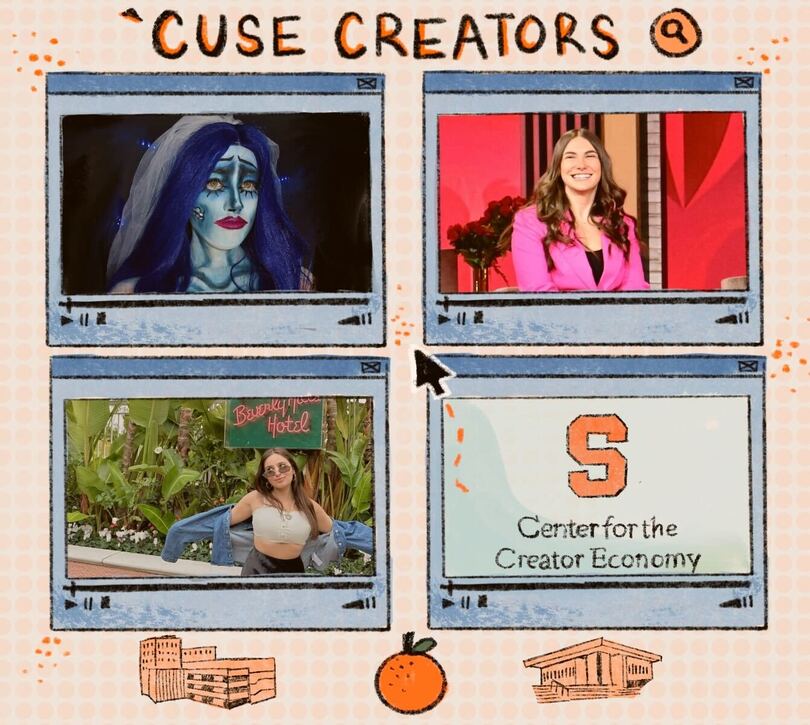
Syracuse University’s Center for the Creator Economy was launched at the beginning of the school year. The launch comes from the number of SU students pursuing content creation on the side and as a career. Illustration by Hannah Mesa | Illustration Editor, Courtesy of Ilana Dunn Solomon, Sylvie Feldman, Chloe Hechter
Get the latest Syracuse news delivered right to your inbox.
Subscribe to our newsletter here.
Syracuse University alum Ilana Dunn Solomon’s 2016 senior capstone, titled “After Hours,” was a six-episode, radio-style show that focused on different topics each episode. At the time, Dunn Solomon didn’t realize she was making a podcast, now a popular medium.
Ten years later, her capstone project is her fulltime career and she has been running her own full-fledged podcast for nearly five years.
“‘After Hours’ is representative of my time at Syracuse, I was doing everything that I’m doing now, just in a different font,” Dunn Solomon said.
Dunn Solomon is not the only SU graduate or current student to pursue content creation. She is among many other influencers — like Quincy Whipple, Ziek Diallo, Hannah Krohne, “Chef Bae,” Ariel Helwani, Roger Moore “Metronade” and Arielle Charnas — whose content creation origin stories began at SU.
SU has been a hotspot for influencers and content creators like these for years. But, at the beginning of the fall semester, it was also the first institution in the United States to launch a center dedicated to the creator economy on the college campus. The Center for the Creator Economy is a joint venture between the Newhouse School of Public Communications and Whitman School of Management.
It shows SU’s commitment to the culture that has been brewing for years, Mark Lodato, dean of Newhouse, said.
“We’ve seen it develop organically through our students, and that has only continued to build over the years,” Lodato said. “It’s really important to not to close our eyes to what our students are doing, but oftentimes embrace the new frontiers that they are finding and conquering.”
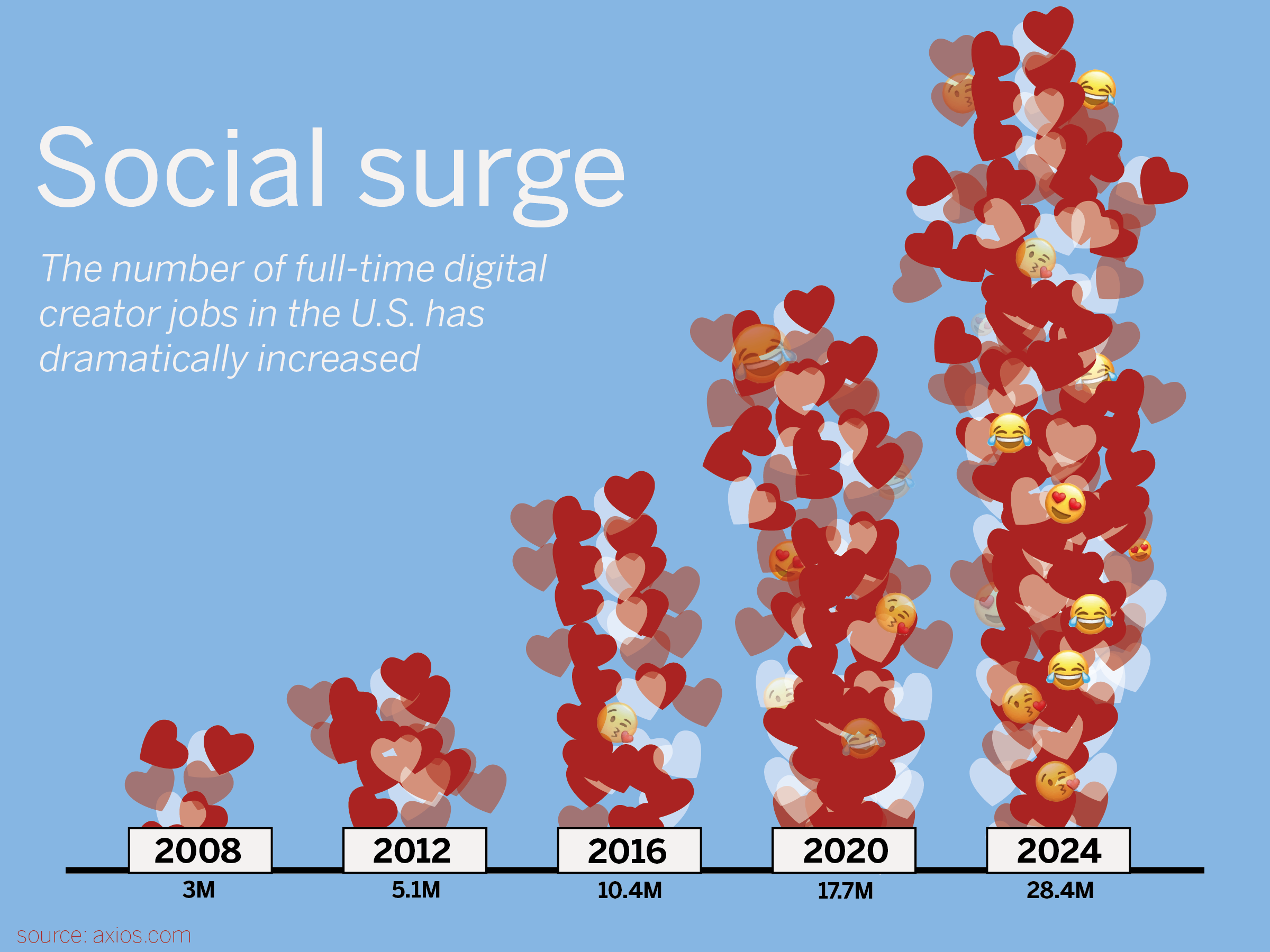
The university is no stranger to the creator economy, Lodato said. Before the surge in digital creator jobs in 2024, SU alums and students were producing content and getting paid for it. Dunn Solomon began making videos in 2018, for example, while Newhouse alum Andrew Graham signed with influencers as early as 2020.
Despite a packed class schedule, SU students have embraced a similar work ethic and commitment to building their own brand as alums have.
SU senior Sylvie Feldman has posted makeup videos on TikTok for almost six years — before she attended SU.
The senior public relations major has accumulated over 100,000 TikTok followers on her @sparklysyl page, where she creates elaborate makeup looks, transforming her face into Elphaba from “Wicked” or Charli XCX’s “brat” album cover.
Feldman said she wouldn’t be as successful in creating her brand had it not been for SU. Over her four years at SU, Feldman has been encouraged by her Newhouse professors to try everything and that “every opportunity is an audition,” she said.
“If you had spoken to me four years ago, I might have wanted to make a personal brand, but I wouldn’t have known how to go about it,” Feldman said. “Even just the repetition of the classes that I’ve taken, I feel like they have really helped me in learning more about how to make my content.”
Feldman is among other SU students, like Reyanna Dundas, John Spina, Maeve Lewis and Caroline Colby, pursuing content creation alongside their classes.
While SU alum Chloe Hechter wasn’t on campus when the Center for the Creator Economy started, she still credits her alma mater for her success. The now full-time influencer with over 180,000 TikTok followers never took any classes in content creation.
“Something that’s so awesome about Syracuse is obviously you do have your required classes, but they really do give you this freedom to forge your own path,” Hechter said. “I feel like the programs that I was a part of and the people I met really did give me the push I needed.”
Ilyan Sarech | Design Editor
Hechter didn’t start posting regularly on TikTok until she graduated from SU. But, she said she wouldn’t be where she is if it weren’t for the encouragement from professors and the confidence she built as the former editor-in-chief of University Girl magazine.
Hechter said that she regularly sees SU alums at brand events, she said that there’s “lowkey is a Syracuse-to-influencer pipeline,” crediting the school in prioritizing creativity and independent thinkers.
When Hechter learned of the Center for Creator Economy’s inception, she said several people sent it to her. Hechter had always said she expected SU to create a content creation major in the next few years, especially after noticing the significant number of students and alums who were becoming successful influencers.
Mike Haynie, SU’s vice chancellor for strategic initiatives and innovation and executive dean of Whitman, said he noticed a similar trend, especially after he saw the amount of content creators who returned to campus for the university’s annual CUSE 50 event.
“I started to find all these Syracuse students that had big followings on social media,” Haynie said. “Typically we think about what we have to teach students, but this was an opportunity to say, ‘What do students have to teach us?’”
That’s when Haynie realized SU’s potential to produce even more content creators. He contacted Lodato in October 2024 to pitch the creator economy center.
“I met students who were paying their college tuition with brand deals,” Haynie said. “These were 19 to 21 year old kids who have created a trusted following on social media that have had real impact.”
When Haynie discovered a student content creator, he would send them an email and ask them to meet him in his office. Some students thought they were getting in trouble, but Haynie said he just wanted to learn how they were managing their social media.
Then-senior Thomas O’Brien, who graduated in 2025 from the College of Visual and Performing Arts, was one of the students called to Haynie’s office. While at SU, O’Brien launched his own music video production brand, Project FreeFall with his classmate, Nick Moscatiello.
“You’re in an environment where you have so many people with so many different perspectives and so many different backgrounds,” O’Brien said. “Through collaboration and being around those people, it sparks creativity.”
O’Brien’s social media and entrepreneurship experience was gained outside of the classroom, he said, from creative projects on campus like the Blackstone LaunchPad and Project FreeFall. This October, O’Brien returned to his alma mater when he was hired as a project coordinator at the new creator economy center.
But, supporting and embracing content creation as a career wasn’t always as prevalent. When Dunn Solomon attended SU, digital creator jobs were less popular and she felt less supported. To empower young creators, Dunn Solomon returned to SU for the creator economy center’s launch.
“At the time, I did not want to be an influencer. There was really a negative connotation associated with the word, so I really tried to position myself as a podcast host,” Dunn Solomon said. “But in order to make money and get more listeners, I became a content creator and an influencer as a side effect.”
When Dunn Solomon is asked about her time at SU, she said she always tells them that every class, project and group assignment prepared her for the skills she now utilizes in content creation.
“I will always say that I didn’t know it at the time, but every single thing I learned at Syracuse was preparing me for this career,” Dunn Solomon said. “At the time, I just had no idea.”