
Airport’s rejection of SU alum’s ad is unconstitutional, judge finds

A federal judge found the Syracuse Regional Airport Authority’s refusal to display Syracuse workplace harassment lawyer Megan Thomas’s ad unconstitutional. The decision ordered for the SRAA and Thomas to negotiate options for injunctive relief. Leonardo Eriman | Senior Staff Photographer
Get the latest Syracuse news delivered right to your inbox.
Subscribe to our newsletter here.
After nearly five months of litigation, a judge found the Syracuse Regional Airport Authority’s refusal to display an advertisement by Syracuse workplace harassment lawyer Megan Thomas unconstitutional, according to a decision filed Jan. 15.
Thomas, an alumna of Syracuse University’s Maxwell School of Citizenship and Public Affairs and the College of Law, filed a federal complaint against the airport authority in August alleging her right to free speech was violated and her contract, set to begin Aug. 1, wasn’t fulfilled.
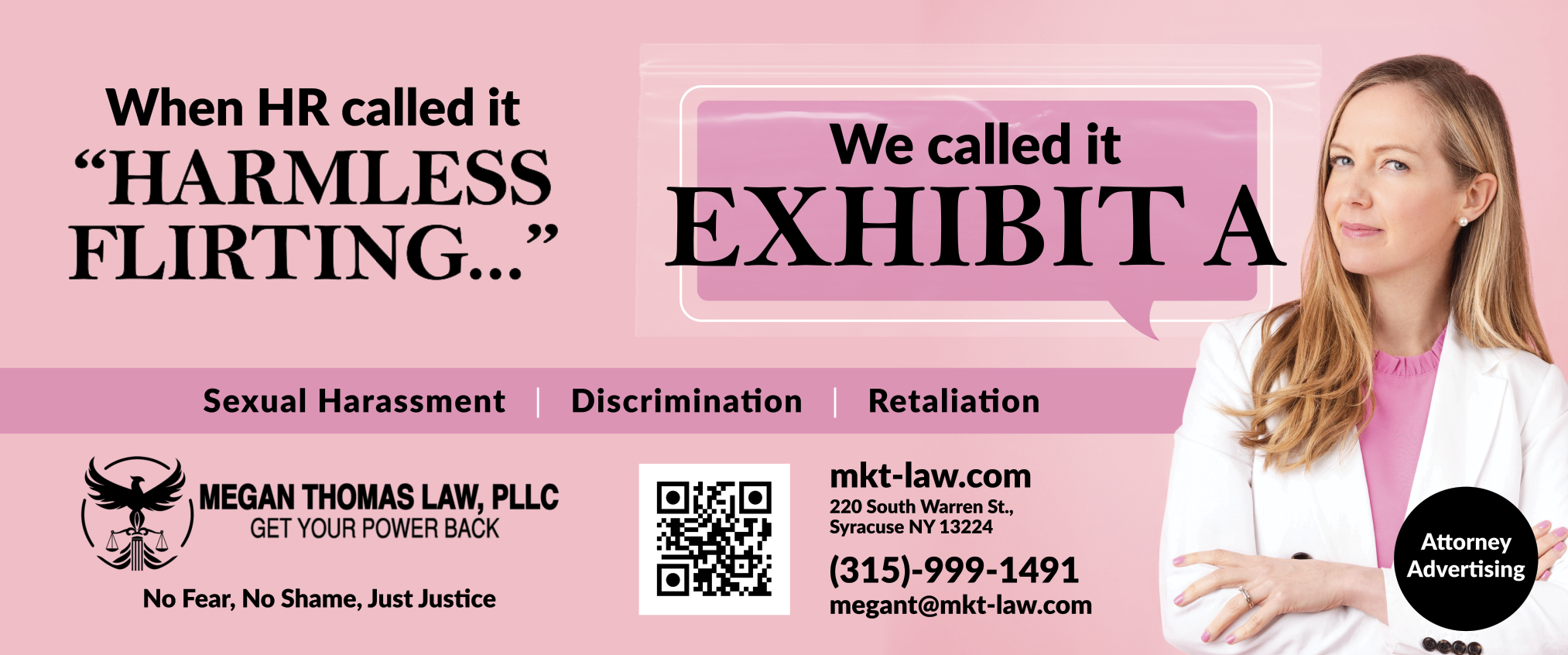
Over the summer, the SRAA refused to display a billboard-style ad for Thomas’s law firm, Megan Thomas Law, PLLC, with a slogan reading “When HR called it ‘harmless flirting’… We called it exhibit A.”
The airport claimed in August the advertisement was “unprofessional, inflammatory, and unnecessary,” and attempted to negotiate with Thomas in creating a new slogan, according to evidence presented in Thomas’s August lawsuit. She maintained that her slogan remained within the airport’s advertising policy and claimed other ads, such as ones promoting plastic surgery, were more offensive.
Courtesy of Megan Thomas
A copy of Meghan Thomas’s ad. The airport authority claimed the ad’s slogan was “unprofessional, inflammatory, and unnecessary.”
The decision mirrored Thomas’ argument, determining that the airport’s rejection of Thomas’s ad under its advertising policy violated the First Amendment, and the rejection of the ad was “viewpoint-based and unreasonable.” The decision also denied the SRAA’s motion to dismiss the case entirely.
The airport argued its decision to refuse the ad was content-neutral, citing the SRAA’s brief, which claims they would have rejected similar ads regardless of viewpoint.
“SRAA highlighted the practical concerns and implications associated with the proposed advertising copy in its brief, writing: ‘Indeed, the Authority would have just as readily rejected an advertisement from an employer-side law firm that used similar language disparaging or threatening ‘disgruntled employees’ or implying that victims of sexual harassment should not be believed,’” Ben Yaus, the counsel to the authority wrote in a statement to The Daily Orange.
While the decision does not immediately order the airport to display Thomas’s ad — which she said is her ultimate goal — it does order the SRAA and Thomas to negotiate options for injunctive relief, which could include posting the ad immediately, allowing the authority to revise its policy again and other “legitimate outcomes.”
As she awaits her next court date, Thomas said she still hopes her ad can be displayed and her attorney fees for her self-representation can be covered.
“I knew the law was on my side,” Thomas said. “I was very clear. I did my research. The law is very clear, so I’m glad the judge held their feet to the fire here.”
Roy Gutterman, a professor of communications law at SU’s Newhouse School of Public Communications, said there are no reasonable grounds to reject her ad, and the decision was a pretrial procedural matter.
“The most obvious resolution would be for the airport to accept the advertisements,” Gutterman said. “But because this went to court with a constitutional question, there might be some other relief the plaintiff might seek as well.”
When Thomas signed her contract, the authority’s 2023 advertising policy stated that ads the SRAA deems inappropriate, offensive, objectionable, political or religious were not permitted.
During litigation, the SRAA began enforcing a revised advertising policy in September, Yaus confirmed. The airport’s new policy states ads should not “diminish or negatively affect the goodwill or reputation of the Airport or the SRAA” or “negatively impact or agitate Airport passengers and/or tenants.”
The airport authority claimed the policy change is to give prospective advertisers “additional guidance” on what types of ads are acceptable “after the airport’s experience with the law firm,” according to documents referenced in the judge’s decision. The judge noted the policy change was “suspect.”
“Certainly, the Authority is entitled to revise its policy,” the decision reads. “But the suspect timing and the fact that its renewed rejection rests on the same grounds under both policies only underscore that the request for injunctive relief is not moot.”
The SRAA later claimed Thomas’s ad falsely implied that “harmless flirting” is actionable harassment. The court also dismissed this point, referencing several other of the airport’s ads.
“The tagline does not claim, suggest, or ‘falsely impl(y)’ any such position — at least, no more than Chick-fil-A’s Authority-approved tagline ‘falsely implies’ that chicken dinners will always make a person happy, or that cows can speak,” the decision reads.
While Thomas said she was confident the law would be on her side, the experience with the airport has made her feel “unwelcomed” as a female business owner and attorney – in the airport and the county.
“The first time a woman wants to be on a billboard by herself, there’s a problem,” Thomas said. “That sends a message to me that my services are not welcome, and also that I, as a woman, leader, business owner, I’m not welcome in this space. I think that’s a real problem.”
Thomas maintains she wants her advertisement displayed, noting many of her female clients often encounter situations of sexual harassment on business trips. For the most part, she’s had community support. Thomas received the public support of New York State Sen. Rachel May and gathered over 1,000 signatures on a petition condemning the airport’s “censorship.”
The SRAA has until Feb. 6 to respond to Thomas’s proposal for injunctive relief. After that, Thomas’s relief — which could include displaying her ad — will be passed.
“This shows what a need there is for these services, for more people to stand up for the rights of women and others who are being treated poorly in the workplace on the basis of a protected class,” Thomas said. “These things are happening left and right in this county, I have more work than I can take on.”