Personal Essay: U.S. polarization creeps into classrooms, daily life
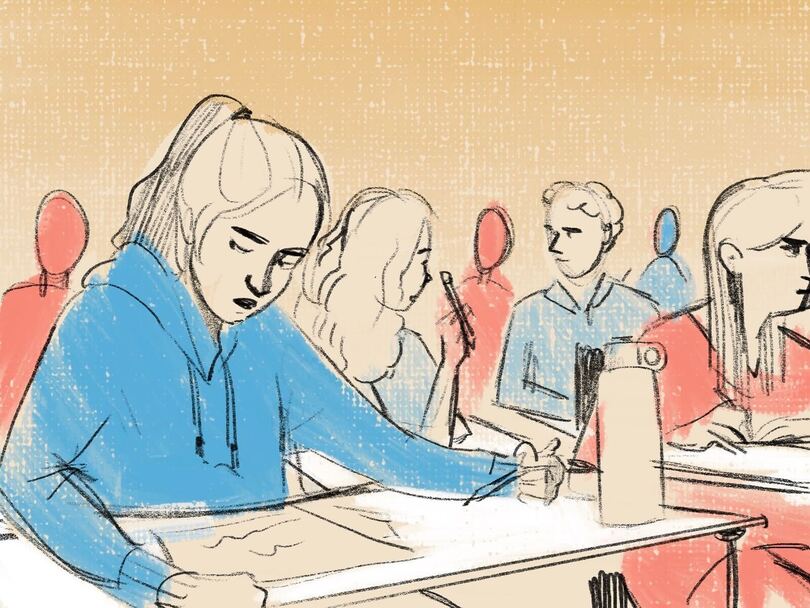
Our columnist argues the politicalization of certain events makes it difficult to have productive classroom discussions. Students must approach dialect with an open mind for the sake of their education, he writes. Julia Rodenberger | Contributing Illustrator
Get the latest Syracuse news delivered right to your inbox.
Subscribe to our newsletter here.
The political divide in the United States has become impossible to ignore. More and more, opinions across the political spectrum are dismissed before being heard, simply due to differing beliefs.
This polarization has seeped into many aspects of daily life, including spaces meant to foster growth and learning, like the classroom.
Especially in college, discussions are meant to be open and thoughtful. But lately, such conversations feel tense or absent. Many professors seem reluctant to address current events or politically charged topics, and students hesitate to raise their hands. I’ve noticed people avoid using certain rhetoric to discuss historical events, often feeling the need to present every issue as having two equal sides.
I’m no exception. I often stop myself from sharing my opinion to not upset others in the room. I don’t want people to think of me negatively because of a belief I hold.
I’m a broadcast and digital journalism major at Syracuse University, and I’ve had multiple classes where professors repeatedly have to clarify they aren’t sharing their personal beliefs, stressing they are simply teaching the curriculum approved by New York state. While I understand why they feel the need to say this, it also signals how fragile these spaces have become.
For instance, one of my professors discussed the events at the Capitol in D.C. on Jan. 6, 2021. They explained some may view it as an insurrection, while others may consider it an ordinary political protest. The facts tell us this day was both an insurrection and a riot, not a peaceful protest. Still, my professor felt compelled to frame both sides as equally valid.
Another one of my professors at SU recounted an incident where two students broke into a hair-pulling fight over a political discussion during his class.
Even history appears to be under contention as a consequence of politicization. According to a RAND report, more than half of school-district leaders report that political polarization disrupts education. Nearly 7 in 10 principals experience conflict over political issues.
What I’ve noticed in my classes isn’t isolated, but part of a much larger issue. Students are increasingly becoming worried about sharing their opinions. One-third of students responded in a survey saying that they are uncomfortable sharing their political opinions on campus due to fears of negative repercussions.
As everything becomes hyperpolitical — such as news, media, classrooms and even our rights — it has become increasingly difficult to talk about real-world events.
This is unfortunate because engaging with these events in an academic setting serves as an effective opportunity to learn. They connect course material to everyday life and help students make sense of national and global issues. When conversations are met with silence or avoided altogether, learning becomes passive rather than engaged. Professors lose the opportunity to teach in a way that is relevant and interesting, and students are left with a watered-down education.
The issue stems from the federal level. When federal administrations condemn certain events, or deny established facts, professors are left in uncomfortable positions. Addressing these issues in the classroom can lead to conflict with students or even the institution itself, while avoiding them allows important realities to be ignored.
Just because something challenges you or feels uncomfortable doesn’t mean it isn’t important.Drew Zundell, Essayist
Currently, the Trump administration is changing school curriculum nationwide. This is creating challenges in higher education, where students typically come from a variety of backgrounds. Difference in curriculum across states can set students back academically or make them feel out of place. It can even lead to anger or resentment toward the instructor for teaching something that doesn’t align with their prior beliefs.
It’s important to understand how decisions made by people in power impact everyone directly. Agreement with one administration doesn’t guarantee agreement with the next. Professors must teach and discuss political events, even if it’s uncomfortable.
This responsibility doesn’t rest on educators alone, though, it starts with students.
Being open-minded to new ideas is how critical thinking develops. You don’t have to change your mind, but being willing to listen to different perspectives is essential to getting the most out of your education.
I know that I’ve occasionally felt uncomfortable with some of the content we have discussed in class. But I think it is important to understand that history is uncomfortable. What I’ve learned in class at SU has made me question much of what I was taught in middle and high school.
Coming from the predominantly red state West Virginia, many of the classes I’ve taken in the predominantly blue state New York, have challenged my beliefs. Last semester, I learned about Sarah Baartman and the colonization of the Caribbean. Honestly, and naively, I had never studied this topic before and was unaware of the terrible events that occurred there.
I felt out of place in that classroom. Many of my classmates seemed to have at least a surface-level understanding, while I didn’t know anything about it. But I learned about it, and I now believe I have a stronger grasp on history because of that discomfort.
This is why these classes exist. They exist to teach us about what we were never exposed to. If New York state had laws that banned this curriculum to fit a certain agenda, I would still be unaware of these histories. I would objectively be in a worse place than I am now.
College is meant to expose students to new ideas and perspectives. Changing curricula to fit the beliefs of a specific group defeats that purpose. Learning is often uncomfortable, and that’s OK. Just because something challenges you or feels uncomfortable doesn’t mean it isn’t important.
At the end of the day, we’re at school to learn. We should be open-minded to our professors’ teachings and classmates’ perspectives, even if it contradicts our beliefs. Learning inherently involves questioning what you already believe and either changing it or reaffirming it based on new ideas. Doing this makes us more well-rounded students and, more importantly, more thoughtful human beings.
Drew Zundell is a sophomore majoring in broadcast journalism. He can be reached at djzundel@syr.edu.