‘Possible Worlds’ exhibit amplifies perspectives of artists with disabilities
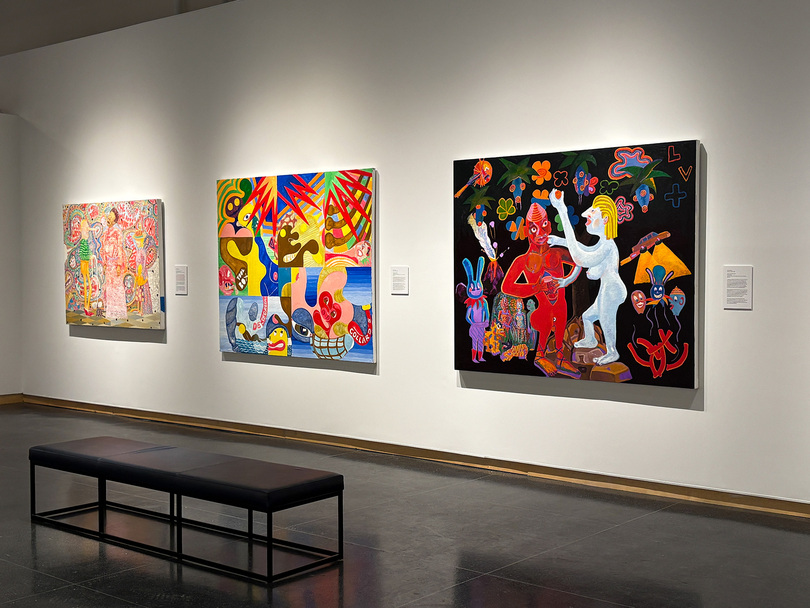
“Possible Worlds: 20 Years of the Wynn Newhouse Awards” encapsulates the works of the winners of the 11 Wynn Newhouse Award recipients. Every piece represents how each artist views the world in their own perspective. Dana Kim | Staff Photographer
Get the latest Syracuse news delivered right to your inbox.
Subscribe to our newsletter here.
From ceramic sculptures to large-scale replicas made out of recycled materials, three large arches lead into rooms, fixing your eyes to the art. Viewers are encouraged to take a pen and notepad to jot down what they see and feel as they explore the exhibit.
“These artists are doing and have done what no one else is doing in the country,” Daniel Fuller, exhibit curator, said. “You look at the range, how great this work is and how it can help expand the larger contemporary art field.”
Established in 2006 by the Samuel I. Newhouse Foundation, the Wynn Newhouse Award is granted annually to an artist with disabilities. Each recipient receives a portion of the $60,000 award and institutional support to pursue creative projects, allowing artists to experiment and expand their craft.
The new exhibition, “Possible Worlds: 20 Years of the Wynn Newhouse Awards,” which showcases works by 11 of the award’s recipients, is on display at the Syracuse University Art Museum through May 9. The back wall contains the names of all the award recipients over the past 20 years. The exhibit depicts how each artist sees the world, Fuller said.
Instead of organizing the exhibition by medium or award year, the works are presented in conversation with one another, emphasizing how each artist approaches scale and material. Moving through the gallery, viewers go from oil paintings to pen-on-paper maps. Each piece represents the identity and the background of the artists behind it, Fuller said.
“Each work represents artists with disabilities going about making art on their own terms, and how they interpret art on their own terms,” Fuller said.
SU freshman Clare Payson said she has visited many art galleries in her hometown, but this exhibit was easier to understand and didn’t require context to fully understand the pieces.
“Walking through, it felt like everything was different. You see sculptures and paintings, but in a way they all come from a similar place,” she said.
One of the pieces in the exhibit is 2021 Wynn Newhouse Award winner Kambel Smith’s “Chinatown Arch.” Smith used cardboard, wooden rods, foam board, spray paint and gold leaves to create a replica of the Philadelphia landmark without measuring any of his materials. Though Smith is mostly nonverbal, he showcases how he sees things from his perspective, SU Art Museum Curator Melissa Yuen said.
“He articulates in detail every single architectural element that he can see. There is this emphasis on detail, thinking and translating everyday experiences for himself into his artwork,” Yuen said.
Directly next to “Chinatown Arch” is “Cincinnati Map” by 2015 award winner Courttney Cooper, created in 2018. Cooper works at a supermarket in Cincinnati, and during his shifts, he created parts of the piece with scrap paper that he eventually glued together to form a large map of Cincinnati during Oktoberfest. Each scrap of paper is carefully planned, with roads that interlock and connect to other sheets, forming a cohesive cityscape, Yuen said at a curator talk on Jan 27.
If the sheets of paper were each turned over, the backs would reveal shelf tags and receipts from the supermarket where Cooper works. These everyday markings are an essential part of the piece, reflecting how Cooper moves through the world on a daily basis, Yuen said.
In contrast, 2011 award winner Peter Williams’ oil paintings on canvas convey his experiences growing up as an African American man in a desegregated United States. Throughout multiple pieces, the late artist articulates his personal experiences and interactions over decades of change, using textural abstraction, figuration and geometric elements.
Williams, who was born in 1952 in Nyack, New York, held his first art exhibit at 17. While studying in New Mexico, Williams lost his right leg in a car accident. After college, he traveled to Minneapolis, Baltimore, Detroit, and Wilmington.
His art uses pop culture symbolism in a grid, which represents his personal struggles as a man with disabilities in America.
“There is a mysteriousness within his paintings. Williams’ works don’t shy away from themes of verbal abuse and dysfunction,” said Jennifer Samet, senior director of Eric Firestone Gallery, which represents Williams’ work.
For Fuller, being able to curate this exhibit was a long time coming. Providing a space for Wynn Newhouse recipients allows the artists to showcase their artistic merit.
“You look at the prize winners and see the massive diversity in work,” Fuller said. “It’s such an amazing award and the exhibit honors it.”