Luc Besson’s ‘Dracula’ retelling withers with tame, nonsensical subplots
Retold classics are appropriate only if fresh substance is added to the source material. However, Luc Besson’s “Dracula” resulted in a forgettable edition of the belabored story, our columnist says. Abigail Aggarwala | Design Editor
Get the latest Syracuse news delivered right to your inbox.
Subscribe to our newsletter here.
UPDATE: This story was updated at 2:26 p.m. EST on Wednesday, Feb. 11, 2026.
In an industry filled with unnecessary sequels and cheap cash grabs, filmmakers should latch onto original ideas. What they shouldn’t do is resurrect age-old stories that already have countless retellings.
Alas, behold: Luc Besson’s “Dracula.”
I can forgive redundant adaptations if they add something fresh to the original source material, which Besson does. However, these new subplots are either poorly executed or frustratingly ridiculous. Besides a few serviceable acting performances, “Dracula” is a forgettable edition of a classic but belabored story.
Released on Feb. 6 in the United States, “Dracula” begins in the 15th century, highlighting the romantic relationship between an Eastern European prince, Vladimir (Caleb Landry Jones), and his wife, Elisabeta (Zöe Bleu).
Elisabeta flees their castle during a battle with Muslim soldiers, but she’s ambushed and killed.
Filled with anger and sorrow, Vladimir blames God for Elisabeta’s death. Vladimir denounces his religion and is subsequently cursed, becoming Count Dracula.
The film fasts forward to the 19th century, revealing a 400-year-old Vladimir. He’s traveled across the globe searching for a reincarnated Elisabeta, his only motivation in life.
In a routine “Dracula” move, solicitor Jonathan Harker (Ewens Abid) visits the castle. After Jonathan finds Vladimir’s coffin, he is held hostage. When examining Jonathan’s locket, which holds a photo of Jonathan’s fiancée, Mina (also played by Bleu), Vladimir realizes she is Elisabeta reincarnated. Invigorated, he tries to find Mina no matter the cost.
This “Dracula” adaptation was tamer than Robert Eggers’ 2024 “Nosferatu.” It felt more like a traditional love story, compared to the disturbing eroticism of Eggers’ version.
While Eggers focused on developing Germany’s 19th-century Gothic atmosphere, Besson’s version centered on fresh subplots. Usually, this would be a good addition, but Besson’s never panned out. He leaned into theatrical and outlandish elements, which are noteworthy only because they feel out of place.
A major part of the story is Vladimir’s search for perfume that will attract women. In Florence, Italy, Vladimir finds said perfume, and when he uses it at a royal ball, all attendants dance in unison because of the scent.
During this scene, I shook my head with disapproval and disbelief. There’s also a similar segment that shows nuns surrounding Vladimir and grasping for him after he sprays the perfume — these scenes are utterly nonsensical, even for a film about a vampire.
Another addition is the gargoyles in Vladimir’s castle; they come alive, acting as his followers. It was an interesting concept but wasn’t executed well. The gargoyles weren’t menacing and looked clunky onscreen.
Sophia Burke | Digital Design Director
What made “Dracula” watchable was the solid acting. And honestly, I saw “Dracula” for one reason: Christoph Waltz.
Unfortunately, Waltz’s character was written one-dimensionally. Waltz plays a priest who searches for Vladimir and his now-vampire victims. The character’s premise and motives are basic, but Waltz makes the most of it.
In a rare memorable moment, Waltz delivers a bone-chilling line. The priest tells Vladimir to repent for his salvation, but Vladimir says Mina is his salvation. In response, the priest says, “But you are her damnation.” The line showed that the priest didn’t fear Vladimir; he wanted him to turn to God.
I hope to see Waltz, a two-time Academy Award-winning actor of extraordinary talent, in another Oscar-worthy role eventually.
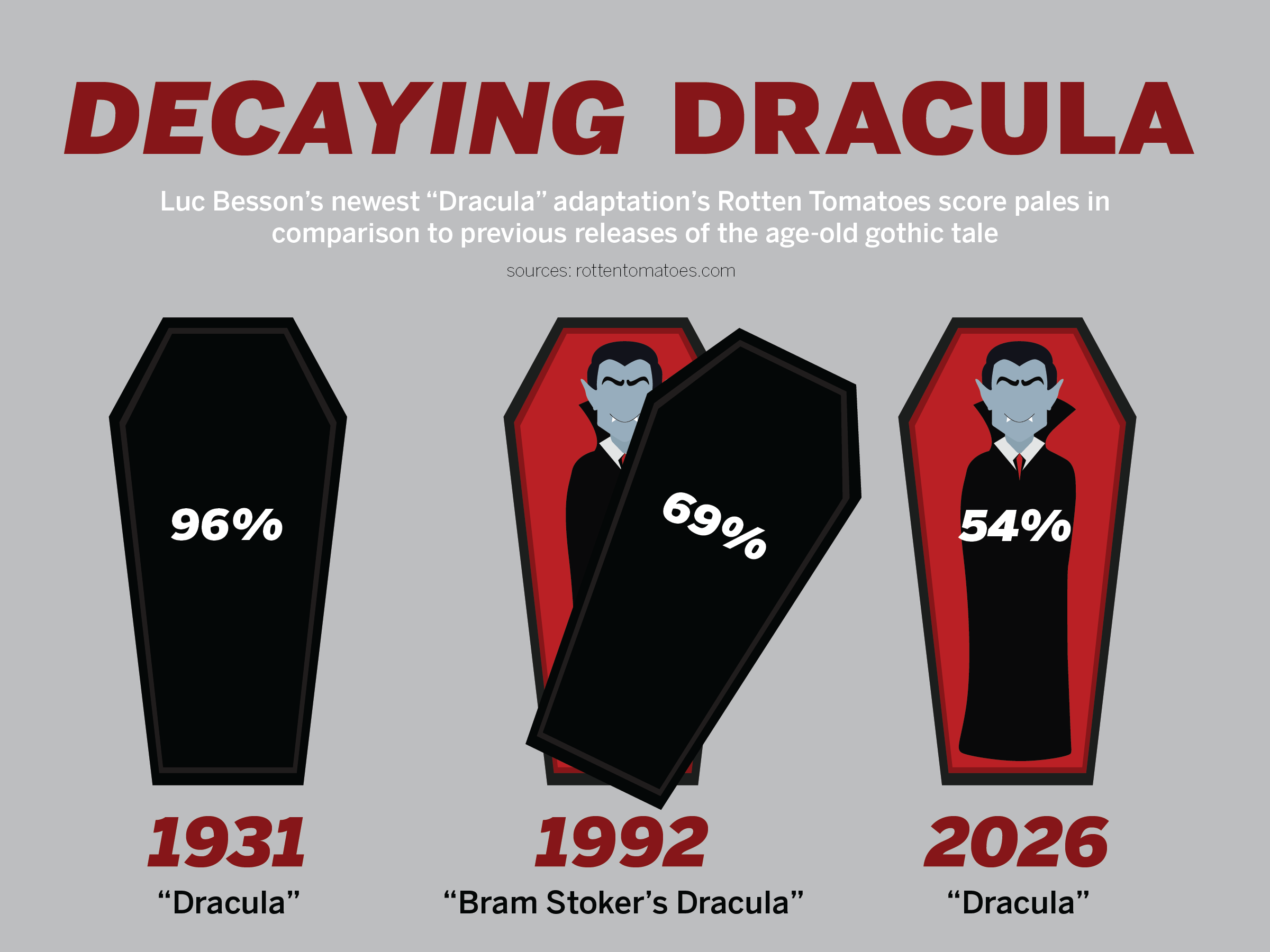
With an underused Waltz, Jones’ performance as Vladimir was a nice surprise. His character’s appearance — pale and wrinkly with a bouffant hairstyle — copies Gary Oldman in 1992’s “Bram Stoker’s Dracula,” but Jones was convincing as the blood-sucking vampire. His voicing had some hints of Bela Lugosi’s interpretation (who starred in the first authorized movie adaptation of “Dracula” in 1931), while staying true to a Transylvanian accent.
The most impressive part of Jones’ performance was his vulnerability. Vladimir yearned for his wife, and he made that adamant throughout the film. There was a motive behind all his evil doings, like sucking people’s blood to reverse his aging. His only goal is to find reincarnated Elisabeta.
Outside of some respectable acting performances, Besson’s “Dracula” is a dud filled with faulty subplots. It’s another example of the need for original storytelling.